Christopher J. Collins
Chapter 1 — Introduction
Engineering Intelligence: measuring, modeling, and improving software engineering as a socio-technical system.
Christopher J. Collins · Chapter Overview
Modern engineering orgs are drowning in operational data — commits, builds, deploys, incidents, AI suggestions — yet still cannot answer:
What does an engineering change actually cost?
Where is scarce expert attention consumed?
Which review activities prevent defects; which merely add delay?
Does an AI reviewer reduce burden, or create a new one?
The obstacle is not a lack of metrics. It is a lack of models.
A metric describes an observation. A model explains how observations relate, supports prediction, and lets rival interventions be compared.
Lead time is useful as a description. It becomes operationally valuable only when you can:
separate waiting from active work
control for change complexity
identify the constrained stage
estimate an intervention’s counterfactual impact
The purpose of engineering measurement is not to count activity. It is to improve decisions about how scarce engineering resources are used.
The scarcest resource in most engineering organizations is not compute or money — it is expert human attention.

Six capabilities close the loop: Observation → Reconstruction → Modeling → Explanation → Experimentation → Learning.
Measurement that does not change a decision is, at best, descriptive.
Lines of code, commit count, PR count, story points, utilization — all local, gameable, context-dependent
DORA metrics and SPACE are system-level foundations, not universal scores
Engineering Intelligence extends them with:
a richer unit of analysis than the individual PR
explicit economic and cognitive models
first-class treatment of AI participants
an experimentation and causal-inference layer
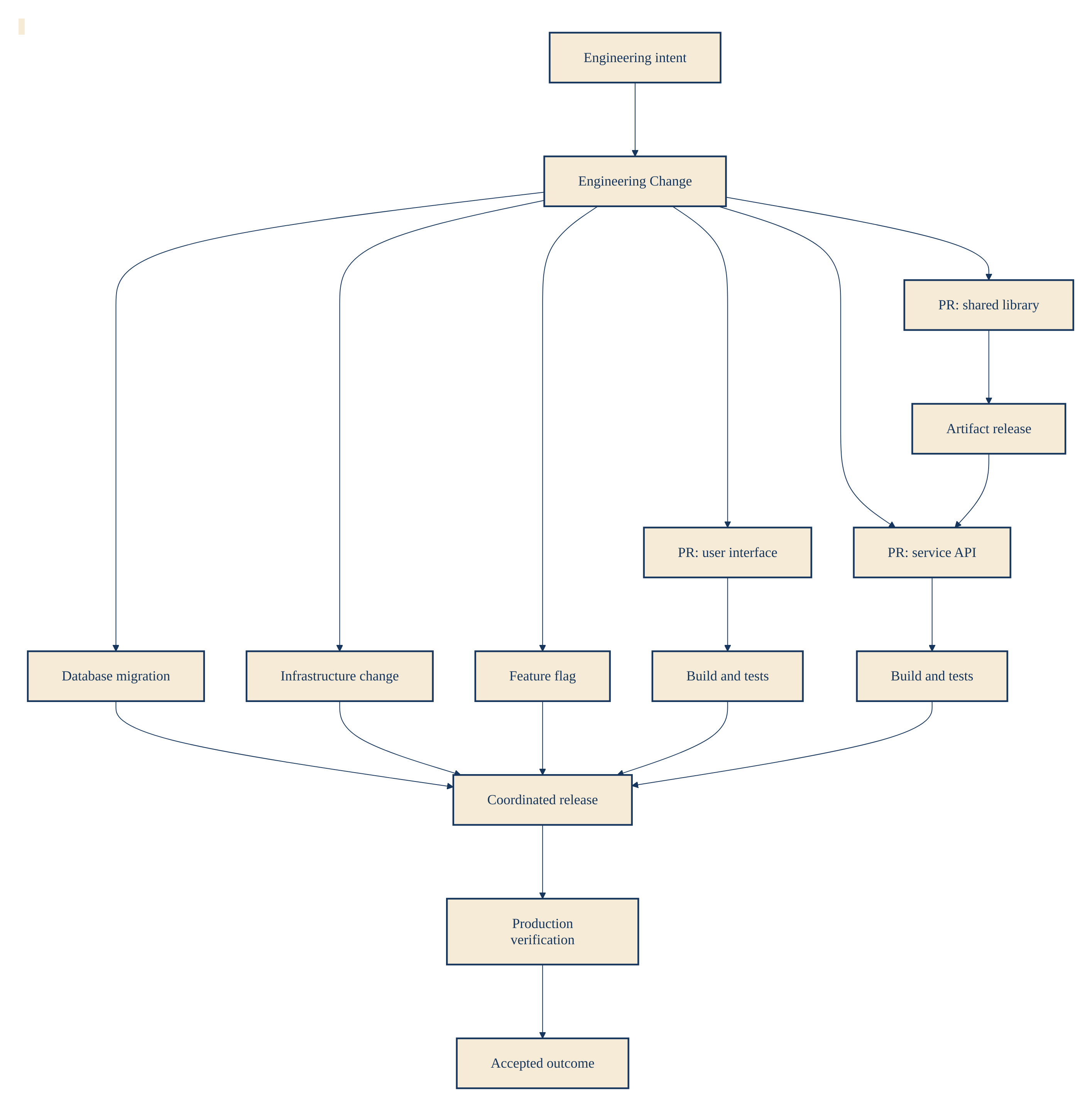
The pull request is a platform artifact. It is not the unit of engineering work.
Important | An Engineering Change is the set of human, AI, code, configuration, data, infrastructure, review, verification, deployment, and operational activities required to move one coherent engineering intent from conception to an accepted outcome. |
One product change may span 8+ PRs, migrations, flags, approvals, deployments — or one PR may bundle several unrelated intents.

Intent → many PRs, deploys, approvals
Attribution runs on the whole graph, not the artifact
Reconstruction may be explicit (change ID, plan) or probabilistic
Confidence and provenance must be preserved
A two-line config change can be trivial in code and catastrophic in blast radius. A 10,000-line generated client can be large and low-risk.
Change is a multidimensional vector:
Implementation | control flow, concurrency, language difficulty |
Domain | security, distributed systems, regulation |
Architectural | services, dependency depth, contracts |
Verification | test environments, nondeterminism |
Deployment | ordering, migrations, rollback paths |
Organizational | teams, approvals, decision rights |
Blast radius | users, data, money, availability, compliance |
Novelty | distance from patterns already understood |
An hour of uninterrupted work is not equivalent to twelve five-minute interruptions.
Four kinds of human effort — all real, only some visible:
Production — code, designs, tests, docs
Verification — review, validate, challenge
Coordination — align people, schedules, decisions
Recovery — reconstruct context after interruption
Recovery is usually invisible in cost accounting — and usually the largest hidden number.
An AI reviewer is not a software license. It participates in engineering work.
Cognitive offload — reasoning avoided because a reliable AI contribution performed it first
Cognitive reload — extra human work created by noisy or untrustworthy AI output
Acceptance rate is not evidence of offload. The correct object of study is the causal effect on quality-adjusted outcomes.
Purpose — what decision does it inform?
Definition — what is counted, at what unit?
Instrumentation — which events and entities are required?
Interpretation — what mechanisms move it?
Failure modes — how can it be biased or gamed?
Actionability — what intervention becomes possible?
Metrics without a decision or an owner accumulate cost while adding noise.
Before-and-after averages mis-attribute. Adoption is non-random. Novelty decays. Definitions drift.
A credible evaluation specifies:
intervention and mechanism
assignment vs. analysis unit
primary and guardrail outcomes
compliance, interference, stopping rules
heterogeneous effects and external events
Randomised experiments when feasible; staggered rollouts, diff-in-diff, synthetic controls when not.

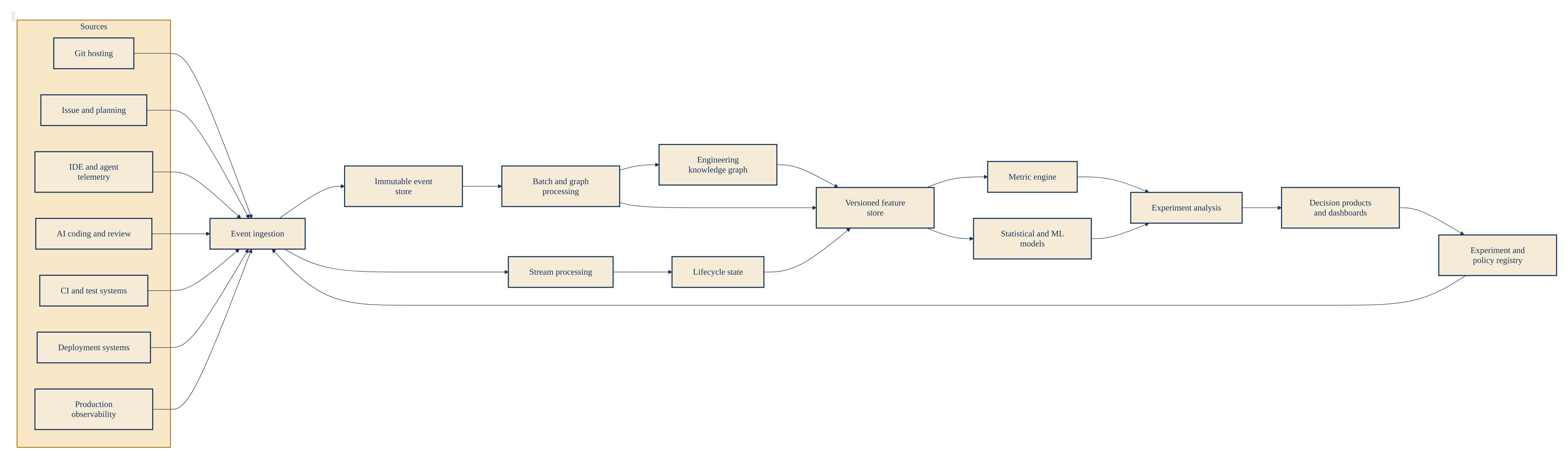
Separate: event capture · identity resolution · change reconstruction · features · causal analysis · presentation.
A number displayed without its definition and model version is not reproducible evidence.
Foundations — Engineering Change, economics, cognition, AI, complexity, blast radius
Measurement — a catalogue of direct and derived measures
Instrumentation — schemas, identity, streams, knowledge graphs, governance
Experimentation — randomised and quasi-experimental design, causal inference
Applications — AI reviewers, merge queues, autonomous agents, portfolio decisions
Organizations lack models, not metrics
The Engineering Change — not the PR — is the primary unit
Attention is the scarce economic resource
AI is a participant that creates both offload and reload
Metrics exist to support decisions, not dashboards
Engineering Intelligence is a closed loop from observation to learning
Chapter 2 — Engineering Economics
The total cost of an Engineering Change · queueing delay · cost-of-delay · attention scarcity multiplier.