build: 2026-10-19 20:32 UTC

AI-Assisted Engineering


Chapter 7 — AI-Assisted Engineering

Modeling AI as a first-class participant in the Engineering Change: contribution, attribution, validation, trust, cost.

Christopher J. Collins · Chapter Overview

From tool to participant

A compiler transforms source deterministically. An AI reviewer judges, ranks, and influences decisions. An agent inspects, edits, tests, and opens PRs.

These systems participate in engineering work in a qualitatively different way than passive tooling.

Every contribution now carries an actor type:

  • human

  • AI model

  • agent or orchestration system

  • deterministic automation

  • hybrid human-AI action

Levels of AI participation

Assistive

Suggests code, tests, explanations; human controls each action

Advisory

Reviews work, ranks findings, recommends decisions

Delegated

Executes a bounded task under explicit constraints

Agentic

Plans and executes multi-step work, uses tools, revises

Autonomous

Operates within a governed scope and escalation policy

Evaluation requirements scale with autonomy. A completion can be judged at suggestion level; an autonomous migration agent needs task, system, and operational evaluation.

AI contribution records

AI contribution provenance

Every AI contribution should retain: change and artifact IDs, actor, model, provider, version, prompt, policy, context selection, tools, input scope, output, confidence, cost, human actions, downstream revisions, governance.

Without provenance, you cannot explain why behavior changed after a model, prompt, or index update.

Attribution is a graph problem

AI work is rarely accepted unchanged. A model proposes, a human edits, another model reviews, a reviewer requests more.

Represent contribution as a derivation graph: GENERATED, EDITED, VERIFIED, REJECTED, REPLACED, INSPIRED, DUPLICATED.

Four distinct attribution objects:

  • Production — who produced the content

  • Decision — who influenced the decision

  • Accountability — which human role accepted responsibility

  • Causal contribution — did the AI change the outcome vs. counterfactual?

Only the last supports value claims — and it normally requires experimentation.

Evaluating AI code generation

Suggestion acceptance is an interaction measure, not an outcome. Evaluation needs:

  • acceptance with and without modification

  • time to usable result

  • compilation and test success

  • defect and security outcomes

  • maintainability and architectural fit

  • duplicated or unnecessary code

  • review burden, downstream rework

  • author understanding

  • task completion and abandonment

At the task level: compare quality-adjusted human effort and accepted outcome — not generated lines.

Evaluating AI review

Findings are information-retrieval + decision-support objects.

\[Precision = \frac{TP}{TP+FP} \qquad Recall = \frac{TP}{TP+FN}\]

Severity-weighted recall matters more:

\[Recall_w = \frac{\sum_{i \in TP} w_i}{\sum_{i \in TP \cup FN} w_i}\]

Ranking quality matters because human attention is limited. Use NDCG, precision at k, and severe-finding recall at k so the most important issues appear first.

Ground truth and golden data

A labeled corpus of Engineering Changes with known defects, non-defects, severity, category, context, and expected evidence.

Golden sets should include:

  • real historical defects

  • injected or mutation-based defects

  • clean changes to estimate false positives

  • security, concurrency, data, UI, API, ops categories

  • multiple languages and repo types

  • expert-adjudicated ambiguous cases

Fixed sets overfit. Maintain hidden holdouts. Refresh. Evaluate live.

Human validation burden

AI output must be interpreted and verified.

\[VB(e) = T_{inspect} + T_{investigate} + T_{correct} + T_{recover}\]

High output volume can raise \(VB\) even when inference cost is low.

Proxies: finding views, code navigation after a finding, time to action, independent reproduction, discussion, suggestion modification, rejection reason.

Trust calibration

The goal is calibrated trust, not maximum trust.

  • Over-trust → automation bias

  • Under-trust → destroys offload value

Trust depends on precision, consistency, explanation quality, confidence honesty, domain fit, and recovery from errors.

Measure: reliance conditional on correctness, rejection of incorrect findings, acceptance of correct high-value findings, behavior change after visible errors, calibration by category and confidence band.

Cognitive offload and reload

AI cognitive workflow

Offload: reduced reasoning, search, production, or verification while preserving outcomes. Reload: inspecting noisy output, reconstructing hidden assumptions, correcting artifacts, recovering from misplaced trust.

\[NCE = W_{offload} - W_{reload}\]

Estimate experimentally. Stratify by task type, expertise, and risk.

Quality-adjusted AI leverage

\[ALF = \frac{\Delta V + \Delta C_{human} + \Delta C_{quality}}{C_{AI} + C_{validation}}\]

Numerator: value added, human cost avoided, expected quality benefit. Denominator: AI cost + validation cost.

A decision model, not a universal score. Assumptions and uncertainty must be visible.

Agents and multi-step tasks

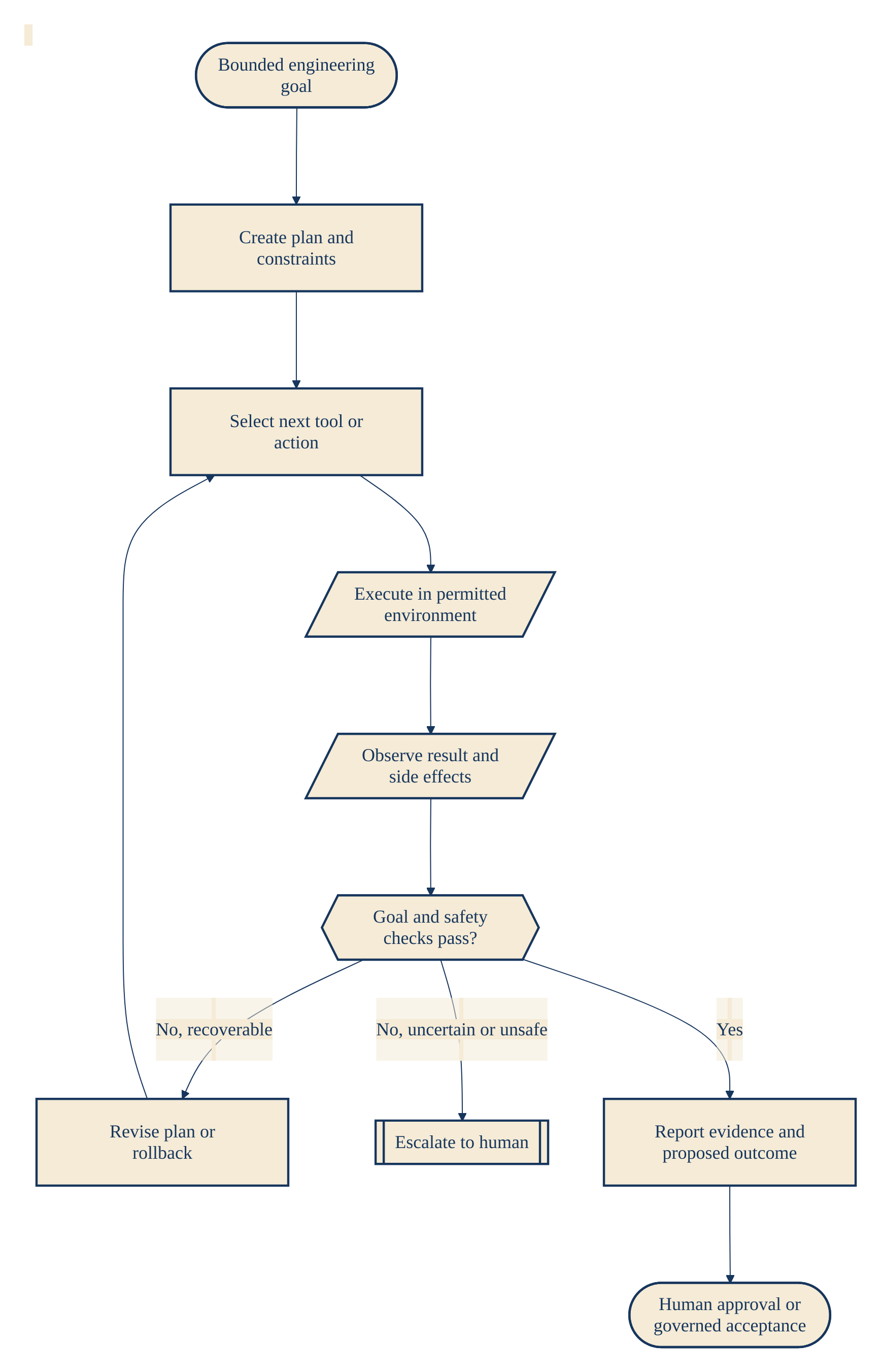
Agent task execution loop

Agent evaluation adds: planning quality, tool selection and permissions, state tracking, recovery from failed steps, verification discipline, boundedness, reproducibility, side effects, final task success.

A successful pull request is not sufficient if the agent used unsafe permissions, modified unrelated files, or produced hidden operational risk.

Every arrow crosses a trust boundary
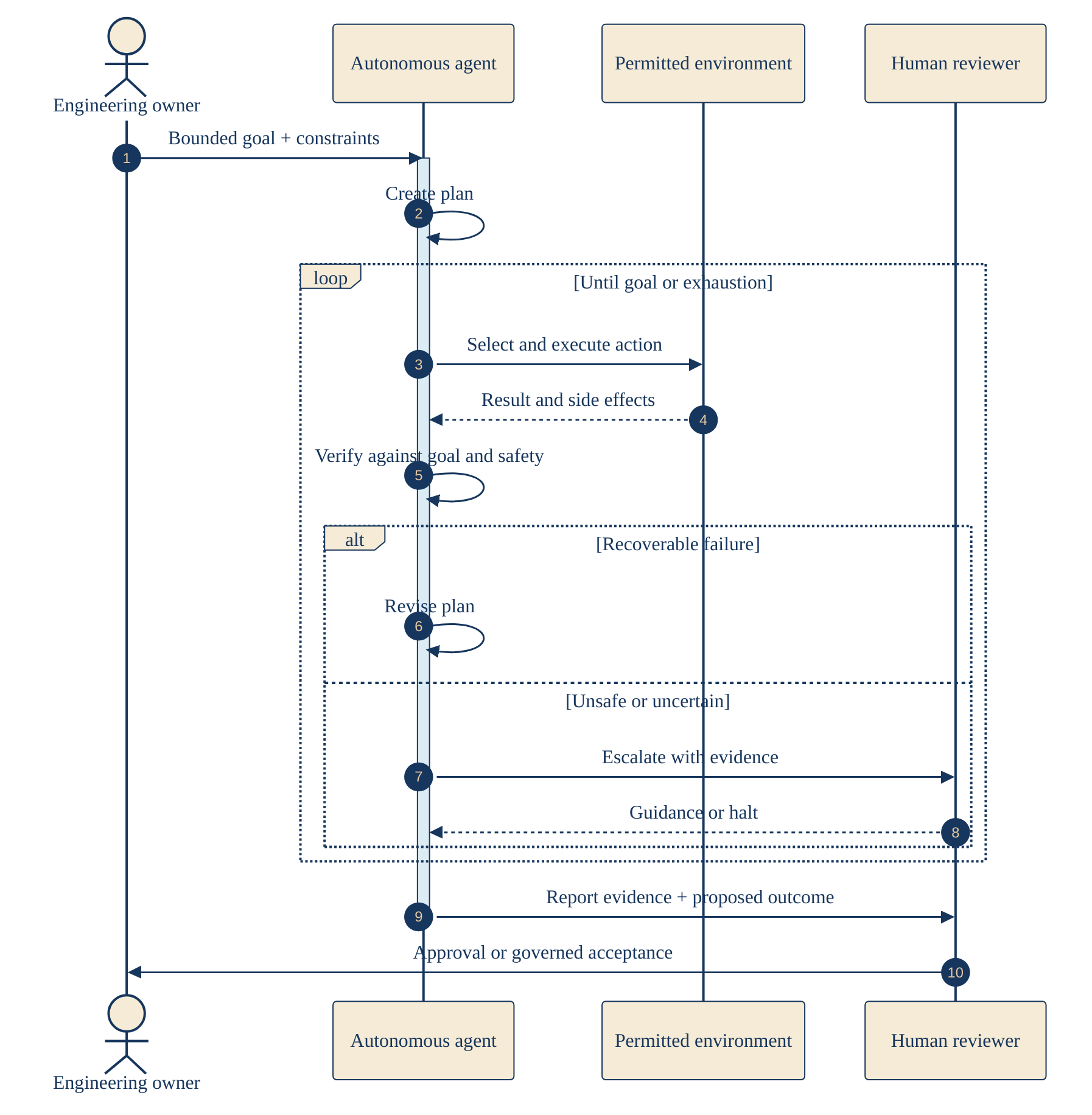
Agent–human–environment sequence

From human intent → autonomous plan → permitted execution surface → human review of evidence.

Each boundary is a place where instrumentation, permissions, and audit trails must be defined.

Autonomy and risk tiers

Low

Advisory output, easy reversal, non-production, standard validation

Moderate

Bounded writes, required tests, human approval, audit, rollback

High

Sensitive data, security, financial logic, infra, broad blast radius; specialist review, constrained permissions

Prohibited

Actions exceeding policy, legal, safety, or accountability boundaries

Risk routing must consider both task risk and model uncertainty.

Drift is a versioned intervention

AI behavior changes because of model upgrades, prompt edits, retrieval changes, repository evolution, or policy configuration.

Monitor: finding volume, precision proxies, action rates, cost, latency, category mix, failure modes, guardrail outcomes.

A vendor model update without an experiment record can invalidate every historical comparison.

Worked example: an AI reviewer

12,400 PRs, twelve weeks, treated vs. matched control cohort.

  • Direct review time saved: −3.3 min

  • Author verification of AI findings: +1.4 min

  • Reviewer verification: +1.1 min

  • Additional rework cycles (probability-weighted): +0.4 min

Net: −0.4 min — a 2.3% reduction, not the 19% headline.

Escaped-defect rate falls 8% (significant). Quality-retention factor \(Q_r = 1.05\) makes QCOI marginally net-positive.

The case for the tool depends on the quality effect, not the raw time saving.

Common failure modes

  • Counting generated code as productivity

  • Treating acceptance as correctness

  • Ignoring human validation cost

  • Evaluating only on synthetic benchmarks

  • Reporting global averages across languages and risk

  • Silent, unversioned model changes

  • Automating beyond the evidence advisory performance provides

Key takeaways

  • AI is a first-class participant with explicit provenance, cost, and outcomes

  • Attribution splits into production, decision, accountability, causal

  • Review evaluation = precision, recall, ranking, validation burden, downstream quality

  • Acceptance is interaction, not value

  • Net value = offload − reload, quality-adjusted

  • Agents require planning, permissions, recovery, side-effect, and boundedness measures

  • Model, prompt, retrieval, and policy versions are part of the treatment

  • Humans remain accountable for accepted engineering outcomes

Next

Chapter 8 — Complexity and Blast Radius

Structural risk, dependency depth, coordinated rollback, and why a two-line change can outrank a ten-thousand-line generated client.