build: 2026-10-19 20:32 UTC

Enterprise Instrumentation


Chapter 8 — Enterprise Instrumentation

The infrastructure required to make Engineering Intelligence reliable, explainable, and governable at scale.

Christopher J. Collins · Chapter Overview

Instrument the system, not the dashboard

Most analytics programs start with a dashboard and work backward toward data. The result is brittle queries, inconsistent definitions, and local extracts that cannot survive a rerun.

A measurement architecture reverses the flow:

  1. identify decisions and constructs

  2. define canonical entities and events

  3. capture raw evidence immutably

  4. normalize identity and time

  5. reconstruct Engineering Changes

  6. compute versioned features and metrics

  7. expose evidence through decision products

The dashboard is the last layer, not the first.

Source domains

Planning

initiatives, issues, priority, intent, ownership

Source control

repos, branches, commits, PRs, reviews, approvals

Dev environment

builds, tests, agent interactions, work sessions

AI systems

model, prompt, context, findings, cost, latency

CI

jobs, steps, tests, scans, retries, queues, artifacts

Deployment

releases, environments, flags, rollout waves, rollback

Production

metrics, traces, incidents, customer outcomes

Organization

teams, roles, ownership, expertise, calendars

No source is universally authoritative. Each is authoritative for a bounded type of evidence.

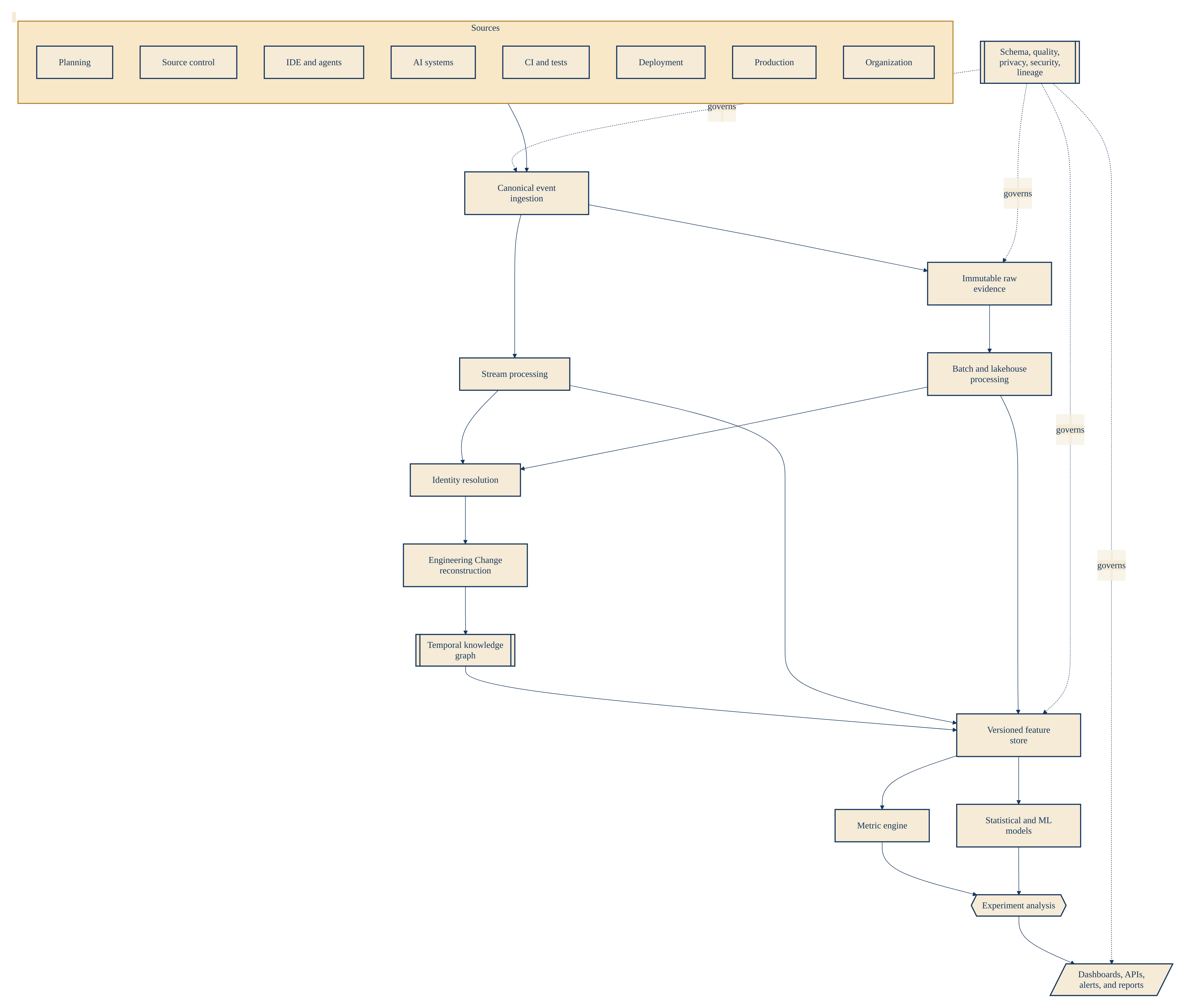
The reference architecture

Enterprise instrumentation architecture

Collection → Semantic Core → Serving. Immutable evidence flows left; governed decisions flow right.

The canonical event envelope

Every source event wears a common envelope while preserving its original payload.

{
  "eventId": "01J9K3...",
  "eventType": "pull_request.review.submitted",
  "schemaVersion": "1.3",
  "eventTime": "...",
  "ingestionTime": "...",
  "source": "github-enterprise",
  "actor": {"type": "human", "id": "person-392"},
  "engineeringChangeId": "EC-01J8...",
  "classification": "internal",
  "payload": { }
}

Required: uniqueness, source identity, event time, schema version, actor type, provenance, classification.

Three clocks, three questions

  • event time — when the source activity occurred

  • ingestion time — when the platform received it

  • processing time — when a computation used it

Late events are normal. Deployments publish after completion; incident links arrive days later; batch imports are out of order.

Stream processors use event-time windows and watermarks. Historical metrics must support correction and recomputation.

Delivery, idempotency, immutability

  • At-least-once is the practical default. Consumers must be idempotent.

  • Use stable event IDs, source sequence numbers, deduplication windows, deterministic upserts.

  • "Exactly-once" marketing does not remove end-to-end idempotency.

Raw source events are retained immutably before transformation — for audit, replay, defect recovery, recomputation, schema migration, forensics, and retraining.

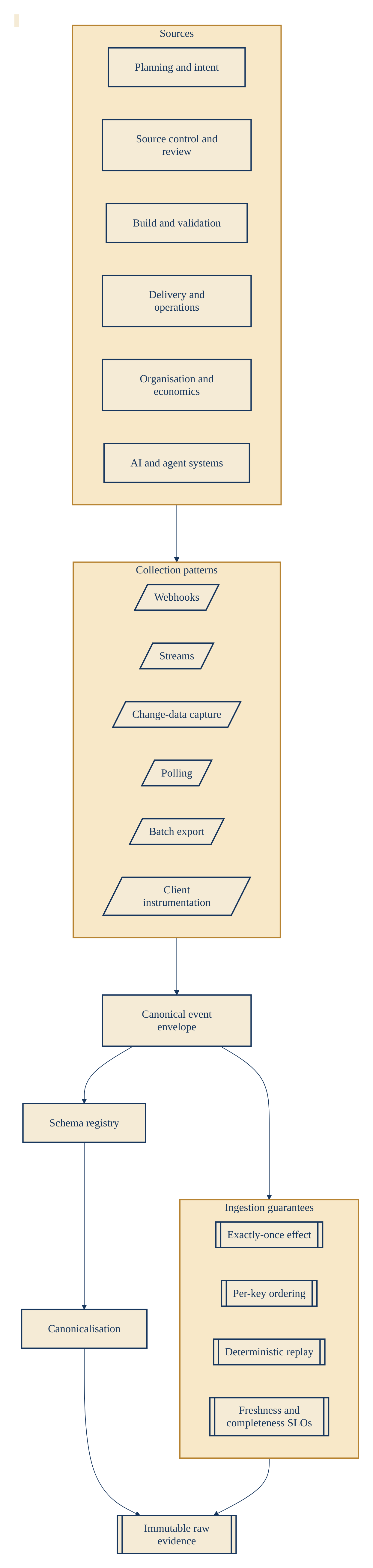
Collection layer

Collection layer components
  • Wrap every event in the canonical envelope

  • Retain original payload verbatim

  • Version schemas; treat semantic drift as more dangerous than structural drift

  • Partition and preserve raw evidence before any transformation

Identity resolution

Different systems use different identifiers for the same person, repo, service, team, environment. Identity resolution creates canonical entities and time-bounded aliases:

\[alias(source, sourceId, canonicalId, [t_s, t_e], confidence)\]

Organizational membership changes over time. A pull request must be attributed to the team and ownership state that existed when the event occurred — not today’s org chart.

Named identity is unnecessary for most system-level questions. Use pseudonyms, role or team aggregation, and minimum-access.

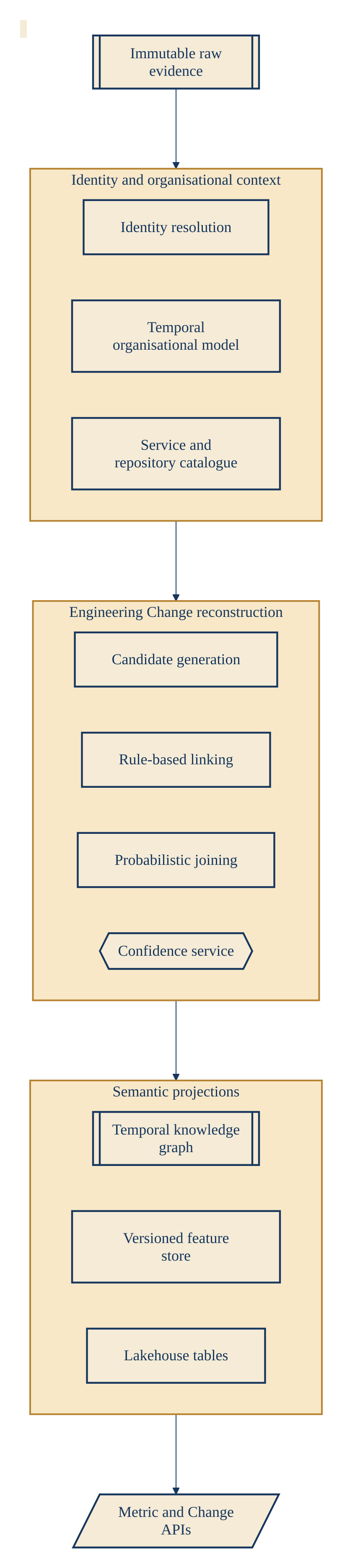
The semantic core

Semantic core components

Where raw events become entities, changes, features, and metrics — all versioned, all point-in-time correct.

Stream vs. batch — latency vs. breadth

Stream

Batch

current Engineering Change state

historical change reconstruction

review, CI, approval queues

repository and dependency topology

aging and stalled work

ownership and collaboration networks

experiment assignment / exposure

incident attribution

AI interaction state

model training and calibration

operational alerts

long-window experiments

Not real-time versus accurate. Both must be accurate. The trade is operational latency versus computational breadth — and both paths must reconcile against a single canonical definition.

Engineering Change reconstruction

The reconstruction service consumes normalized events and identity mappings, applies deterministic links, computes probabilistic ones, and maintains a temporal Engineering Change graph.

It exposes:

  • create, merge, split, close operations

  • membership and confidence

  • parent–child relationships

  • evidence and explanation

  • temporal state and correction history

  • versioned graph snapshots

High-confidence explicit identifiers override weak inferred links unless contradictory authoritative evidence exists.

The engineering knowledge graph

Connects Engineering Changes to people, AI actors, repositories, services, teams, dependencies, builds, deployments, incidents, and outcomes.

Useful queries:

  • the critical path across repositories

  • services repeatedly involved in failed changes

  • scarce reviewers bridging many teams

  • incident-to-artifact tracing

  • repository boundaries causing coordination delay

  • shared dependencies with high blast radius

Current ownership and historical ownership are distinct facts.

Feature store and metric engine

Feature store — versioned, reusable inputs. Every feature has a definition, entity key, event-time semantics, freshness, owner, source lineage, version.

Metric engine — separates semantic definition from execution. One spec compiles to stream, SQL, or batch plans.

Point-in-time correctness is essential: experiment analysis must use features known before treatment, not information that arrived after.

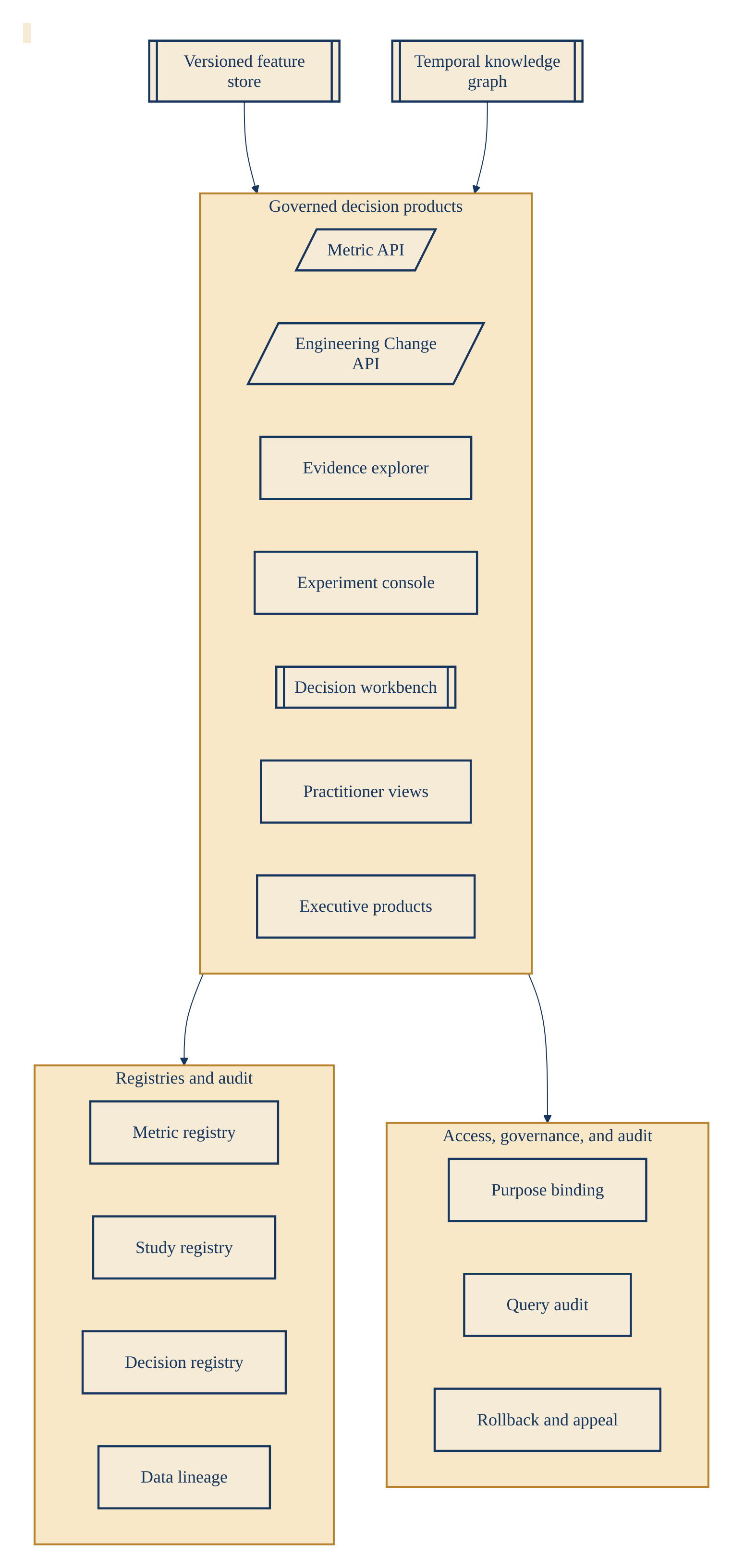
Serving layer

Serving layer components
  • Governed metric catalogue with versions and guardrails

  • Experiment data plane: deterministic assignment, exposure events, treatment versions, outcome joins

  • Decision products: dashboards, alerts, APIs, reports, recommendations

  • Every reported value carries lineage back to raw evidence

The Engineering Intelligence record

Engineering Intelligence record flow

Every published number should be reproducible from: metric version, feature versions, model version, source schemas, source partitions, computation code, execution time, correction history.

A decision made six months ago must be reproducible even if definitions have since changed.

Data quality as a product outcome

Measure — and enforce thresholds on:

  • event completeness, duplicate rate, late-event rate

  • schema-conformance rate

  • identity-resolution confidence

  • Engineering Change linkage coverage

  • contradictory-link rate

  • source freshness, event-to-metric latency

  • replay divergence, orphan entity rate

Measurement systems that silently lose events create misleading confidence. Fail visibly. Publish freshness.

Worked example — identity-resolution accuracy

41,290 source identities across six systems → 4,177 canonical actors, validated against 500 hand-labeled samples.

  • Precision: \(462 / (462 + 8) = 98.3\%\)

  • Recall: \(462 / (462 + 9) = 98.1\%\)

Both high — but the consequences are asymmetric.

  • False positive: work attributed to the wrong person (governance and fairness risk)

  • False negative: under-attribution and inflated headcount

SLO set at precision \(\geq 99.0\%\). Changes below 0.90 confidence are flagged for manual review. Two months later: 0.4% of joins reviewed — absorbable.

Common failure modes

  • Dashboard-first architecture — local queries become the unofficial data model

  • Transformed-only storage — processing defects cannot be replayed or audited

  • Ignoring temporal identity — today’s org chart applied to yesterday’s work

  • Mixing event and processing time — late data produces unexplained metric swings

  • Unversioned schemas and metrics — history stops being comparable

  • Excessive behavioral telemetry — privacy risk up, trust and validity down

  • Treating one source as universal truth — no single tool contains intent, implementation, deployment, and outcome

Key takeaways

  • Design around evidence, entities, and decisions — not dashboards.

  • Canonical envelopes, immutable raw storage, and replay are foundational.

  • Event time, identity, schema, metric, and model versions enable reproducibility.

  • Stream and batch serve different needs — and must reconcile against one definition.

  • Engineering Change reconstruction and a temporal knowledge graph connect fragmented evidence.

  • Feature stores require point-in-time correctness for valid experiments.

  • Quality, privacy, security, lineage, and reliability are first-class capabilities.

Next

Chapter 9 — Experimentation and Causal Inference

From well-governed telemetry to credible causal claims: assignment, exposure, guardrails, and what "the AI reviewer helped" really has to prove.