Christopher J. Collins
Chapter 9 — Complexity, Blast Radius, and Repository Topology
Engineering effort is not code size. Risk is not incidents. Repositories are not units of work.
Christopher J. Collins · Chapter Overview
Three changes, three verdicts:
two-line authorization change touching every customer — small, high risk
thousand-line generated API client — large, routine
one-table migration with dual writes, backfill, cutover, rollback — modest code, operationally hard
Complexity is a vector, not a raw count. Lines changed is evidence, not measurement.
For an Engineering Change \(e\):
\(C_i\) Implementation | algorithms, concurrency, state |
\(C_d\) Domain | security, consistency, tax, ML, embedded |
\(C_a\) Architectural | services touched, fan-in, contracts |
\(C_v\) Verification | nondeterminism, environment scarcity |
\(C_o\) Organizational | teams, handoffs, approvals, vendors |
\(C_t\) Topological | repository and deployment structure |
\(C_n\) Novelty | distance from what is already known |
\(C_b\) Blast radius | potential impact if it misbehaves |
Verification is often a stronger predictor of cycle time than implementation size.
A first-order model:
\(T_e\) teams · \(H_e\) handoffs · \(A_e\) approvals · \(X_e\) external boundaries
Coefficients are calibrated from observed delay — not chosen for elegance.
The same team count creates very different friction depending on interface quality and prior collaboration.

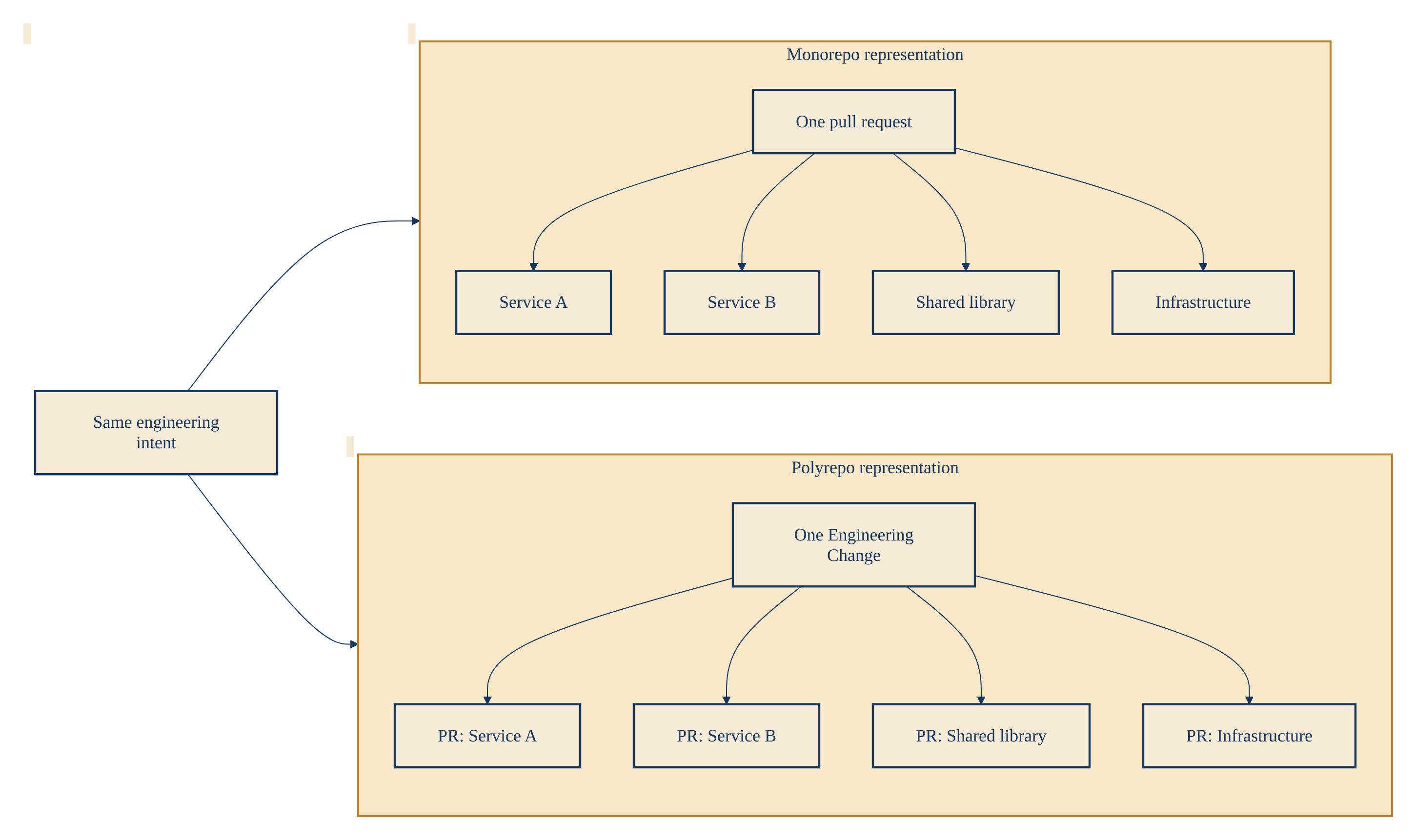
The same Engineering Change appears as one PR in a monorepo and many linked PRs in a polyrepo. Code topology and deployment topology are also distinct — a migration may stay operationally active long after every PR merges.
Repository count is a topology feature — not an intrinsic measure of work.
Let \(G_R=(V_R,E_R)\) be the implementation graph. Critical-path duration:
Parallelism ratio:
Parallel work reduces elapsed time only when dependencies permit — coordination overhead sets the ceiling.
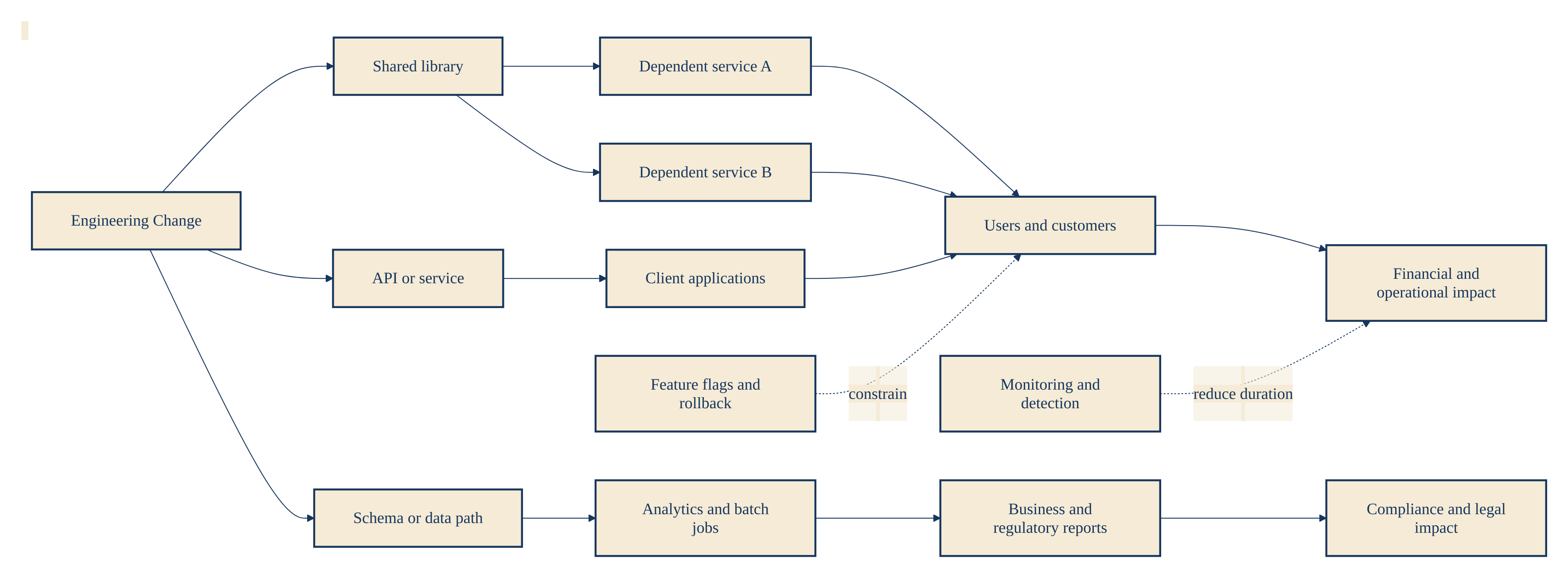
Important | Blast radius is the set and severity of systems, users, data, business processes, and obligations that could be affected if an Engineering Change behaves incorrectly. |
Users · Services · Data · Financial · Availability · Compliance · Reversibility.
Potential blast radius is distinct from realized impact. Controls that prevent incidents do not lower the potential.
\(g_k\) transforms each dimension; \(w_k\) reflects priorities
Interactions matter — sensitive data × broad reach exceeds either alone
Calibrate against incidents, expert assessment, and policy — not numerical convenience
Preserve component drill-down even when a scalar is used for routing
A flagged UI change disables in seconds. A destructive data migration may never fully reverse.
Reversibility features:
rollback time and completeness
data restoration
compatibility duration
feature-flag coverage
whether side effects escape organizational control
High-reach reversible ≠ lower-reach irreversible. Reach alone does not determine risk.
Change surface | Impact surface | |
Shared-auth one-liner | tiny | huge |
Isolated test rewrite | large | small |
Schema migration | modest | very large |
Change surface — what was modified. Impact surface — what can be affected.
Review, routing, and experimentation need both.

A combined reach graph joins: build-time deps · runtime calls · data flows · event subscriptions · deployment coupling · ownership · customer and business-process mappings.
Dependencies change — the graph must be versioned temporally.
A shared-auth library update: 38 lines, one repo, tests pass.
Reach: 47 downstream services, 31 pick up on next deploy
Exposure: 5 internet-facing, authenticated
Reversibility: coordinated fleet redeploy or mixed-version handling
Top quartile. The score does not block — it selects the coordinated-rollout playbook the PR would otherwise skip.
Raw cycle time misleads. A hierarchical model:
The residual highlights unexpectedly high or low friction after work mix is controlled.
Use for team-level learning and routing. Never as an individual performance ranking.
Complexity features drive controls:
low-risk routine → automated checks, light review
high-domain → specialist reviewer
high-blast-radius → stronger verification, rollout safeguards
high-novelty → design review, knowledge sharing
irreversible → explicit recovery plan
AI performance varies by dimension too — evaluation must stratify by domain, novelty, dependency depth, blast radius, and verification.
Lines changed = complexity | misses domain, arch, verification, impact |
Repo count = work count | topology is a lens, not a measure |
One universal score | hides why something is hard |
Static deps = full reach | runtime, data, deploy, org coupling missed |
Incidents = blast radius | controls hide potential impact |
Ignoring reversibility | reach alone doesn’t set risk |
Engineering Change complexity is multidimensional — code size is one feature among many
Model domain, architecture, verification, org, topology, novelty, and blast radius separately
Repository and deployment topology shape appearance and coordination, not intrinsic work
Multi-repo work is a dependency graph with a critical path
Blast radius is potential — not realized incidents
Change surface ≠ impact surface
Complexity supports adjustment, routing, experimentation — never individual ranking
Chapter 10 — The Engineering Change Graph
Reconstructing intent across PRs, deploys, approvals, and flags — the graph on which every credible metric is computed.