GET /engineering-changes/{id}/graph
POST /engineering-changes/{id}:merge

GET /metrics/review-friction/v2.1
  ?entityType=engineering_change
  &entityId=EC-01J8...
&asOf=2026-07-15T22:00:00ZThe Engineering Intelligence Platform
Christopher J. Collins
Chapter 10 — The Engineering Intelligence Platform
From concepts and metrics to a concrete architecture: services, storage, APIs, computation, governance, and operating model.
Christopher J. Collins · Chapter Overview
From ideas to a platform
The preceding chapters defined the concepts, metrics, and evidence. This chapter turns them into an operable system.
An Engineering Intelligence platform must answer four classes of questions:
What happened? — reconstruct changes, queues, reviews, deployments, outcomes
Why did it happen? — constraints, complexity, dependencies, external factors
What is likely to happen next? — delay, risk, cost, quality
What should we change? — experiments, routing, prioritization, investment
It is not a reporting warehouse. It is an evidence and decision system.
Core architectural principles
Preserve immutable raw evidence
Separate canonical entities from source-specific IDs
Treat the Engineering Change as the primary unit of analysis
Version events, features, metrics, models, policies
Support both near-real-time and retrospective recomputation
Keep causal assignment independent from metric computation
Expose uncertainty, provenance, and quality with every result
Minimize surveillance; prohibit unsupported individual ranking
Logical architecture
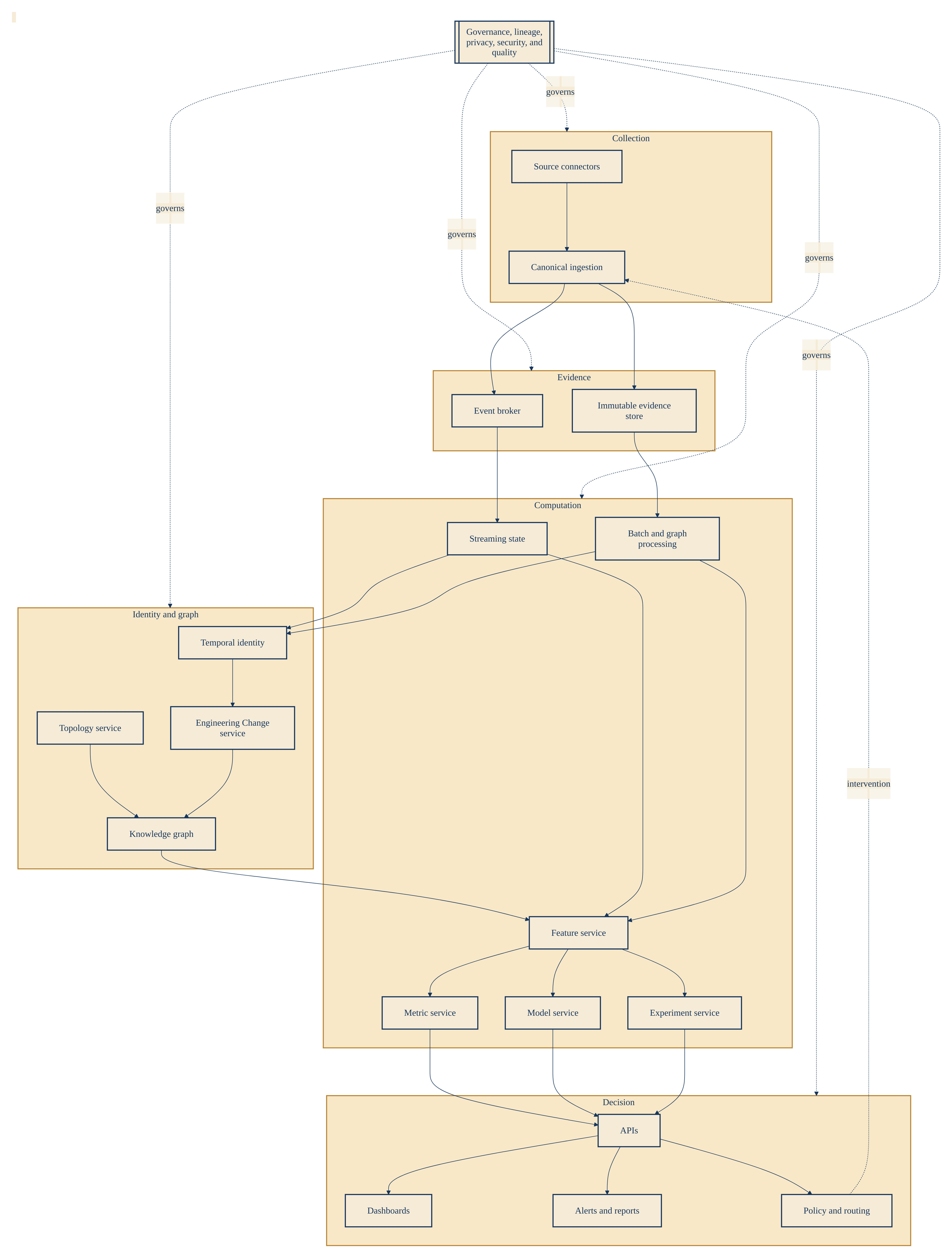
Seven planes, each with a distinct responsibility.
The seven planes
Collection | connectors, webhooks, CDC, polling, agent telemetry |
Evidence | immutable log, raw payloads, deduplication, replay |
Identity & graph | canonical identities, change reconstruction, topology |
Computation | streaming state, batch features, metrics, models, experiments |
Governance | schema registry, lineage, privacy, access, retention, audit |
Decision | dashboards, alerts, APIs, reports, recommendations |
Control | experiment assignment, policy delivery, versions |
Service boundaries
Not one monolith. Nine services with sharp contracts:
Source connector — canonical envelopes, original payloads preserved
Identity — stable temporal identities for people, AI, repos, services, teams
Engineering Change — lifecycle, graph membership, confidence, provenance
Topology — repo, service, data, ownership, and business dependency graphs
Feature — versioned point-in-time features
Metric — governed definitions with lineage and uncertainty
Experiment — eligibility, assignment, exposure, guardrails
Model — predictive, causal, ranking, reconstruction
Decision product — APIs, dashboards, alerts tailored per audience
Canonical APIs
Every metric result is a tuple: value, interval, sample basis, quality, lineage.
Explicit version and time context are required — always.
Storage: no single database wins
Object store / lakehouse | immutable events, history, batch features, snapshots |
Event broker | low-latency transport, ordering, replay |
Relational store | experiment registry, catalogues, operational state |
Graph store | change, repo, service, ownership relationships |
Search index | interactive discovery over changes and findings |
Feature store | point-in-time online + offline model inputs |
Analytical warehouse | large-scale aggregation and reporting |
The canonical source of truth must be explicit for every entity and fact.
Streaming, batch, and graph
Streaming maintains lifecycle state, queues, exposure, AI interaction, freshness alerts. Transitions must be deterministic and replayable; processors emit changelogs, not opaque state.
Batch handles historical reconstruction, semantic code analysis, dependency graphs, ownership networks, complexity features, experiment datasets, model training.
Incremental graph processing where possible — complete recomputation available for recovery.
A metric specification language
A declarative definition eliminates divergence between dashboards and experiments.
id: review_friction
version: 2.1.0
entity: engineering_change
construct: review_process_friction
features:
  - review_queue_minutes
  - review_response_cycles
  - context_recovery_events
aggregation: weighted_sum
uncertainty: bootstrap_clustered_by_repository
guardrails:
  - severe_escape_rate
  - rollback_rate
owner: engineering-intelligence
The engine compiles it into SQL, batch, or streaming plans.
Policy engine: metrics become operational
Metrics matter when they change routing.
Send high-blast-radius changes to specialist review
Suppress low-confidence duplicate AI comments
Prioritize aged changes with high cost of delay
Require stronger rollout for irreversible migrations
Route scarce reviewers to highest expected risk reduction
Every policy is versioned, explainable, and linked to an experiment.
Decision products by audience
Engineer | current change, dependencies, review queues, AI findings, outcome |
Team | flow distributions, WIP, review constraints, quality, experiments |
Platform | infrastructure latency, tool cost, drift, source freshness |
Executive | portfolio cost, value, risk, capacity, intervention evidence |
One governed semantic layer. Different views. Drill-down from aggregate to evidence — without leaking individual detail.
Contracts, SLOs, and freshness
Each domain owns event quality. The platform owns canonical contracts, identity, lineage, and shared computation.
Suggested platform SLOs:
event ingestion availability · source-to-platform lag
duplicate and loss rate · reconstruction latency
metric freshness · experiment assignment availability
replay time · lineage completeness · data-quality alert time
Freshness must be visible in every product. Stale metrics must not appear current.
Reference implementation roadmap
Six phases, not one big bang:
Evidence foundation — source-control, CI, deploys; canonical envelopes; replay; identity
Engineering Change graph — explicit IDs where possible, probabilistic elsewhere
Governed metrics — catalogue, features, lineage, quality
Experimentation — assignment, exposure, external-factor registry, guardrails
AI and cognitive instrumentation — contributions, validation, trust, offload
Predictive and prescriptive — delay, risk, complexity, routing; policy after validation
Common failure modes
Universal data lake without decisions — data accumulates, value unclear
Metrics coupled to dashboards — definitions diverge, cannot be reproduced
Provenance hidden — users cannot challenge or correct conclusions
Ownership centralized — platform team cannot understand every source
Policy automated too early — unvalidated models create self-reinforcing bias
Operating model ignored — technology exists; no one owns definitions or action
Build vs buy
Buy commodity capabilities. Retain control of the strategic ones. Vendor products should integrate through contracts — not become the only place where evidence lives.
Buy: connectors, visualization, cataloguing, infrastructure monitoring.
Build/own: canonical event history, identity, Engineering Change reconstruction, metric definitions, experiment assignments, AI telemetry, policy logic.
Sequencing first-year value
18 engineer-quarters. Four candidate capabilities. The naive parallel plan slips all four.
The sequenced plan:
Q1 — ingestion + descriptive dashboard through governance (7 EQ)
Q2–Q3 — Engineering Change reconstruction on governed ingest (6 EQ)
Q4 — experiment platform against the reconstructed graph (4 EQ)
Outcome by month twelve: two governed executive metrics, one causal experiment on review routing, one adopted blast-radius measure.
Experiment platform first would have shipped nothing for eight months.
Key takeaways
An Engineering Intelligence platform is an evidence, experimentation, and decision system — not a dashboard stack
Sharp service boundaries separate collection, identity, graph, features, metrics, experiments, models, decisions
Immutable evidence, temporal identities, point-in-time features, and versioned definitions are foundational
Operational policies must be explainable, versioned, and experimentally validated
Different audiences, one governed semantic layer
Deliver value before automation — evidence first, prediction later
Next
Chapter 11 — Adoption, Governance, and the Road Ahead
Rolling the platform out · governing consequential use · the maturity ratchet · what comes after the reference architecture.