The Engineering Metrics Catalogue
Christopher J. Collins
Chapter 11 — The Engineering Metrics Catalogue
Governed definitions, not dashboard proliferation: a reference model for measures across flow, quality, economics, cognition, AI, architecture, and experiments.
Christopher J. Collins · Chapter Overview
Why a catalogue matters
Every organisation has many definitions of "cycle time" — commit-to-merge, PR-open-to-merge, work-start-to-deploy, intent-to-outcome.
All can be valid. None are interchangeable.
Without a catalogue, arguments about performance become arguments about definitions.
The catalogue fixes the vocabulary
One governed location for each measure:
semantic definition and construct
the decision it supports
unit of analysis and eligible population
formula, exclusions, and lineage
uncertainty and data quality
biases, gaming risks, invalid uses
intended actions and guardrails
owner and review cadence
Catalogue governance is a decision-quality concern, not an infrastructure concern.
The metric specification
Identifier / Title / Version | Stable name; semantic versioning of definition |
Construct / Decision | What is measured; what decision it supports |
Unit / Population | Engineering Change, PR, service, team — with exclusions |
Formula / Sources | Exact computation; events, entities, features, models |
Latency / Uncertainty | Time to availability; confidence or quality state |
Interpretation / Failure modes | What movement means; how it misleads or is gamed |
Guardrails / Owner | Tolerances that must hold; accountable group |
A metric without these fields is a chart, not evidence.
Flow — lead time and its decomposition
Engineering Change lead time:
Flow efficiency separates execution from waiting:
Lower lead time may mean faster delivery, simpler work, or weaker verification. Always stratify.
Flow — queue time is where lead time lives
Useful subtypes: review · CI · approval · environment · deployment.
Complements:
Work in process — weighted by complexity, not headcount
Aging work — 95th percentile relative to class-expected duration
Detects stalled work before aggregate lead time worsens
Review — the Review Friction Index
Composite diagnostic:
Components (drill-down must be exposed):
review queue age (cost-of-delay weighted)
response cycles
context recovery time
unresolved discussions
validation effort
A high value may mean poor initial quality, unclear expectations, complex work — or effective defect discovery.
Quality — beyond change failure rate
Change failure rate — proportion needing rollback, hotfix, or material remediation (window must be declared)
Escaped defect rate — severity-weighted, with attribution confidence
Rework ratio:
Detection stage distribution — authoring · AI review · human review · CI · staging · rollout · production · customer
Earlier detection is often cheaper. Stage alone does not establish value.
Economics — total change cost is a model
This is a model with explicit assumptions — not an observed number.
Cost per accepted outcome — only within comparable outcome classes
Cost of delay — report ranges, not false precision
Scarce-attention consumption — identifies organisational bottlenecks
Tool net value — benefits must be causal estimates
Cognition — the invisible half of engineering
Context recovery time — resume-to-productive after interruption
Concurrent cognitive inventory:
Cognitive Offload Index:
Cognitive reload — work created by inspecting, correcting, recovering from tool output
For system research and workload design — never for individual ranking.
AI participation — precision, burden, leverage
Precision at k — is limited attention being directed to useful findings?
NDCG — ranking quality when severity is graded
Duplicate finding rate
Human validation burden — inspect, investigate, correct, recover
Action rate — applied · modified · equivalent independent fix · follow-up · acknowledged · rejected · ignored
AI contribution latency — a late finding may be worthless even if correct
AI Leverage Factor — value and avoided cost vs AI + validation cost
Acceptance is not offload. Offload is not value.
Architecture — topology as a first-class signal
Repository spread — repos participating in one Engineering Change
Dependency depth — longest path among affected components
Critical-path duration — longest duration-weighted path
Ownership boundary count — approval boundaries crossed
Blast Radius Score — users · systems · data · money · availability · compliance · reversibility
Change surface to impact surface:
A high ratio finds small changes with disproportionate reach.
Experiments and data quality
Experiment metrics:
exposure rate, compliance rate
average treatment effect: \($ATE = E[Y(1)-Y(0)\)$]
minimum practical effect attainment
guardrail breach rate; experiment decision latency
Data quality metrics:
event completeness — expected events actually received
linkage coverage — artefacts linked to Engineering Changes above a confidence threshold
identity ambiguity — unresolved actors, repos, services, teams
freshness and replay divergence
A number without its data-quality state is a rumour.
Metrics as bundles, not scores
Consume together, not in isolation.
AI review bundle | human effort · validation burden · severe-finding recall · precision at k · duplicates · cycle time · escaped defects · cost |
Flow bundle | lead time · active time · queue time by stage · WIP · aging · flow efficiency · accepted outcome rate |
Platform bundle | freshness · linkage · latency · replay divergence · availability · source failure |
A composite that hides its components invites gaming.
The metric lifecycle
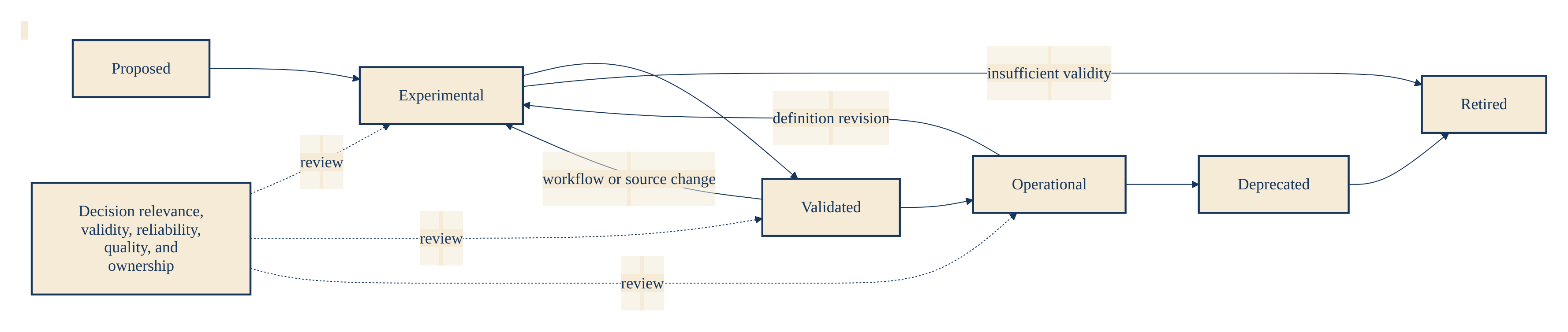
Proposed → Experimental → Validated → Operational → Deprecated → Retired.
A proposed metric does not belong on an executive scorecard.
A validated metric has evidence of construct validity and reliability.
An operational metric has an owner, SLO, lineage, and action process.
Worked example — reading the flow bundle
A workflow change three months ago. Every flow number improves:
Measure | Before | After |
Lead time (days) | 7.9 | 6.2 |
Review queue (days) | 2.6 | 1.4 |
WIP | 51 | 42 |
Flow efficiency | 41% | 50% |
Accepted outcome rate | 91% | 87% |
Isolated: unambiguous win. As a bundle: the loudest signal is the four-point drop in accepted outcomes.
Drill-down: customer-facing UI reverted twice as often — a specialist reviewer was routed around. Amend the routing, keep the queueing gains.
Common failure modes
Name without definition — two teams, one word, incompatible meanings
Formula without construct — precisely computed, invalidly interpreted
Metric without decision — noise that accumulates cost
Score without components — hides movement, invites gaming
Dollar value without assumptions — false precision on uncertain rates
Retire measures that no longer inform a decision. Do not preserve them because they once appeared on a dashboard.
Key takeaways
A governed catalogue is necessary for reproducible Engineering Intelligence
Every metric requires construct, decision, unit, formula, lineage, uncertainty, owner, failure modes
Represent flow · quality · economics · cognition · AI · architecture · experiments · data quality together
Consume as bundles; expose components of every composite
Separate experimental from operational scorecards
Prohibit unsupported individual ranking
Retire what no longer changes a decision
Next
Chapter 12 — Instrumentation and Data Foundations
The event schemas, identity resolution, streams, and knowledge graphs the catalogue depends on.