Christopher J. Collins
Chapter 13 — Governance, Ethics, and Organizational Adoption
The rules, architecture, and operating model that keep Engineering Intelligence legitimate.
Christopher J. Collins · Chapter Overview
Engineering Intelligence can:
improve decisions
reduce wasted effort
make hidden constraints visible
It can also:
become a surveillance system
distort incentives
silently repurpose telemetry into performance scoring
Governance is not paperwork — it decides whether the platform is trusted enough to be used at all.
Once a metric exists, engineers respond to it. Predictably.
splitting PRs to inflate throughput
delaying issue creation to shorten lead time
avoiding hard work that harms personal scores
accepting AI suggestions to lift adoption
moving coordination into uninstrumented channels
optimising deploy count over customer value
Behavioural adaptation is part of the system being measured, not a discipline problem.
When a measure becomes a target, it often ceases to be a good measure.

Correlation → reward → optimisation of proxy → decoupling from outcome → misleading metric.
The answer is not to abandon measurement — it is bundles, guardrails, rotation, and no individual quotas from diagnostic telemetry.
Purpose limitation | Only for declared engineering, safety, or operational decisions |
Data minimization | Least granular data that answers the question |
Proportionality | Intrusiveness matches decision importance and risk |
Transparency | People know what is collected, derived, accessed, decided |
Contestability | Users can challenge identities, links, classifications |
Separation of purposes | System telemetry is not performance data |
Human accountability | Models inform; humans remain accountable |
Generally appropriate | Queue bottlenecks, tool evaluation, CI reliability, review routing |
Heightened governance | Team comparisons, cognitive-burden studies, risk prediction, AI trust |
Generally inappropriate | Ranking engineers by commits, PRs, review speed, AI acceptance |
Prohibited (barring exceptional basis) | Covert surveillance, keystroke monitoring, automated employment decisions |
Publish the boundaries before broad instrumentation begins.
Some events must retain actor identity to reconstruct changes, approvals, and handoffs. That does not justify named individual scorecards.
Recommended controls:
pseudonymous IDs in analytical datasets
team or role aggregation by default
minimum group-size thresholds
audit logs for identity lookups
explicit review before any new individual-level use
Private self-view is legitimate. Silent repurposing is not.
People represented in the data should have practical rights:
to know what is measured
to understand metric definitions
to see relevant personal or team data
to correct factual errors
to challenge derived classifications
to know whether data affects consequential decisions
to understand retention and access
Rights improve trust — and, incidentally, data quality.
Enforce privacy structurally, not by policy alone.
pseudonymisation before analytical processing
separate identity vaults
row- and column-level authorisation
aggregation before broad access
short retention for detailed behavioural events
irreversible aggregation for long-term trends
deletion propagation across raw, graph, feature, metric stores
A dashboard cannot leak data the underlying service never exposes.
Every model used for reconstruction, risk, complexity, or routing needs a record:
owner and accountable approver
intended and prohibited uses
training and evaluation data
features and sensitive attributes
subgroup performance, calibration, uncertainty
drift monitoring, human override
rollback and retirement criteria
version history
Models that shape review, permissions, or workload get greater scrutiny than exploratory ones.
Engineering populations differ by role, tenure, location, repo, accessibility, work type.
Metrics can create unequal effects without using protected attributes:
legacy-system owners look slower
new engineers score lower on familiarity
specialists appear as delays because they are the bottleneck
distributed teams show longer calendar latency
Goal: avoid unjustified harm from invalid comparisons — not force identical raw numbers.
Before operationalising a metric, ask:
How could a rational person improve this number without improving the outcome?
Which work becomes invisible?
Who bears the cost of optimisation?
What behaviour will be discouraged?
What guardrail detects distortion?
When should this metric be retired?
A metric’s gaming surface is part of its specification.
Trust is not a communications layer. It determines whether people use tools, correct data, join experiments, and believe conclusions.
Rises with accuracy, transparency, usefulness, corrigibility, restraint. Falls when metrics are surprising, opaque, punitive, or obviously incomplete.
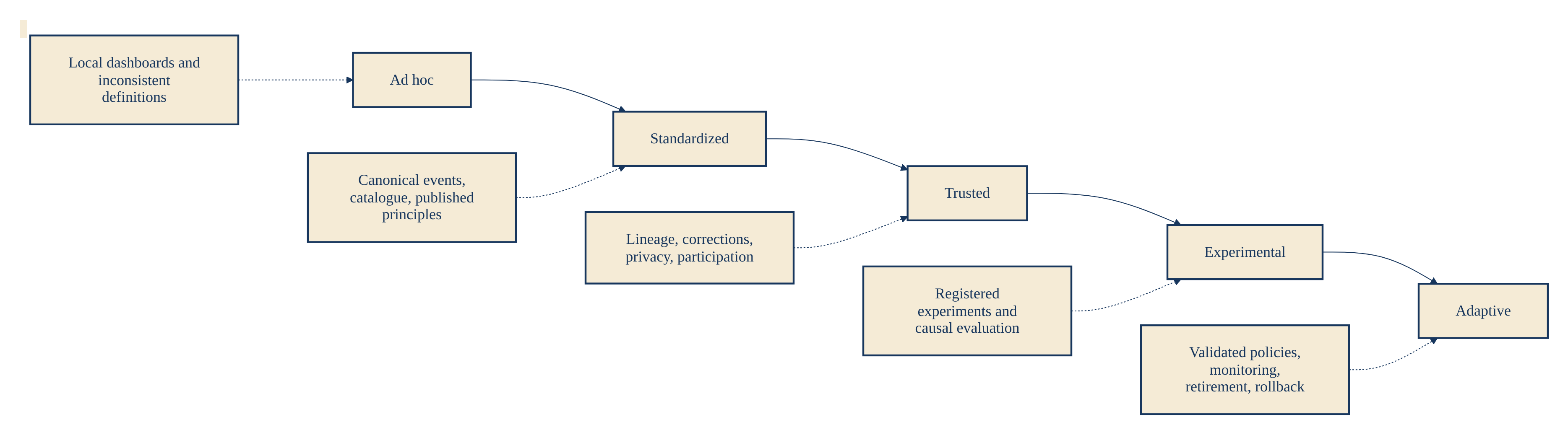
Ad hoc | Local dashboards, inconsistent definitions, limited governance |
Standardized | Canonical events, metric catalogue, published principles |
Trusted | Transparent lineage, corrections, privacy controls, participation |
Experimental | Registered experiments, guardrails, causal evaluation |
Adaptive | Validated models, continuous monitoring, formal retirement and rollback |
Ranking dashboards first — defensive behaviour before value is proven
Policy without architecture — rules exist, raw access makes misuse trivial
Consent theater — informed on paper, no real correction path
Fairness as equal averages — different work should not produce identical numbers
Permanent experimental telemetry — one study’s data reused forever
Governance only after harm — oversight built reactively, after behaviour has shifted
Start with visible system problems engineers already feel
Publish principles and prohibited uses
Deliver local value: queue visibility, CI diagnosis
Involve teams in metric definitions
Show uncertainty and data quality openly
Allow corrections
Evaluate interventions, don’t rank teams
Expand only after trust and usefulness are demonstrated
A VP asks for "the top 20 lowest-performing engineers" ranked by review-latency contribution.
Review-latency is registered as Class 2 (organisational decision support)
Individual ranking would be Class 4 — currently prohibited
Metric owner declines in writing, citing registered purpose
Request logged as a governance incident
Purpose-bound metric API had already blocked the underlying query
Board reaffirms the boundary, updates leadership onboarding. No sanction — the point is to make boundaries visible, not to punish first contact.
Measurement changes behaviour and incentives
Purpose limitation, minimisation, transparency, contestability, separation are foundational
System telemetry must not silently become individual performance data
Privacy and governance are enforced through architecture, not policy alone
Models, routing, and experiments need lifecycle governance and rollback
Trust is a functional dependency of valid Engineering Intelligence
Adoption begins with local value and practitioner participation
Chapter 14 — From Metrics to a Learning Engineering Organization
Closing the loop · evidence-led decisions · continuous experimentation · the operating model of a measured engineering system.