Implementation and Rollout
Christopher J. Collins
Chapter 15 — Implementation and Rollout
How to stand up Engineering Intelligence in a real organisation — starting with one consequential decision, not universal instrumentation.
Christopher J. Collins · Chapter Overview
Start with decisions, not completeness
The common failure pattern: months connecting tools, designing schemas, and building dashboards while practitioners see nothing change.
A better first move — pick a decision that is:
important — real capital or attention at stake
repeated — worth instrumenting once, using many times
measurable — has an observable outcome
currently made with weak evidence
Collect only the evidence needed to answer that decision credibly.
Pilot selection criteria
A good pilot has:
a meaningful operational or economic problem
sufficient event volume
willing engineering partners
stable enough workflows to define treatment and outcome
manageable privacy and security risk
accessible source-control, CI, and deployment evidence
a plausible intervention within one or two quarters
A technically convenient pilot with no decision consequence will not establish legitimacy.
The minimum viable evidence path
Enough to answer a real question — nothing more:
source-control events
CI and test outcomes
deployment or accepted-outcome evidence
canonical actor, repository, and team identities
a basic Engineering Change linkage strategy
a small metric catalogue
experiment assignment and exposure (when applicable)
You do not need the whole reference architecture to prove value.
The phased rollout
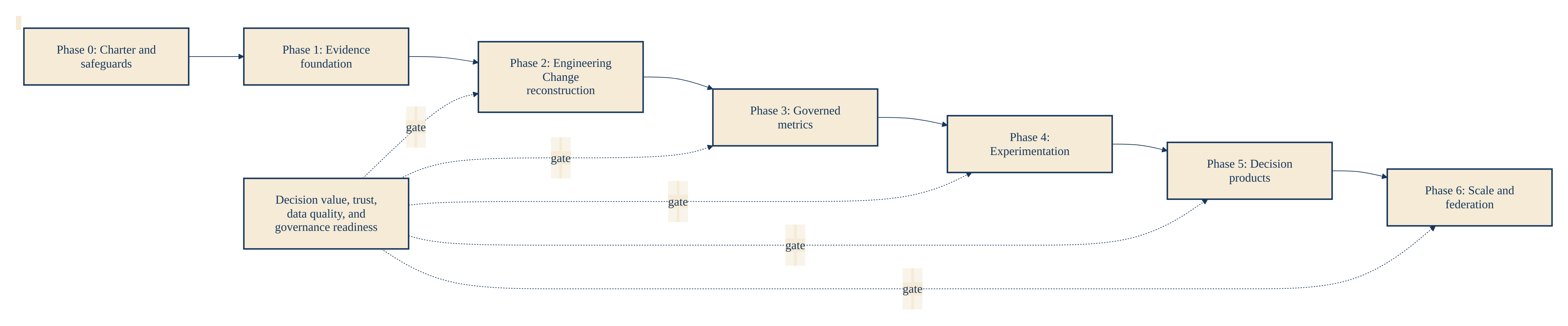
Seven phases, from charter to federation — sequenced so trust is earned before scale.
The seven phases
Phase 0 | Charter, safeguards, prohibited uses, stopping criteria |
Phase 1 | Evidence foundation — canonical events, identity, lineage |
Phase 2 | Engineering Change reconstruction and linkage confidence |
Phase 3 | Governed metrics tied to the pilot decision |
Phase 4 | Experimentation — assignment, exposure, guardrails |
Phase 5 | Operational decision products per audience |
Phase 6 | Scale, federation, repeatable onboarding |
Each phase has an exit condition. Trust is the ratchet.
The team that ships this
A small cross-functional team beats a large dashboard organisation:
platform engineering
data engineering
applied statistics / causal inference
ML or information retrieval
developer experience
security and privacy
domain representatives
product or program leadership
Statistical and domain depth matter more than headcount.
Engineering Intelligence is a product
The backlog is not "dashboards to build." It is:
decisions to improve
user workflows to serve
evidence gaps to close
metric quality to raise
experiments to run
source reliability to increase
governance debt to pay down
adoption and trust to earn
Usage is not the success metric. Decision quality and realised outcome improvement are.
Proving value — five flavours
Distinguish, don’t blend:
realised savings — money that stopped leaving
avoided future cost — a purchase not made
released capacity — attention returned to teams
expected quality benefit — better outcomes over time
theoretical model estimates — the weakest evidence
A "$4M value" headline that mixes all five is not defensible.
Baseline before intervention
Before changing a workflow, capture:
current metric distributions
work-mix and complexity features
source coverage and missingness
seasonality and release cycles
existing tool exposure
quality and economic baselines
external events
A rushed intervention without baseline evidence makes causal interpretation impossible later.
Data quality gates
High-level metrics must not publish when evidence falls below declared thresholds.
minimum event completeness
maximum source lag
minimum Engineering Change linkage confidence
maximum unresolved identity rate
sufficient sample size
stable metric version
no known processing incident
A visible unavailable state is better than a precise-looking but invalid number.
Shadow mode and staged rollout
New metrics and policies run without affecting decisions first.
opt-in pilot
selected representative teams
staged repository cohorts
risk-bounded populations
shadow recommendations before advisory
advisory before blocking policy
regional or organisational waves
Shadow mode collects corrections; corrections improve both data and trust.
Operating cadence
Weekly | Operational — source failures, queue anomalies, exposure, incidents |
Monthly | Metric review — definitions, quality, drift, dashboard use, outcomes |
Quarterly | Governance — new uses, privacy, retention, fairness, retirement |
Ad hoc | Experiment decision reviews when predeclared conditions are met |
Cadence turns a project into a system.
Anti-patterns
Enterprise-wide launch first — universal coverage before any decision improved
Data platform as the product — infrastructure milestones replace outcomes
Dashboard proliferation — every stakeholder gets a bespoke scorecard
Hidden quality problems — coverage and freshness omitted from executive views
No local ownership — central analysts interpret domain workflows without practitioners
Scaling before trust — mandatory use before governance and legitimacy exist
A 90-day pilot outline
Days 1–30 — finalise charter; select pilot and intervention; connect core sources; establish baseline event quality; define linkage; register metrics and experiment design.
Days 31–60 — run reconstruction and metrics in shadow mode; validate with practitioners; correct identity and linkage; complete power and readiness review; deliver pilot decision products.
Days 61–90 — launch bounded experiment; monitor exposure and guardrails; publish data quality and preliminary findings; record adoption, issues, and next-stage criteria.
Rare quality events will need longer follow-up.
Failure recovery is a first-class capability
Be prepared to pause or reverse:
a metric that creates gaming
a model with poor subgroup calibration
a policy that increases quality risk
an invasive data source
a dashboard used for an unapproved purpose
an experiment with a guardrail breach
Rollback is technical, policy, communication, and data-retention actions — not just a flag flip.
Key takeaways
Begin with a consequential decision, not universal instrumentation
Build the minimum trustworthy evidence path for a bounded pilot
Establish safeguards, identity, lineage, and quality before advanced models
Scale only after proving decision value, trust, and repeatable onboarding
Use shadow mode and staged rollout to improve safety and calibration
Treat Engineering Intelligence as a product with operating cost and measurable value
Maintain rollback paths for metrics, models, policies, and data collection
Next
Chapter 16 — The Future of Engineering Intelligence
Where the discipline is going · autonomous agents as participants · policy as versioned intervention · the adaptive engineering organisation.