Chapter 17 — The Learning Engineering Organization
Christopher J. Collins
Chapter 17 — The Learning Engineering Organization
The purpose of Engineering Intelligence is not measurement. It is learning.
Christopher J. Collins · Chapter Overview
Measurement is not the destination
An organization can have excellent telemetry and still fail to learn.
collect events without constructing evidence
compute metrics without changing decisions
run experiments without retaining the results
deploy AI without knowing whether it releases or consumes capacity
Engineering Intelligence succeeds only when evidence changes action — and the consequences of that action become new evidence.
The organizational learning loop
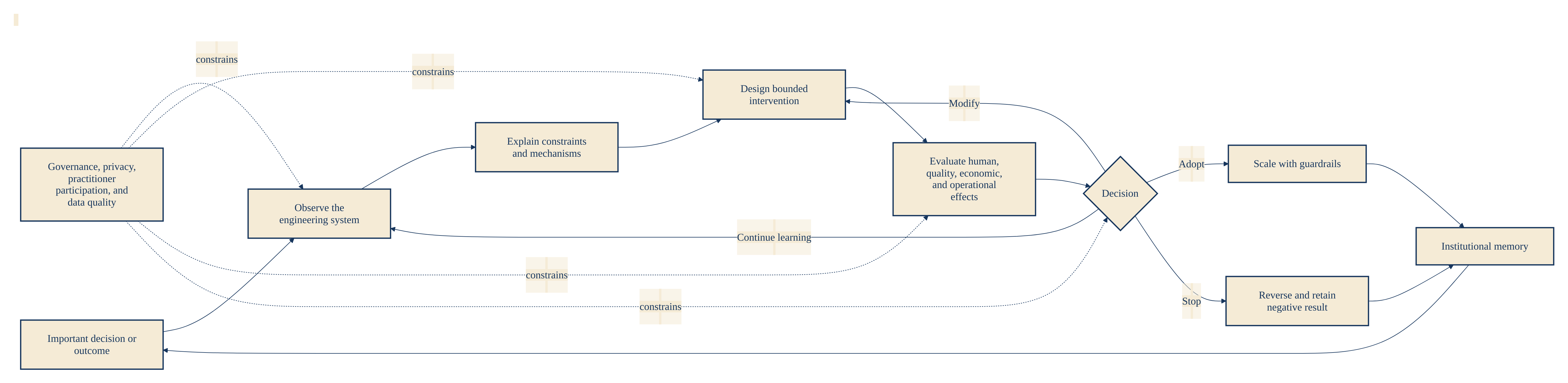
Seven activities, repeated:
identify a consequential decision
describe the current system
form a theory of what limits performance
design a bounded intervention
observe operational, human, quality, and economic effects
decide: adopt, modify, or stop
preserve the result as institutional knowledge
Observation, explanation, intervention
Observation — trustworthy evidence, with visible coverage and uncertainty
Explanation — a mechanism, not just a pattern; combines telemetry with local expertise
Intervention — bounded, reversible, observable, ethically acceptable, economically plausible, mechanism-linked
A metric identifies a pattern. Explanation identifies a mechanism.
Evaluation is more than the primary metric
An intervention that improves the median while concentrating risk in a few teams is not an unqualified success.
Evaluation examines:
intended outcome and guardrails
human effort and attention
distribution across teams and work types
direct and indirect cost
adoption fidelity
short-term and delayed effects
behavioral adaptation and alternative explanations
Decisions and institutional memory
Every evaluation ends in a decision: adopt, adopt narrowly, keep gathering, modify, replace, stop, or preserve without action.
A decision record states:
evidence and assumptions
uncertainty
affected population
expected value and guardrails
owner and review date
Memory is searchable by construct, system, intervention, outcome, decision — not by presentation filename.
The five capabilities
Evidence | collect, link, govern, interpret trustworthy engineering data |
Experimental | test workflow, tool, architecture, and policy interventions credibly |
Decision | translate evidence into explicit choices under uncertainty |
Adaptation | change tools, processes, architecture, allocation from results |
Memory | preserve and retrieve what the organization has learned |
Weakness in any one capability breaks the loop.
Central foundations, local ownership
Learning happens close to the work — but cannot depend on isolated local systems.
Central foundations | Domain teams |
canonical event contracts | workflow semantics |
identity & temporal ownership | local hypotheses |
Engineering Change reconstruction | intervention ownership |
governed metric definitions | interpretation |
experiment & exposure services | validation of reconstructed evidence |
privacy, lineage, evidence registry | adoption and follow-through |
A federated model avoids centralized misinterpretation and duplicated local infrastructure.
Leadership behavior
Leadership determines whether Engineering Intelligence becomes a learning system or a surveillance system.
Leaders should ask:
What decision will this metric improve?
What mechanism do we believe is operating?
What evidence could change our minds?
Who bears the cost or risk of this intervention?
Has the result replicated? When will we review or retire it?
They should not ask which engineer produced the most visible artifacts.
Practitioners are co-designers, not subjects
Practitioners understand what telemetry cannot see:
hidden manual work and workflow exceptions
why apparently idle time exists
where automation creates validation burden
which approvals are substantive or ceremonial
how architecture constrains change
which metrics will be gamed
Participation improves construct validity, intervention design, trust, and adoption.
Learning from incidents and from success
Incidents expose interactions among code, architecture, process, ownership, and attention — the richest learning surface an organization has.
Successful high-risk changes reveal effective review patterns, decomposition strategies, ownership models, and resilient deployment mechanisms.
Studying success distinguishes robust capability from mere absence of observed failure.
AI as participant and subject
AI systems both perform engineering work and are subjects of evaluation.
Measure them for:
task success and error severity
validation burden and ranking quality
latency, cost, calibration
change in human behavior and long-term skill effects
security and governance risk
Don’t ask whether engineers use AI. Ask how AI changes the production function of engineering — and under which conditions that change creates durable value.
Capability preservation
Automation can improve output while quietly weakening latent capability.
Can the organization still:
diagnose failures without a vendor?
review critical changes deeply?
understand generated code?
operate during model or tool outages?
maintain architecture knowledge?
train less-experienced engineers?
challenge automated recommendations?
Resilience requires preserving critical human capability even when routine work is automated.
Incentives, truth, and economic discipline
Metrics that affect status, funding, or headcount get optimized — sometimes at the expense of the evidence needed to learn.
Protect truth by:
limiting high-stakes use of weak proxies
separating exploration from formal accountability
publishing definitions and limitations
auditing for gaming and displacement
retiring metrics that distort behavior
And apply economic reasoning: not every significant improvement is worth implementing.
Signs of maturity vs. failure
Mature | Failing |
metrics have owners, versions, quality indicators | dashboards multiply; decisions unchanged |
leaders ask for causal evidence | successful pilots scaled without replication |
experiments include exposure and decision rules | negative studies disappear |
practitioners correct reconstructed evidence | teams cannot explain metric calculations |
AI evaluated on net value and validation burden | AI measured only through usage |
negative results retained | metrics used beyond their validity |
metrics retired when meaning degrades | no intervention is ever stopped |
The durable advantage
Tools can be purchased. Models can be copied. Dashboards can be reproduced. Practices diffuse quickly.
A more durable advantage is the ability to learn faster and more honestly than comparable organizations.
That advantage combines high-quality evidence, explicit theory, disciplined experimentation, economic judgment, practitioner knowledge, architectural understanding, trustworthy governance, and institutional memory.
Engineering Intelligence is the system that connects them.
Key takeaways
The purpose of Engineering Intelligence is organizational learning, not measurement for its own sake
Learning requires a closed loop: observation → explanation → intervention → evaluation → decision → memory
Central evidence foundations and local domain ownership must operate together
AI, architecture, process, and policy are all testable interventions
Leadership behavior determines whether evidence supports learning or surveillance
Negative findings, correction mechanisms, and metric retirement protect integrity
Learning velocity depends on decision consequence and retained knowledge — not experiment count
Next
Chapter 18 — Closing
The book in one line · what to do on Monday · the ninety-day path from first decision to first learning.