The Future of Engineering Intelligence
Christopher J. Collins
Chapter 18 — The Future of Engineering Intelligence
From measuring human activity to governing a human-machine production system.
Christopher J. Collins · Chapter Overview
A changing production system
Software engineering is moving from predominantly human-authored work to a mixed production system.
A single Engineering Change may involve:
a product manager expressing outcome in natural language
an agent decomposing the work
specialised agents editing code, tests, infra, docs
automated reviewers and policy systems
humans validating architecture, intent, and risk
autonomous deployment and recovery
The boundaries between plan, build, review, deploy, and operate blur.
Intent becomes a first-class artifact
Traditional instrumentation begins after intent has already been compressed into a ticket, branch, or commit.
As natural-language interfaces spread, the original intent must be preserved:
desired business or user outcome
constraints and acceptance criteria
risk tolerance and affected populations
architectural boundaries and prohibited approaches
expected value and uncertainty
The question becomes: did the delivered system solve the intended problem? — not merely were the requested artifacts produced?
From Engineering Change to change lineage
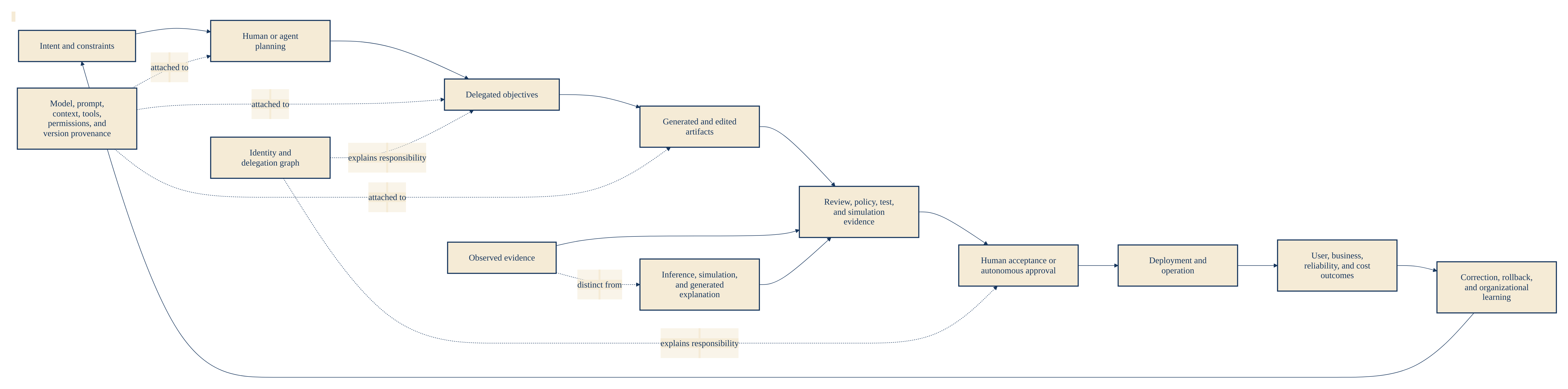
Lineage connects intent, plans, generated artifacts, prompts, models, reviews, tests, deployments, production behaviour, and outcomes — supporting explanation, audit, learning, and rollback.
AI agents as economic actors
Agents are not free automation. They consume:
inference capacity and tool calls
repository and environment access
human validation and test infrastructure
deployment capacity and organizational risk budget
The question is not how much code an agent generated. It is whether the agent changed the cost, speed, quality, risk, and capability profile of producing a useful outcome.
Identity, delegation, and accountability
Autonomous agents need durable identity and delegation graphs.
Identity | model + version, config, policy, tools, initiating human, delegated objective |
Delegation | who initiated, who decomposed, what authority passed, where humans approved |
Accountability | enough provenance to understand and govern machine participation |
Not moral equivalence — traceable participation.
Activity inflation vs. validation scarcity
As generation gets cheap, artifact volume gets less meaningful.
Expect abundant: commits, branches, PRs, comments, tests, docs, experiments, fixes.
Scarce and precious: domain judgment, architecture understanding, security expertise, production context, ethical reasoning, accountability.
The central optimization problem shifts from increasing output to allocating validation attention.
Review becomes orchestration
Review evolves from reading a diff to orchestrating evidence.
The reviewer weighs:
intent and constraints
generated plans and semantic change summaries
dependency impact and simulations
adversarial findings and policy checks
production analogues and uncertainty estimates
agent disagreement
Engineering Intelligence must measure whether this evidence improves decisions or overwhelms reviewers.
Model monoculture and continuous evaluation
Dependence on one model family creates correlated failure across design, review, and operations.
Engineering Intelligence should track:
model concentration and vendor lock-in
failure correlation across workflows
critical workflows lacking independent validation
Evaluation must be continuous, contextual, and run in shadow mode before affecting critical decisions.
Human control is not binary
Control is a spectrum, not a switch.
Prior policy | permission boundaries, prohibited actions |
Real-time | approval gates, exception review |
Retrospective | audit, kill switches |
Bounded autonomy | reversible closed-loop actions under evaluated policy |
Outcome supervision | escalate anomalies to humans |
Automation levels should match evidence strength, reversibility, and consequence.
Governance, privacy, and the evidence system
Richer lineage creates greater risk. Design accordingly:
Governance at machine speed — executable policy, configuration lineage, model registries, dynamic risk classification
Privacy under richer instrumentation — purpose limitation, data minimization, separate learning from employment decisions
Security of the evidence system — the platform itself is a high-value target
Adversarial behavior — telemetry poisoning, misleading activity, corrupted risk scores
Synthetic evidence risk
As generated text, code, tests, and reports become common, preserve the boundary between observation and interpretation.
An AI-generated incident summary is not the incident record.
A generated test is not evidence that the requirement is correct.
A model’s confidence is not empirical uncertainty.
Lineage must distinguish observed events, human assertions, model inferences, generated explanations, simulated outcomes, and verified outcomes.
A staged future architecture
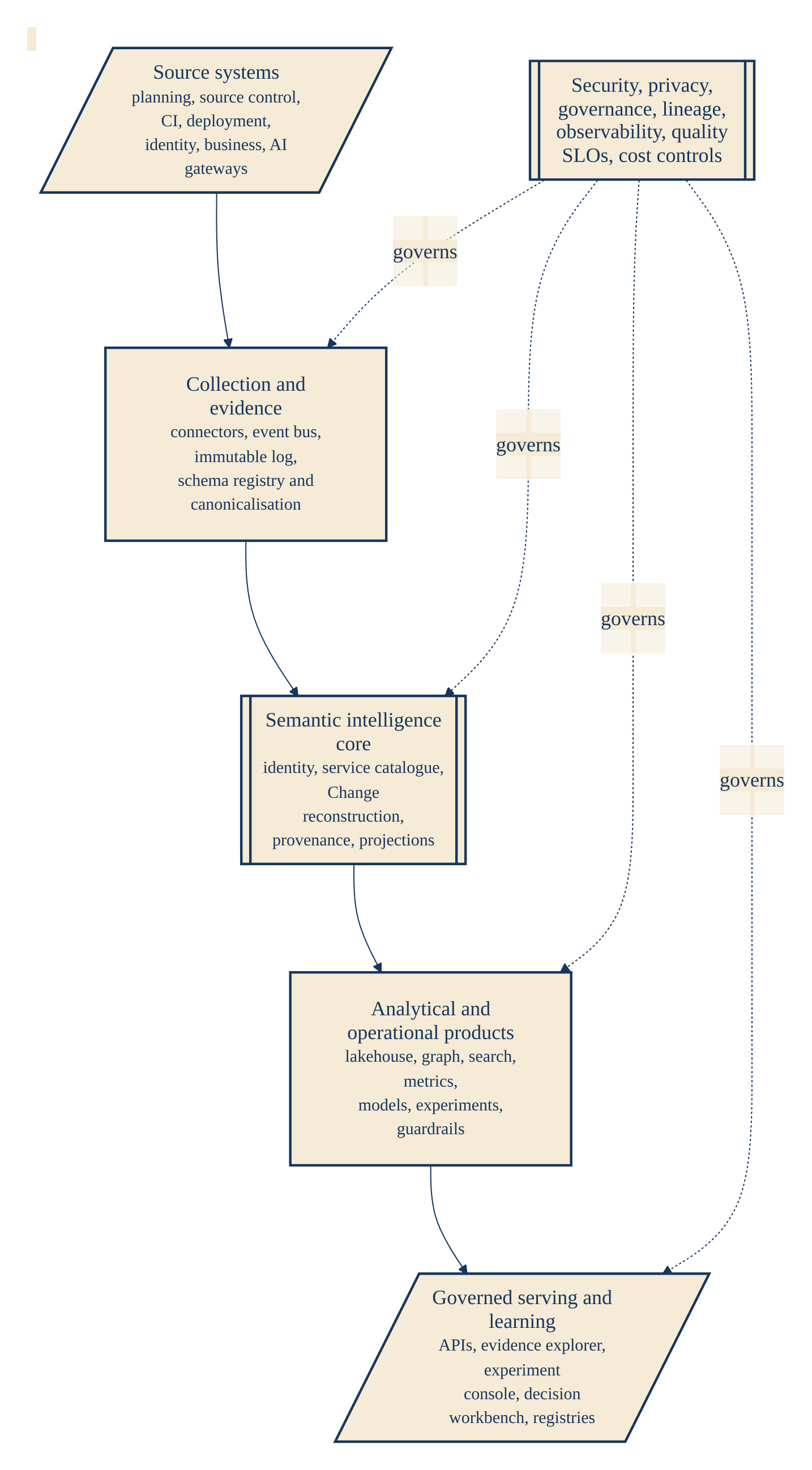
Stage 1 | Observable workflows |
Stage 2 | Reconstructed Engineering Changes |
Stage 3 | Experimental organization |
Stage 4 | Human-machine production system |
Stage 5 | Prescriptive intelligence |
Stage 6 | Bounded autonomous optimization |
Do not skip foundational stages just because advanced models are available.
Failure futures to avoid
Several undesirable futures are plausible:
The surveillance enterprise — ranking individuals through weak proxies
The automation illusion — generated activity soars while defects and queues grow
The model monoculture — one vendor’s assumptions embedded everywhere
The unaccountable agent mesh — delegation without provenance
The synthetic management system — polished narratives disconnected from evidence
The permanently experimental organization — endless pilots, no decisions
Engineering Intelligence should be designed explicitly to avoid these.
A desirable future
Not one in which humans disappear — one in which:
routine implementation becomes cheaper
intent is clearer and validation better targeted
architecture decisions are evidence-informed
AI failures are detectable and reversible
engineers spend more time on consequential judgment
experimentation replaces unsupported opinion
organizational learning compounds over time
Engineering Intelligence is not a control tower watching engineers. It is a shared nervous system helping the organization understand and improve how change is produced.
Key takeaways
Software engineering is becoming a mixed human-machine production system
Intent, agent identity, delegation, model provenance, and validation burden are essential evidence
Artifact volume becomes less meaningful; attention and validation remain scarce
AI must be evaluated economically, causally, longitudinally, and at the system level
Support bounded autonomy while preserving provenance, reversibility, and human challenge
Vendor-neutral evidence and open standards are strategically important
The desirable future is a learning system, not a surveillance system
The book, in one line
Software engineering can be understood and improved when organizations connect intent, change, attention, architecture, evidence, economics, and outcomes — without reducing human contribution to visible activity.
Thank you.
Christopher J. Collins · Engineering Intelligence