build: 2026-10-19 20:32 UTC

Classifying an Engineering Intelligence Use


Classifying an Engineering Intelligence Use

A hands-on workshop derived from Chapter 13 and Appendix D of Engineering Intelligence.

90 minutes · 4 hands-on segments · real proposed uses from your org

Learning outcomes

After this workshop you can:

  • Classify a proposed use of engineering telemetry by consequence class 0–4

  • Identify the individual-ranking uses that should not be built at all

  • Write an acceptable-use record — purpose, populations, retention, minimisation, deletion, review date

  • Run a use review — including the moment where a Class 1 use quietly becomes Class 3

The problem

An analyst on your platform team says:

"We could correlate keystroke pauses with promotion outcomes. It’d be a great signal for coaching."

Sounds like coaching. Sounds like curiosity.

It is a Class 4 individual-consequence use running on prohibited telemetry, dressed as an exploratory study.

Why this workshop, and not a policy PDF

Misclassification is more dangerous than a wrong statistical test.

A wrong test produces a wrong number. Someone can find it later.

A wrong classification puts a Class 3 or Class 4 use into a Class 1 review body — where nobody who is qualified to stop it ever sees it. The number that comes out is unchallenged by design.

The five consequence classes

Class 0

Platform operations — connector health, event freshness, schema failures

Class 1

Descriptive team learning — queue analysis, retrospectives, CI bottlenecks

Class 2

Organisational decision support — tool procurement, portfolio, staffing

Class 3

Policy influence — review rules, gates, routing, org-wide defaults

Class 4

Individual or employment consequence — evaluation, promotion, discipline

Each class implies a different review body, evidence bar, access scope, and re-examination cadence.

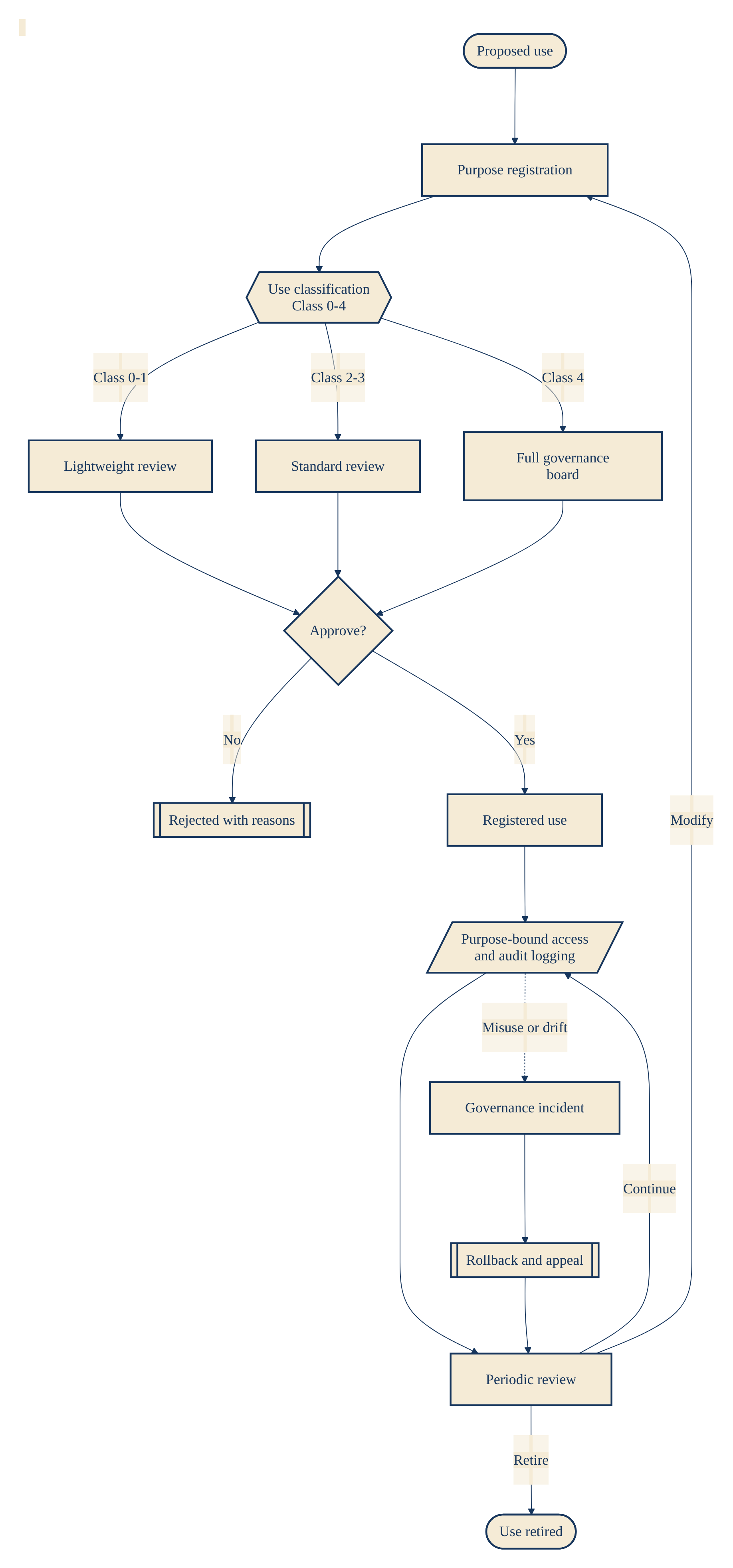
The review loop

Acceptable-use review loop

Proposal → classification → review body → approval → implementation → monitoring → reassessment → retirement.

Two branches give it teeth: classification routes proposals to the right body, and monitoring feeds drift back into rollback and appeal.

Governance without both branches degrades quickly into paperwork.

The use-review lifecycle
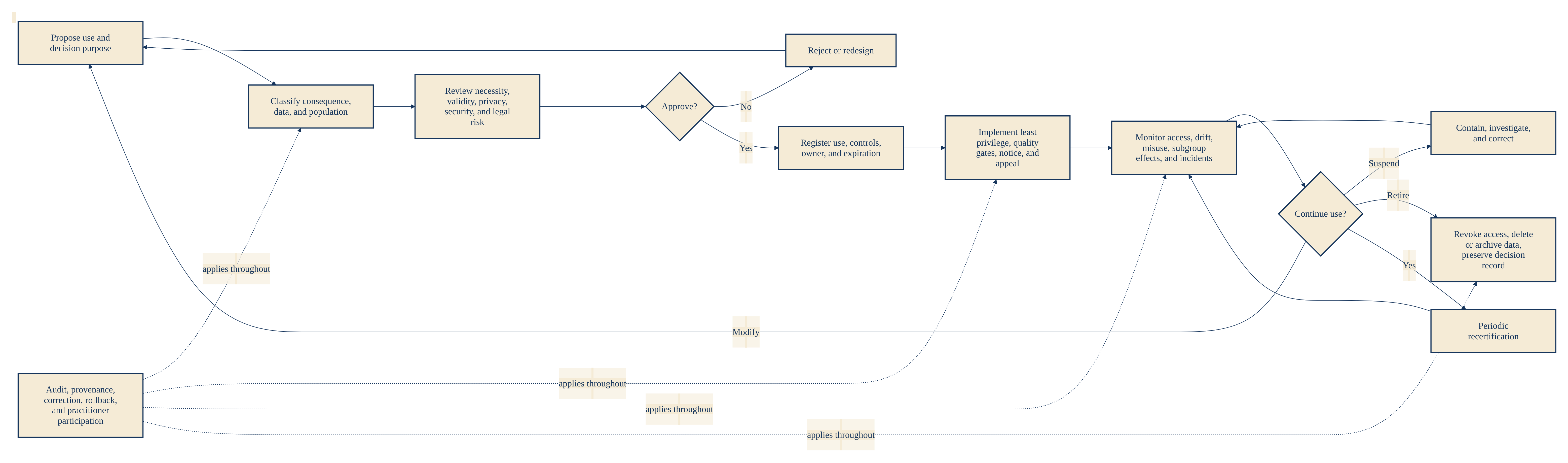
Governance and acceptable-use lifecycle

Every governed use has an owner, a purpose, an expiration date, and a way to be retired.

There is no such thing as a permanent pilot.

Prohibited by default

Regardless of class, these are off the table without an exceptional legal and ethical basis:

  • ranking individuals by commits, PRs, review speed, or AI acceptance

  • keystroke, screen, or message-content collection for productivity scoring

  • automated employment decisions from engineering telemetry

  • using exploratory metrics in compensation or discipline

  • penalising people for correcting erroneous data

  • covert monitoring outside an approved purpose

"We’re just exploring" is not a purpose.

The acceptable-use record

Every non-trivial use is registered. Minimum fields:

  • use_id and human-readable name

  • owner — accountable person, not a mailing list

  • use_class — 0 to 4

  • purpose — the decision this supports

  • population — repos, teams, roles included

  • data — fields, at the field level

  • metrics — versioned metric IDs

  • decisions — what this evidence will inform

  • prohibited_extensions — the uses that are explicitly out of scope

  • review_date — expiration, not aspiration

What you’ll produce today

Each team leaves with:

  • 2–3 classified use records for real uses currently under discussion in your org

  • One item marked "do not build" — the one that a review body would decline in writing

  • A named review body for each of your live proposals

Not a workshop deck. Records you can hand to a governance board on Monday.

Segment 1 (15 min) — surface the real proposals

Each attendee writes down two uses of engineering telemetry currently under discussion on their team.

Rules:

  • Real. Not hypothetical.

  • One sentence per use: "We want to use X to decide Y."

  • Include the awkward ones. Especially the awkward ones.

Report back: each person reads one aloud. No debate yet.

Segment 1 — traps to notice

While people write, watch for these framings — they usually hide the class:

  • "Just for coaching" — often Class 4

  • "Just a dashboard" — Class 3 if a leader will act on it

  • "Just exploratory" — Class 2 or 3 the moment it drives a budget

  • "Just aggregate" — check the group size, and the joins

The word just is a classification smell.

Segment 2 (20 min) — classify each

For every proposal on the wall, decide:

  1. Which class — 0, 1, 2, 3, or 4?

  2. Which review body must see it before it ships?

  3. Which prohibited extensions must be written down explicitly?

Use the class table. Argue.

If the group disagrees between two adjacent classes, register the higher one. The cost of over-classification is a slower approval. The cost of under-classification is a decision that shouldn’t have happened.

Segment 2 — the review body map

Class 0

Platform operations owner

Class 1

Team lead + metric owner

Class 2

Metric council + data governance

Class 3

Governance board + practitioner representative + legal/privacy

Class 4

Presumed prohibited; if pursued, formal HR / legal / works-council process, separate from EI

The review body is named on the record. "Someone senior" is not a review body.

Segment 3 (25 min) — write the record

For every Class 2+ proposal, write an acceptable-use record. Minimum:

  • purpose — the decision, not the topic

  • population — who is in, who is out, who might be re-identifiable

  • data — field list; run the minimisation review on each field

  • retention — how long, and why that long

  • deletion — the workflow, including derived artefacts

  • review_date — when this record expires

One record per proposal. On paper if needed. Owner signs it.

Segment 3 — the minimisation questions

For each field on the record, ask:

  • Is it necessary for the approved purpose?

  • Can a less detailed feature replace it?

  • Can it be aggregated earlier?

  • Can identity be pseudonymised?

  • Can content be replaced by metadata?

  • Can the retention period be shorter?

Fields with no defensible answer come off the record.

"We might want it later" is not a defensible answer.

Segment 4 (15 min) — red-team a promotion

Pair up. Take a partner’s Class 1 use — a descriptive team retro, say.

Your job: promote it to Class 3 by adding one more join at a time.

Try:

  • join identity

  • join timesheets

  • join calendar

  • join performance-review cycle dates

At each step, ask: has the class changed? When exactly did it flip?

Segment 4 — where it flips

Common flip points:

  • A Class 1 team-queue view + identity join = named individual scorecard = Class 4

  • A Class 1 retro + calendar join = inferred availability / cognitive load = Class 2 at best, often Class 3

  • A Class 2 tool evaluation + timesheet join = per-engineer productivity = Class 4

  • Any Class 1 view repeatedly filtered until n=1 = de facto individual view

Report back: the join that produced the biggest jump, and which review body should have seen the promoted use.

The worked example — say no in writing

A VP asks for "the top 20 lowest-performing engineers" by review-latency contribution.

  • Review-latency is registered as Class 2

  • Individual ranking would be Class 4 — prohibited

  • Metric owner declines in writing, citing the registered purpose

  • Request is logged as a governance incident

  • The purpose-bound metric API had already blocked the query at the interface

Board reaffirms the boundary and updates leadership onboarding. No sanction — the point of the process is to make boundaries visible, not to punish the first person who bumps into one.

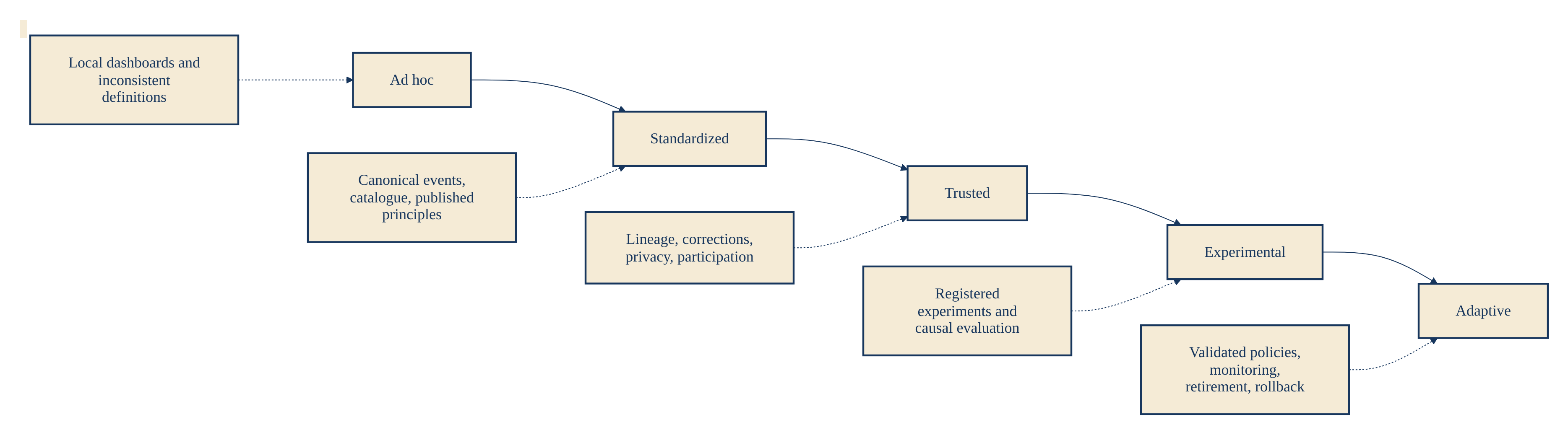
Governance maturity

Engineering Intelligence governance maturity

Level 0 — implicit. Level 1 — documented. Level 2 — operational. Level 3 — auditable. Level 4 — adaptive. Level 5 — trustworthy autonomy.

Most organisations should aim honestly at Level 2 or 3 before they instrument broadly.

Don’ts, worth memorising

  • Don’t classify a use by who is asking for it. Classify by what it can decide.

  • Don’t accept "just exploratory" as a class.

  • Don’t approve a Class 2+ use without an expiration date.

  • Don’t let a Class 1 view be joined into individual identity without re-review.

  • Don’t rely on aggregation for anonymity when the group size can be filtered down.

  • Don’t treat a metric’s approved purpose as inherited by any new use.

What you go home with

  • 2–3 signed acceptable-use records for real proposals

  • One "do not build" item — declined in writing, with the reason

  • A named review body per record

  • A review date on every record — typically 90 to 180 days

  • A prohibited-extensions list per use — the sentences that say what this record is not authorising

Take them to your governance board. If you don’t have one, the "do not build" item is the reason to convene one.

Wrap-up

  • Classification is the load-bearing control. Get it wrong and every downstream safeguard misses.

  • The review body is part of the classification, not a downstream detail.

  • Class 1 uses become Class 3 or Class 4 with one join. Watch the joins.

  • Records expire. Uses are retired. There are no permanent pilots.

  • "Do not build" is a legitimate — often the correct — governance output.

Read: Chapter 13 and Appendix D of Engineering Intelligence.

Reconvene: 90 days. Bring the records. Bring the "do not build" you were asked to reconsider — and the reasons you held the line.

Thank you

Classification is the moment governance is real, or theatre.

Choose real.