Engineering Intelligence Maturity Assessment
Workshop — 2 hours
Engineering Intelligence Maturity Assessment
A self-assessment workshop derived from Appendix J of Engineering Intelligence.
2 hours · self-scoring · roadmap outputs
Purpose
By the end of this workshop your team will:
Have scored your organisation across the eight EI dimensions
Know which capability closes the biggest decision-risk gap
Have a next-quarter investment plan grounded in the maturity ratchet — not in tool fashion
What we mean by maturity
Not: how many dashboards you have.
Yes: what class of decision your evidence system can defensibly support.
Every level closes a specific gap. You cannot skip levels; each is a prerequisite for the practices at the next.
The six levels
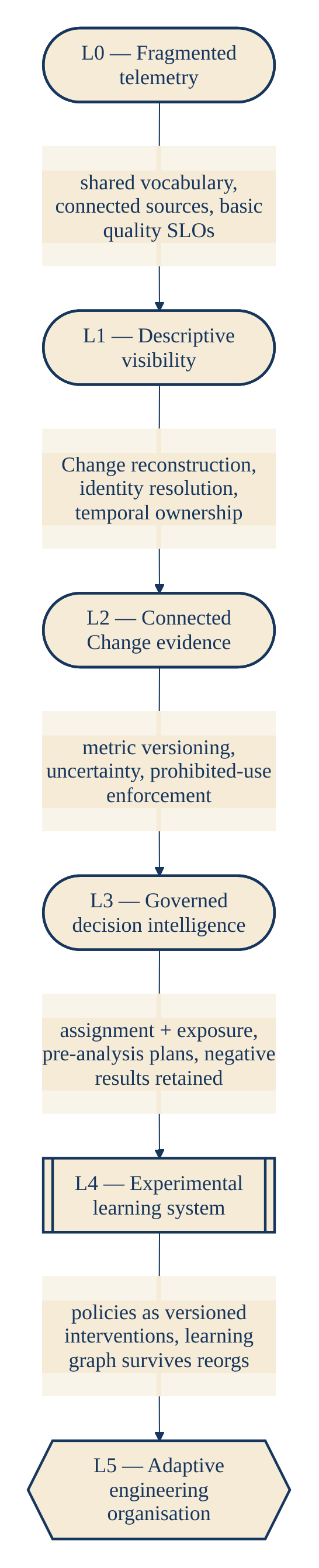
L0 → L5, each ratchet adds specific capability.
Level 0 — Fragmented telemetry
"Teams answer the same question three different ways."
Metrics defined locally
Cross-system linkage missing
Activity counts dominate
Data quality mostly implicit
Cost: every strategic conversation starts with definition arguments.
Level 1 — Descriptive visibility
"A leader can open a dashboard without arguing about definitions."
Major sources ingested
Standardised team and repo metrics
Basic lineage and quality monitoring
Missing: mechanism. You can see patterns, not explain them.
Level 2 — Connected Engineering Change evidence
"End-to-end questions become answerable for the first time."
Reconstruction of intent → outcome
Confidence bands on joins
Analysts stop reasoning about pull requests, start reasoning about Changes
Cost of missing this level: multi-repo coordination is a rumour, not a measure.
Level 3 — Governed decision intelligence
"A metric change is a release, not a query edit."
Metrics have semantic versions
Consequential measures carry uncertainty
Decision records reference metric versions
Prohibited uses are enforceable
Cost of missing this: a metric shift and a real change are indistinguishable.
Level 4 — Experimental learning system
"'We rolled it out and things got better' is no longer evidence."
Assignment + exposure instrumentation
Guardrails and stop rules
Pre-analysis plans and reproducibility packages
Negative results shipped
Cost of missing this: your AI evaluations rest on before-after averages.
Level 5 — Adaptive engineering organisation
"The operating model itself is a subject of measurement."
Policies as versioned interventions
Learning graph survives reorganisations
Bounded automated policy with audit + appeal
AI agents with identity, authority, provenance
Rare. Not many organisations. That’s OK — L3 is the pragmatic target.
The eight assessment dimensions
Score each on 0–5 separately:
Decision orientation
Source evidence and contracts
Engineering Change semantics
Identity, ownership, organisational context
Metrics and governance
Experimentation
Economics
AI participation
A single averaged score hides critical weaknesses.
Segment 1 (30 min) — self-score
Individually score your organisation across the eight dimensions.
One rule: score demonstrated operating capability, not documented policies or purchased tools.
If you can’t cite a decision that was made or reversed because of the evidence, that dimension is not at L3.
Segment 2 (25 min) — reconcile
Compare scores across the group.
You will disagree. That’s the useful part.
The disagreements are usually about interpretation of "demonstrated." Push each other to name the decision.
Segment 3 (25 min) — identify the binding constraint
For each dimension where you scored 0-2, ask:
Which decision class becomes unreachable at this level?
What is the smallest capability that would unlock the next level?
Not: what tool to buy. Yes: what would allow us to answer one specific question we cannot answer today.
Segment 4 (20 min) — pick one
You get one investment for next quarter.
Choose the dimension where:
The next-level unlock has the largest decision consequence
The path to that unlock is bounded and known
Use the pilot-selection rubric: sponsored, consequential, evidence-reachable.
Reference: companion/notebooks/20-pilot-selection.py.
Anti-patterns to name and avoid
Maturity theatre — scoring high without operating evidence
Average-score optimism — hiding an L1 dimension inside an L3 average
Tool-based maturity — believing a purchase implies capability
Roadmap by connector — sequencing by data availability, not decision value
Enterprise-wide first step — trying to boil the ocean instead of proving one loop
Ninety-day plan template
Week 1-2: Register the decision question. Name the sponsor.
Week 3-6: Build minimum evidence path (source + reconstruction if needed)
Week 7-10: Governed metric v1.0 with uncertainty and guardrails
Week 11-12: Register the use, produce the decision record
What ships: one Class-2 decision supported by governed evidence. Not a platform.
What you go home with
Signed self-assessment scorecard (per dimension)
One next-quarter investment written as a bounded pilot proposal
A
nolist — dimensions you deliberately are not investing in yetA review date (typically 90 days out) to reconvene
Reading and running
Read: Appendix J of Engineering Intelligence
Read: Chapter 15, Implementation and Rollout
Run:
companion/notebooks/20-pilot-selection.pyRun:
companion/notebooks/19-portfolio-allocation.pywhen you’re negotiating capacity
Thank you
Reconvene in 90 days.
Bring the decision you made. Bring the decision you almost made and reversed. Those are what a maturity system is for.