Building a Portfolio Bundle
Workshop — 90 minutes
Building a Portfolio Bundle
A hands-on workshop derived from Chapter 14 of Engineering Intelligence.
90 minutes · 4 hands-on segments
Learning outcomes
After this workshop you can:
Model a set of competing initiatives as portfolio candidates
Represent capacity as multidimensional — not one interchangeable pool
Surface mandatory work as a constraint, not a rank entry
Produce a portfolio bundle — not a single score — that legitimately supports an executive decision
The problem
A leadership team ranks eight initiatives by ROI score. They pick the top three. Green-light meeting adjourns in forty minutes.
Underneath: two of the top three compete for the same six database specialists. A regulatory floor eats a quarter of general capacity that nobody subtracted. The fourth-ranked item is the one that unblocks the second.
The ranking is coherent as arithmetic. It is incoherent as a plan.
What we are producing today
Each team leaves with a portfolio bundle for 3–5 real initiatives — the ones actually competing on your roadmap right now.
The bundle contains:
value estimate with a range
general vs. specialist capacity demand
dependency edges to other initiatives
mandatory constraints and floors
cost of delay
a decision record — including what is not chosen and why
The portfolio value model
For initiative \(e\):
Selection under multiple constraints:
One constraint per scarce resource \(k\). Not one budget line — several.
Capacity is multidimensional
Headcount is not one interchangeable pool.
general implementation effort
specialist domain expertise
review and approval bandwidth
platform and infrastructure capacity
deployment windows, test environments
leadership attention
change absorption in customers and operations
A plan fully funded in nominal engineer-months can still be infeasible because one scarce pool is overcommitted.
Mandatory work is a floor
Regulatory commitments, security remediation, contractual obligations, safety controls, end-of-life migrations, incident recovery.
These are constraints. They are not competitors in a ranking.
Assigning them an artificial financial "benefit" so they win an ROI comparison is the most common way a portfolio ranking becomes incoherent.
Cost of delay
Different work has different delay-cost shapes.
Regulatory: flat, then a cliff.
Seasonal launch: steep before the season, negligible after.
Incident remediation: high and immediate.
Internal refactor: mostly linear, often small.
A useful heuristic:
Heuristic. Not a ranking rule. Adjust for dependencies and scarcity.
Segment 1 (15 min) — list your candidates
On a shared surface, list 3–5 initiatives currently competing for capacity on your team’s roadmap this quarter.
Rules:
Real ones. Not aspirational.
Include at least one mandatory item if any exists.
Include at least one you suspect has a specialist bottleneck.
Report back: one initiative someone at the table wants funded that a naive ROI ranking would drop.
Segment 2 (25 min) — model each initiative
For each of the 3–5 candidates, capture:
| Field | Content |
|---|---|
Value | Point estimate and a credible range |
General capacity | Engineer-quarters of general effort |
Specialist capacity | Which specialty, how many quarters |
Dependencies |
|
Mandatory | Yes / no. If yes: deadline and consequence |
Cost of delay | Shape (linear, cliff, seasonal) and rate |
Report back: the specialist pool that turned out to be a hidden bottleneck.
A quick dependency graph
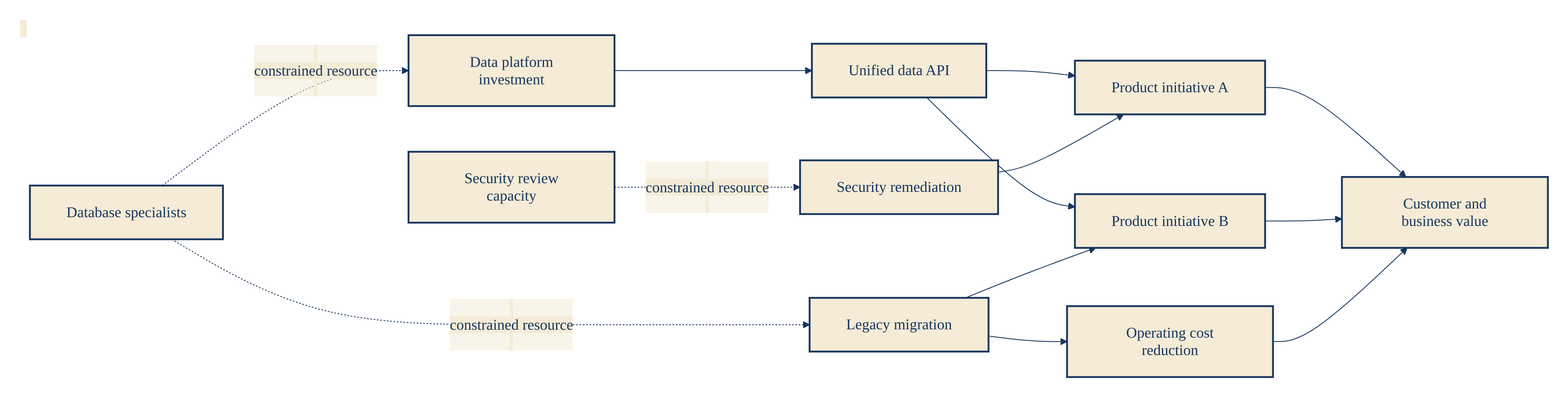
Edges: ENABLES · BLOCKS · REQUIRES · COMPETES_FOR · REDUCES_RISK_OF.
Useful measures: prerequisite depth · enabled value · shared bottlenecks · critical portfolio path.
The bundle, not the ranking
A bundle answers: "given the floors, the scarce pools, and the dependencies, what subset can we actually run?"
A ranking answers: "which item has the highest score?"
Bundles compose. Rankings only sort.
Opportunity cost belongs in the bundle
The cost of choosing an initiative includes the value of the best alternative displaced by the same constraint.
If bundling A consumes the only database specialists, the cost of A includes B’s foregone benefit — because B needed the same six people.
A portfolio bundle makes this legible. A ranked list hides it inside the score.
Segment 3 (25 min) — assemble the bundle
Now build a bundle from your modelled candidates.
Lock the mandatory floor first. Subtract its capacity from every pool.
Budget specialist capacity next. It usually binds before general capacity does.
Respect
REQUIRESedges. An initiative whose prerequisite is not in the bundle is not in the bundle either.For each candidate not chosen, write the opportunity cost — the specific pool or edge that displaced it.
Report back: the specialist pool that decided the bundle for you, and the initiative it displaced.
The worked example, condensed
42 general + 6 specialist engineer-quarters.
A — Payments migration. $8M, 24 general + 3 specialist, $180k/mo delay.
B — Platform upgrade. $4M, 30 general + 0 specialist, $60k/mo delay.
C — Regulatory program. Mandatory. 18 general + 5 specialist. Missing date = $12M penalty.
ROI ranks A first. But C is a floor — it takes 18 + 5 before any ranking starts.
Remaining: 24 general + 1 specialist. A wants 3 specialist. B wants 30 general. Neither fits as posed.
The bundle is: fund C · negotiate specialists for A · sequence B — and name the $180k/mo delay on A as the price of C.
The decision record
For every bundle you ship, preserve:
alternatives considered — including the ranked list you rejected
value and cost distributions, not just point estimates
the constraints that bound the bundle
the initiatives displaced and the pool that displaced them
dissenting views
review date and trigger conditions
A decision record enables later learning without judging past choices solely by realized outcome.
Segment 4 (15 min) — red-team the bundle
A peer team argues: "just compress everything to one ROI number. Executives don’t have time for a bundle."
Your job: show them where the wrong decision hides inside their single score.
Prompts:
Which mandatory item disappears into the ranking?
Which specialist bottleneck the single score does not represent?
Which dependency the ranking cannot express?
Which not-chosen initiative’s opportunity cost is now invisible?
Report back: the one line you’d add to the exec summary that a single ROI score cannot carry.
Common failure modes
Ranking by ROI alone — mandatory, option, risk, and dependency ignored
Treating capacity as fungible — headcount hides scarce expertise
Double-counting value — savings, throughput, and delay reduction overlap
Ignoring uncertainty — point forecasts create brittle commitments
Portfolio theater — scores produced after allocation is already fixed
Punishing forecast error — teams hide uncertainty, estimate politically
Don’ts, worth memorising
Don’t rank mandatory work — floor it.
Don’t budget capacity as one pool — specialists bind first.
Don’t ship a bundle without naming the not chosen.
Don’t collapse the bundle into a single score at the exec door.
Don’t judge a past bundle by its realised outcome alone — judge it by the decision record.
What you go home with
A portfolio bundle for 3–5 real initiatives on your roadmap
An explicit list of not chosen items and the pool that displaced each
A dependency sketch that survives the meeting
A decision record template your next allocation cycle can reuse
Bring the bundle to your next portfolio review. Bring the not chosen list too.
Thank you
Reconvene at the next portfolio cycle.
Bring the bundle you shipped. Bring the not chosen list, marked with what actually happened. Those are what a portfolio system is for.