Chapter 1
Reading the body and understanding living systems
A shared language, and the habit of asking what keeps a structure alive
Human Biology for the Medical Maker
Why this chapter exists
- An educator asks for a model that shows how an elbow bends
- You build something beautiful that bends
- It is wrong twice: vocabulary and frame
- "Put the cable on the inside" meant one thing to you, another to them
- The model taught that the cord contracts
Two failures, two causes. This chapter fixes both.
Anatomy answers where; physiology answers how
Anatomy — structure
- Shapes, positions, relationships
- The contours of the elbow bones
Physiology — function
- How parts work, and how that is regulated
- Muscle generates force; tendon transmits it
A model can be anatomically plausible and physiologically misleading. Decide which you need.
Levels of organisation
- Each level has properties the level below lacks
- An organ is never one material
- The heart: muscle, connective tissue, lining, nerves, its own blood supply

What living tissue needs that a workshop material does not
- A chemical environment within limits: pH, temperature, osmolarity, ions
- A continuing blood supply for oxygen, nutrients, and waste removal
- It changes with use: adapts, is injured, repairs, ages
- Repair often produces something mechanically different
Cartilage has little blood supply and heals poorly; bone remodels continuously.
A shared coordinate system
Anatomical position, directions, planes, cavities
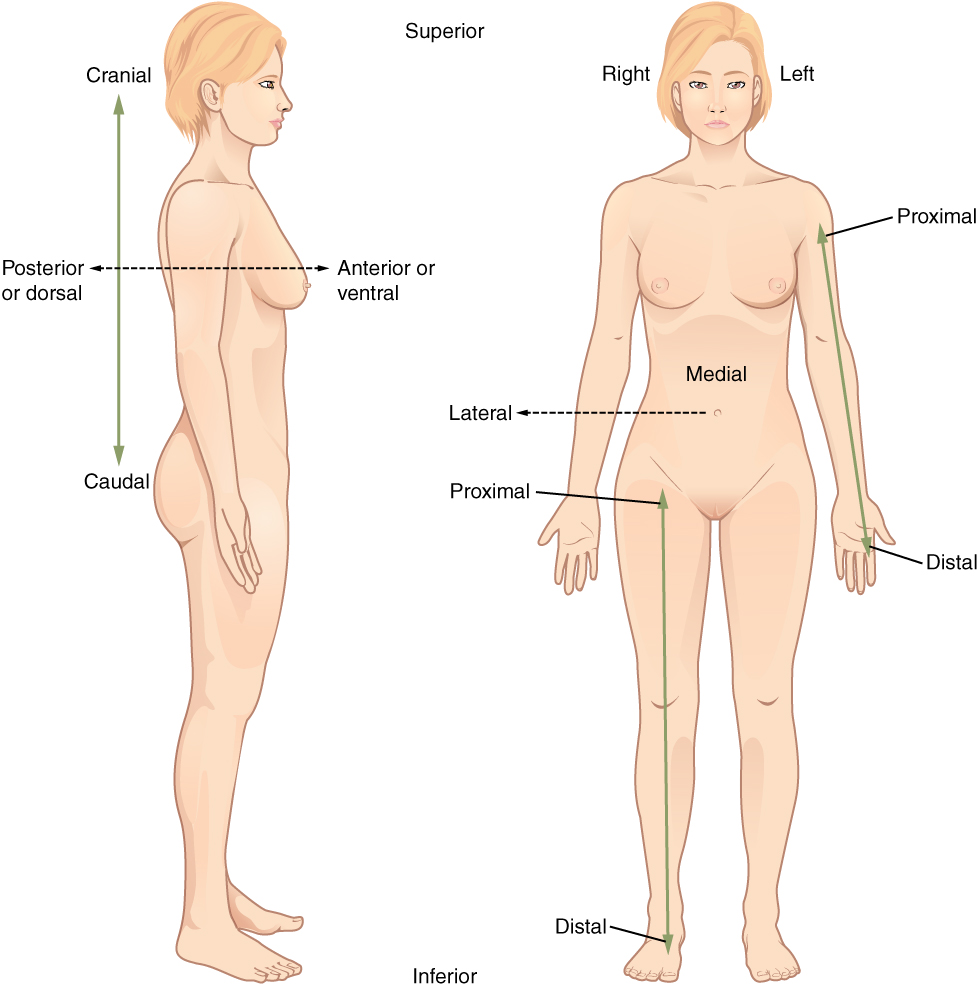
Anatomical position
- Upright, facing forward, arms at the sides
- Palms facing forward
- All descriptions refer to this pose
- Then describe the actual posture separately
The most common newcomer error
Left and right belong to the person being described — not to you, and not to the page.
A person facing you has their right on your left. A conventionally displayed radiograph does too.
Directional terms
| Pair | Meaning | Example |
|---|
| Anterior / posterior | Front / back | The kneecap is anterior to the knee joint |
| Superior / inferior | Toward head / feet | The chest is superior to the pelvis |
| Medial / lateral | Toward / away from midline | The thumb is lateral to the little finger |
| Proximal / distal | Nearer / farther from limb attachment | The elbow is proximal to the wrist |
| Superficial / deep | Nearer / farther from surface | Skin is superficial to muscle |
| Ipsilateral / contralateral | Same / opposite side | A left brain injury affects the contralateral limbs |
| Palmar / dorsal; plantar | Palm / back of hand; sole | A palmar splint sits against the palm |
| Prone / supine | Face down / face up | Positioned prone for the procedure |
The trap: proximal and distal are about the limb
- Raise a hand above the head
- The wrist is now higher than the elbow
- It is still distal to the elbow
- Distance is measured along the limb from the trunk, not by height
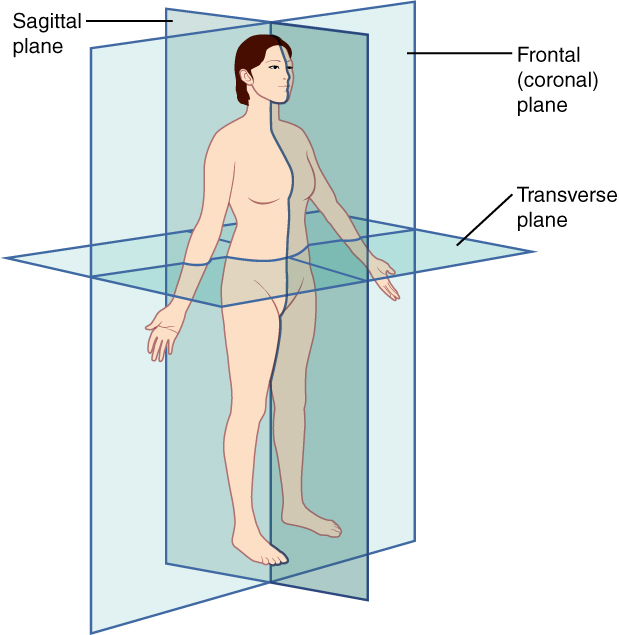
Planes and sections
- Sagittal: separates left from right; midsagittal on the midline
- Frontal or coronal: front from back
- Transverse or axial: upper from lower — the usual CT and MRI slice
- Like CAD section views — with two cautions
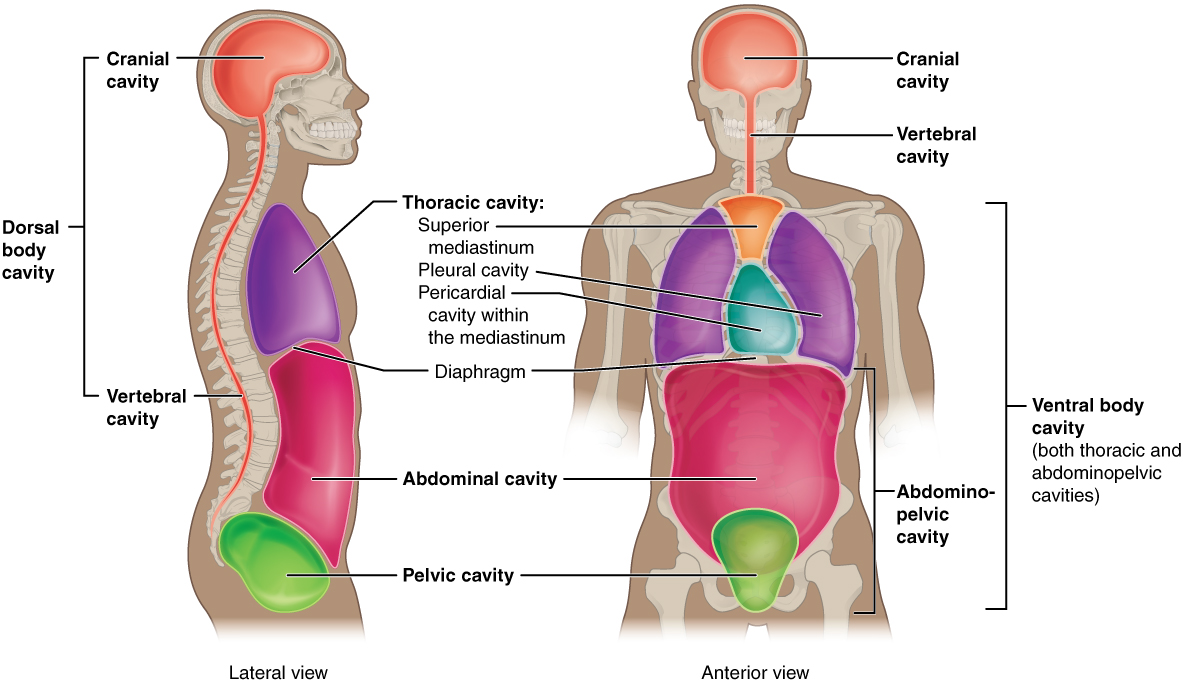
Body cavities
- Dorsal: cranial cavity and vertebral canal
- Ventral: thoracic and abdominopelvic, divided by the diaphragm
- Serous membranes let organs slide on a fluid film
- Four quadrants: "pain in the RLQ" is a location, not a diagnosis
Cells maintain an internal environment
Membranes, tonicity, and energy
How things cross a cell membrane
| Mechanism | What moves | Needs energy? |
|---|
| Simple diffusion | Oxygen, carbon dioxide, small nonpolar molecules | No |
| Osmosis | Water, toward higher effective solute concentration | No |
| Facilitated diffusion | Glucose, ions, through channels or carriers | No |
| Active transport | Ions pumped against their gradient | Yes — ATP |
| Bulk transport | Large particles and fluid volumes | Yes |
State the limit of your analogy out loud. A model that teaches a false relationship is worse than none.
Tonicity: why this is not academic
| Solution | Relative to cell interior | Effect on the cell |
|---|
| Isotonic | Same effective solute concentration | Volume stable |
| Hypotonic | More dilute | Water enters; cell swells, may burst |
| Hypertonic | More concentrated | Water leaves; cell shrinks |
"Sterile water" and "sterile saline" are not interchangeable.
Energy, and why oxygen matters
- Cells run on ATP; oxygen supports the efficient pathways
- Cut the blood supply and function changes — in minutes for some tissues
- Anything that compresses tissue may be restricting its blood supply
- "It fits nicely in CAD" says nothing about two hours against a person
Homeostasis is ongoing regulation
Many loops, finite capacity, moving set-points
Negative feedback
- Negative means opposing, not harmful
- Thermoregulation: sensors, hypothalamus, sweat and blood vessels
- A thermostat is a fair first analogy
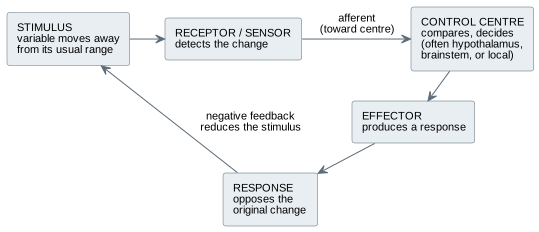
Where the thermostat analogy fails
The body
- Many interacting, competing loops
- Finite, individual capacity
- The set-point can move — fever is regulated
Positive feedback
- Runs to an endpoint, not a set-point
- Clotting, labour, the nerve impulse upstroke
- Without an endpoint it is pathological
Why "normal" is a trap
1 in 20
healthy people fall outside a typical reference range — by construction
Displaying a value is engineering. Deciding what it means for a person is a clinical act.
Engineering bridge: scale
| Structure | Typical size | Workshop comparison |
|---|
| Red blood cell | 7 to 8 micrometres | A tenth of a fine hair |
| Capillary | 5 to 10 micrometres | Red cells pass single file |
| Epidermis | 0.05 to 0.1 mm | Thinner than printer paper |
| Alveolus | 0.2 to 0.3 mm | Smaller than a 0.4 mm nozzle, end-mill radius, or stitch |
| Full skin | 1 to 4 mm | Thin plywood |
Label what your model does and does not resolve — whatever it is made from.
Engineering bridge: units
| Quantity | Clinical unit | Note |
|---|
| Blood pressure | mmHg | 1 mmHg is about 133 Pa; 120 mmHg is about 16 kPa |
| Airway pressure | cmH2O | About 98 Pa |
| Glucose | mmol/L or mg/dL | 5 mmol/L is about 90 mg/dL — a real error source |
| Biosignals | mV, microvolts | ECG about 1 mV; EEG tens of microvolts |
Carry units in the type, reject ambiguous input, show the unit beside every number.
Reading medical words
Roots
- cardi/o heart · my/o muscle · oste/o bone
- arthr/o joint · neur/o nerve · derm/o skin
- haem/o blood · nephr/o kidney · hepat/o liver
Endings and prefixes
- -itis inflammation · -ectomy removal
- -ostomy opening · -plasty repair
- hyper / hypo · brady / tachy
Build vocabulary from your project, and always verify abbreviations.
Workshop exercise and exit criteria
- Annotate a body map with directions, planes, and cavities
- Twenty vocabulary cards from a real conversation
- Describe your elbow model's parts in anatomical terms, left and right correct
- Explain negative feedback with a thermostat — and where it fails
What this chapter does not establish
- You can describe a location; you cannot interpret a clinical image
- You know what a reference range is; you cannot judge a value for a person
- You know the loops exist; you cannot assess anyone's physiology
Next — Foundations of chemistry.