Chapter 2
Foundations of chemistry
Atoms to reactions, and how chemists work
Human Biology for the Medical Maker
Why this chapter exists
- Everything you make is a chemical system — it reacts with disinfectant, sweat, saline, oxygen, heat
- Measurement in medicine is overwhelmingly chemical — most tests measure a concentration
- The workshop is a chemical environment — solvents, adhesives, fluxes, resins
Chapter three applies these ideas to the molecules of life and to your materials.
Atoms and the periodic table
Protons define the element; outer electrons decide the chemistry
Inside an atom
- Nucleus: protons (positive) and neutrons; almost all the mass
- Electrons: almost all the volume; about 1/1836 of a proton's mass
- Atomic number — the proton count — defines the element
- Chemistry is the behaviour of the outer electrons
- Atoms lose, gain, or share electrons to reach a full outer shell
Ions and isotopes
Ions — electrons gained or lost
- Cations: sodium, potassium, calcium, hydrogen
- Anions: chloride, bicarbonate, phosphate
- Their gradients run nerves and muscle
Isotopes — different neutrons
- Same chemistry, different mass
- Fluorine-18: PET tracer, half-life about 110 minutes
- Technetium-99m: nuclear medicine workhorse
The body handles a radioactive isotope just like the stable one — the whole trick of nuclear medicine.
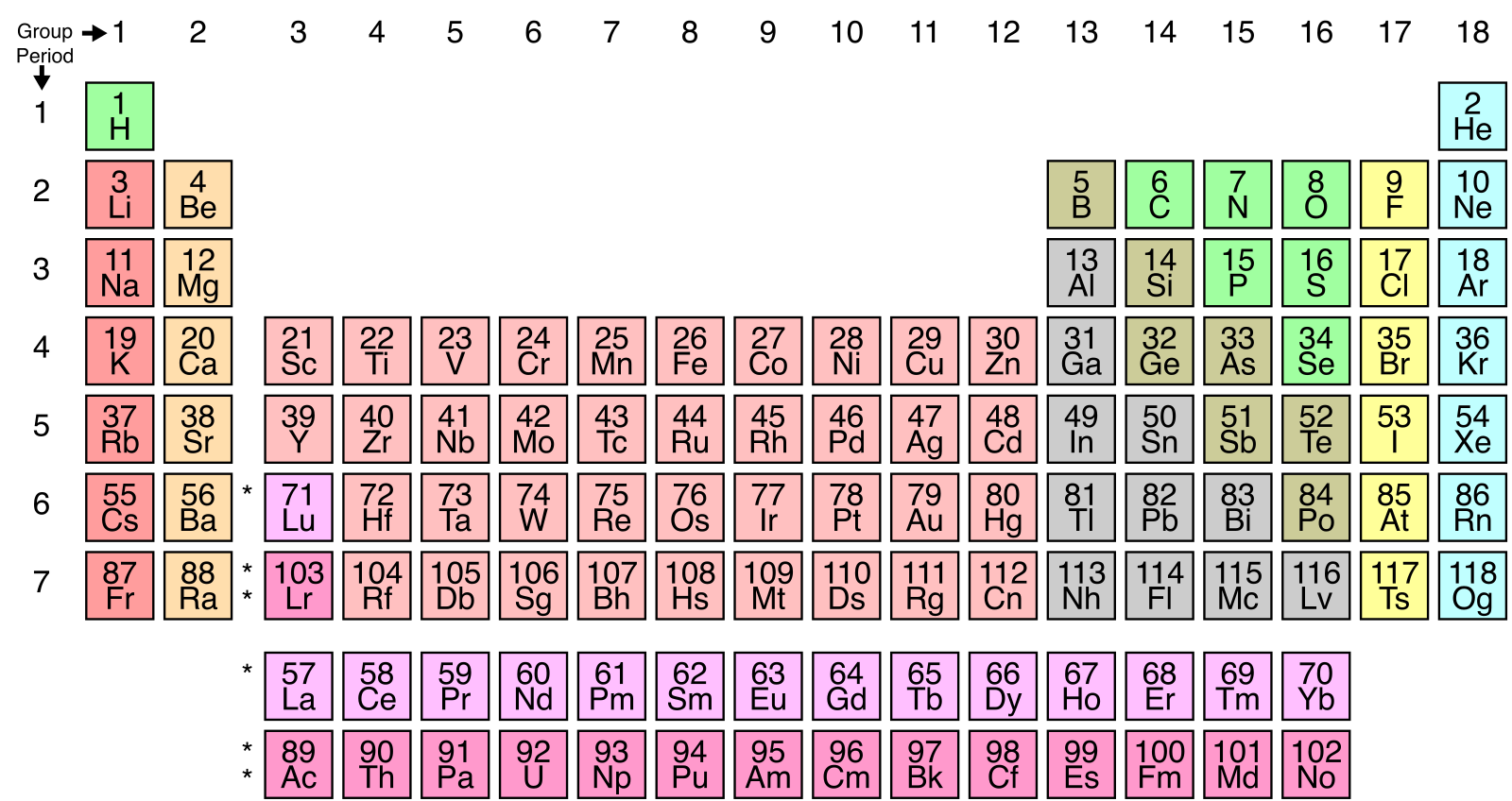
The periodic table is a map of electrons
- Rows add a shell; atoms get bigger going down
- Columns share valence electrons, so they behave alike
- Group 1 forms +1 ions; group 17 forms −1 ions; group 18 barely reacts
- Metals left and centre, non-metals right
The elements of the body, and of devices
The body
- Oxygen, carbon, hydrogen, nitrogen: about 96 percent of mass
- Calcium and phosphorus: bone, ATP, DNA
- Trace: iron, zinc, copper, iodine, selenium
Devices
- Iron, chromium, nickel, molybdenum: stainless steel
- Titanium; cobalt-chrome; silver; platinum
- Iodine, barium, gadolinium: contrast agents
- Lithium: batteries
The gas laws
- PV = nRT — temperature always in kelvin
- Boyle: expand the chest, pressure falls, air flows in
- Dalton: each gas contributes its share of the pressure
- Oxygen in dry air at sea level: about 159 mmHg; in the warm, wet trachea about 149
- Henry: dissolved gas is proportional to partial pressure
The mole: counting atoms in batches
- One mole = 6.022 × 10²³ particles
- Mass of one mole in grams = molecular mass
- Water 18 g/mol · sodium chloride 58.4 · glucose 180
- Reactions care about moles, not grams
Concentration units, and why medicine uses so many
| Unit | Meaning | Where you meet it |
|---|
| mmol/L | Moles per litre | Electrolytes; glucose outside the US |
| mg/dL | Mass per volume | Glucose and cholesterol in the US |
| % w/v | Grams per 100 mL | 0.9% saline is 9 g/L |
| % v/v | Volume per 100 mL | 70% alcohol disinfectant |
| ppm | Parts per million | Chlorine strength; about 1 mg/L |
| mOsm/kg | Dissolved particles | Tonicity; IV fluid design |
| Units | Biological activity | Insulin, heparin |
Two conversions worth doing by hand
Glucose
- 5.0 mmol/L × 180 g/mol = 900 mg/L
- = 90 mg/dL
- Factor of about 18 between the units
Normal saline
- 9 g/L ÷ 58.4 g/mol = 154 mmol/L
- Two particles each: about 308 mOsm/L
- Close to plasma — that is why 0.9%
Dilution: C1 × V1 = C2 × V2. 354 mL of 99% isopropanol makes 500 mL of 70%.
Energy in reactions
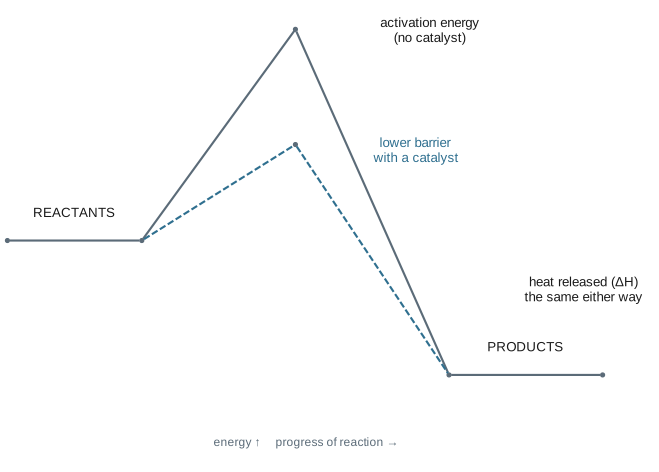
- Exothermic: releases heat — epoxy curing, respiration
- Endothermic: absorbs heat — instant cold packs
- Activation energy: the barrier to climb first
- A catalyst lowers the barrier; it changes speed, not destination
Rates and the 10 °C rule
×2
roughly, the rate of many reactions for every 10 degree rise near room temperature
First-order kinetics: a constant fraction disappears each interval — decay, drug elimination, microbial kill.
Equilibrium: the body's carbon dioxide buffer
- Forward and reverse rates equal; composition steady
- Le Chatelier: disturb it and it shifts to partly counteract
- CO₂ + H₂O ⇌ H₂CO₃ ⇌ H⁺ + HCO₃⁻
- Breathe off CO₂ → pH rises; retain it → pH falls
- Never mix cleaners: bleach plus acid releases chlorine gas
Redox and the electrochemical cell
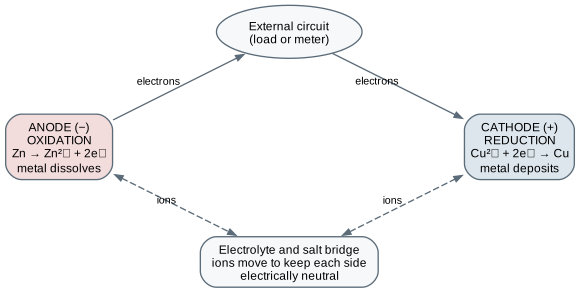
- Oxidation is loss of electrons; reduction is gain
- Anode oxidises and dissolves; cathode reduces
- Zinc against copper: about 1.1 volts
- Disinfection, corrosion, batteries, respiration
Electrochemistry in medical devices
| Device | Principle |
|---|
| Glucose meters and CGMs | Enzyme oxidises glucose; electrode measures current |
| Blood gas analysers | pH glass electrode; oxygen reduced at platinum |
| ECG electrodes | Silver and silver chloride for a stable skin interface |
| Breath alcohol testers | Fuel cell oxidises ethanol |
| Hearing aid cells | Zinc–air, about 1.4 volts |
| Implant corrosion | Unwanted galvanic cells at crevices and dissimilar metals |
Batteries and thermal runaway
- Energy is roughly voltage × capacity: 3.7 V × 2 Ah ≈ 7.4 Wh
- Lithium-ion: high energy density, needs protection circuitry
- Lithium iron phosphate: lower density, more thermally stable
- Coin cells: a serious swallowing hazard
- Thermal runaway is a positive-feedback loop
Organic chemistry in one sitting
Functional groups to recognise
- Hydroxyl: alcohols, sugars
- Carboxyl, amine: every amino acid
- Ester, amide: polyesters, nylon, proteins
- Isocyanate: a potent respiratory sensitiser
Chirality
- Mirror-image molecules, like hands
- Identical in a bottle, different in a body
- Thalidomide is the cautionary example
Chemical safety in your own workshop
| Substance | Hazard | Control |
|---|
| Acetone, isopropanol | Highly flammable vapour | Small quantities, ventilation, no ignition |
| Two-part epoxy | Skin sensitiser | Nitrile gloves, no skin contact |
| Polyurethanes | Isocyanates cause occupational asthma | Avoid spraying; extraction |
| Solder flux fume | Respiratory sensitiser | Fume extraction at the iron |
| Bleach | Corrosive; toxic gas with acids or ammonia | Never mix |
| Hydrofluoric acid | Penetrates skin; can be fatal | Do not use outside a proper lab |
An irritant hurts and stops. A sensitiser changes your immune system — often for life.
Four calculations worth owning
Cylinders and ageing
- 2 L cylinder at 200 bar ≈ 400 L of gas; about 3 hours at 2 L/min
- Accelerated ageing at 55 °C versus 25 °C: factor 8
- One year simulated in about 46 days
Faraday and batteries
- m = QM / nF
- 1 microamp of corrosion for a year ≈ 9 mg of iron
- Concentrated at a crevice, enough to perforate
The field in practice
What chemists do, and the tools they use
The branches of chemistry that touch health
| Branch | Real-world use | Typical tools |
|---|
| Analytical | What is it, and how much? | HPLC, GC, mass spec, spectroscopy |
| Clinical chemistry | Thousands of patient samples a day | Automated analysers, ion-selective electrodes |
| Pharmaceutical | Design, formulate, manufacture, test every batch | Synthesis, HPLC, dissolution, stability |
| Materials and polymer | Qualify materials; leachables; failure analysis | FTIR, DSC, TGA, SEM with EDS |
| Electrochemistry | Sensors, batteries, corrosion | Potentiostats, battery cyclers |
| Water and environment | Dialysis water, Legionella control | Conductivity, TOC, ICP-MS |
| Radiopharmacy | Tracers made within their half-lives | Cyclotrons, hot cells, dose calibrators |
The analytical workflow
- Question — what must we know, and how well?
- Sample — collect, label, store, chain of custody
- Prepare — weigh, dissolve, dilute, extract
- Separate — chromatography, centrifugation, filtration
- Detect and quantify — against calibration standards and controls
- Report — result, units, uncertainty, traceability
A result's quality belongs to the whole chain, not the instrument at the end.
The instruments: what each one tells you
| Instrument | Measures |
|---|
| UV-visible spectrophotometer | Light absorbed; concentration by Beer–Lambert |
| FTIR | Bond vibrations — identifies an unknown plastic in a minute |
| HPLC and GC | Separates mixtures; purity, residual solvents |
| Mass spectrometer | Molecules sorted by mass — trace drugs and leachables |
| ICP-MS | Elements at trace level — metal leaching from implants |
| XRF | Alloy composition, non-destructively |
| DSC, TGA | Glass transition, melting, moisture, filler |
Handling, data, and software
Lab infrastructure
- Balance, volumetric glassware, micropipettes
- Fume hood — protects the user, not the sample
- Glovebox and Schlenk line for sensitive reagents
- LIMS and ELN: samples, results, audit trail
Software
- PubChem, NIST WebBook: free references
- RDKit, Open Babel: cheminformatics in Python
- Ketcher, Avogadro, PyMOL: draw and view
- Pint: units carried through calculations
From molecule to medicine
| Stage | What happens |
|---|
| Target and discovery | A disease-linked protein; screening and design of lead molecules |
| Preclinical | Lab and animal safety, dose, pharmacokinetics |
| Phase I | Tens of people: safety and dose |
| Phase II | Hundreds: does it work? |
| Phase III | Thousands: compared with standard care |
| Approval | The regulator reviews the evidence |
| Manufacture and QC | Every batch tested; stability; post-market surveillance |
Ten to fifteen years from target to approval; most candidates fail along the way.
Where a maker contributes
- Teaching instruments: LED colorimeters, conductivity and pH loggers
- Open-source potentiostats for teaching and research
- Lab fixtures and racks: machined, sheet metal, moulded, laser-cut — chemically compatible
- Scientific glassblowing and custom apparatus
- Lab automation and instrument-to-LIMS data scripts
Best first build: an LED colorimeter — Beer–Lambert, calibration, and noise in one afternoon.
Worked example: a dispenser for chlorine tablets
- Tablet: 1.5 g available chlorine; policy 1,000 ppm = 1 g/L → 1.5 L per tablet
- The real product: an unambiguous fill mark, not a mixer
- Solution decays — show when it was made up
- Polypropylene or HDPE; not aluminium
- Distinct shape and colour so it is never used for acids
Perhaps best of all — propose a pre-made product. Then measure whatever is built.
Workshop exercise and exit criteria
- Build a calibration curve from a food-dye dilution series
- Clinical arithmetic with units: saline, dextrose, glucose, alcohol
- Make a zinc–copper cell; watch a galvanic couple corrode
- Identify plastics by density; note what FTIR would add
- Audit five workshop substances from their safety data sheets
What this chapter does not establish
- You are literate in chemistry, not a chemist
- A straight calibration line is a teaching instrument, not a validated method
- Reading an SDS is not a risk assessment for someone else's workplace
- Accelerated ageing supports a claim; it is not shelf-life proof
Next — Chemistry and molecular biology for the maker.