Chapter 5
Tissues, skin, and contact with an object
A good fit in CAD does not establish a suitable interface with a person
Human Biology for the Medical Maker
Why this chapter exists
- The most common serious harm from a maker's contact object
- Almost always caused by someone competent
- A well-machined splint with a crisp edge
- A moulded handle with its parting line across the point of highest load
- A strap sized in the morning on a limb that swells by afternoon
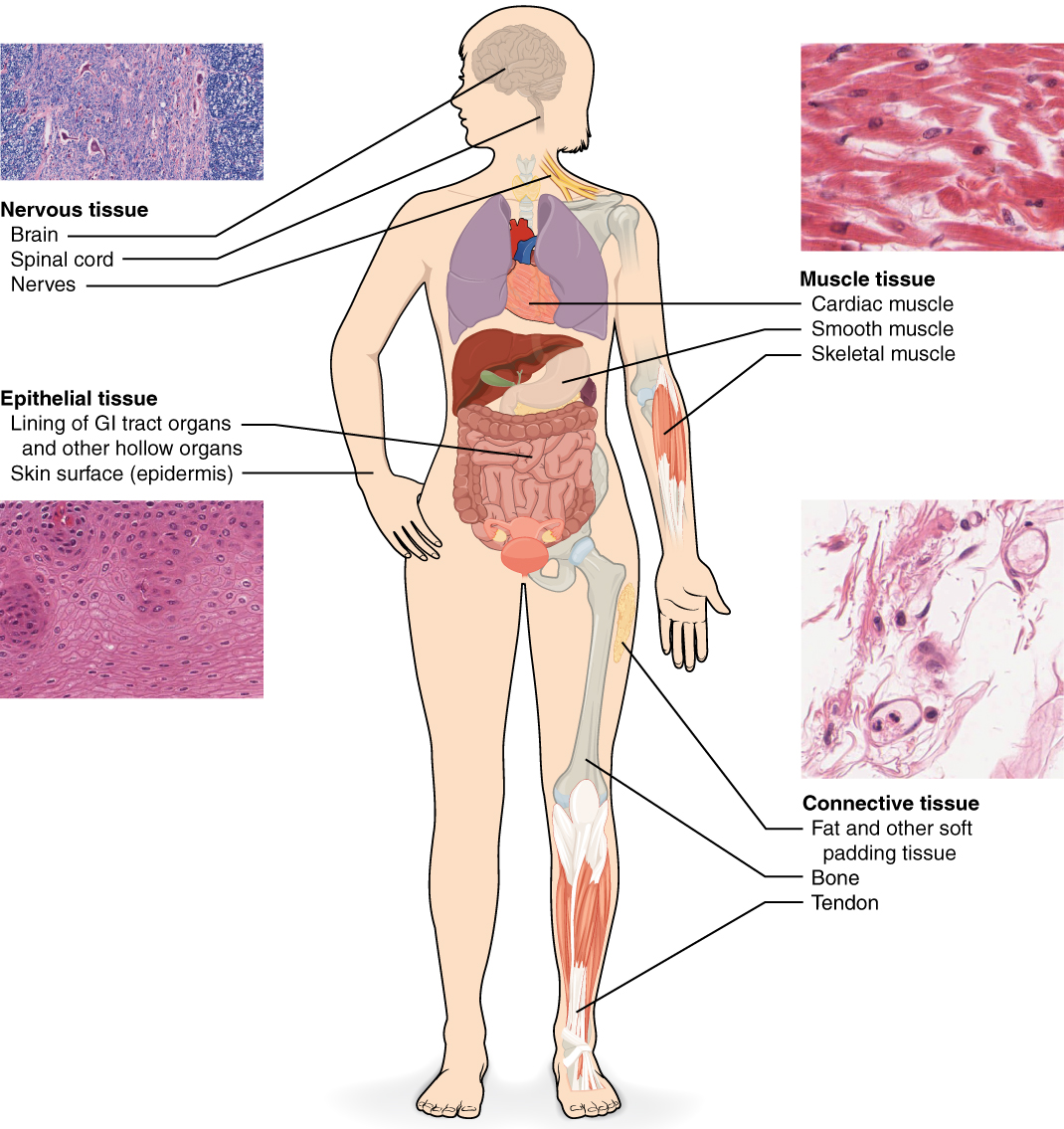
The four tissue families
- Epithelial: covering, lining, barrier
- Connective: support, defined by its matrix
- Muscle: generates force
- Nervous: communication and control
Epithelium — two facts with design consequences
- Named by cell shape and layers: simple squamous in alveoli, stratified in skin
- Avascular: fed by diffusion from the connective tissue beneath
- Damage to the layer beneath is what causes real trouble
- A continuous epithelium is the primary barrier
- Breach it — even a 3 mm pressure break — and it becomes a wound project
Connective tissue: the engineer's family
| Matrix component | Mechanical role | Analogy and its limit |
|---|
| Collagen | High tensile strength, low stretch | Aramid fibre — but living and remodelling |
| Elastin | Large recoverable strain | Rubber — interwoven so stiffness rises sharply |
| Ground substance | Binds water, resists compression | A hydrogel — fluid flow makes it time-dependent |
The tissues a maker confuses
| Tissue | Connects | Do not model it as… |
|---|
| Tendon | Muscle to bone | The motor — it transmits; it does not generate |
| Ligament | Bone to bone | A tendon — different job and place |
| Articular cartilage | Covers bone ends | A rubber pad — its load-bearing is fluid pressure |
| Fibrocartilage | Discs, menisci | Solid |
| Fat | Beneath skin | A uniform layer of known thickness |
| Bone | The skeleton | Inert — it remodels with load |
Simplify — and label the simplification. "Cord represents a tendon; the demonstrator supplies the muscle force."
Skin is an organ
A layered composite with active biology, not a cladding material
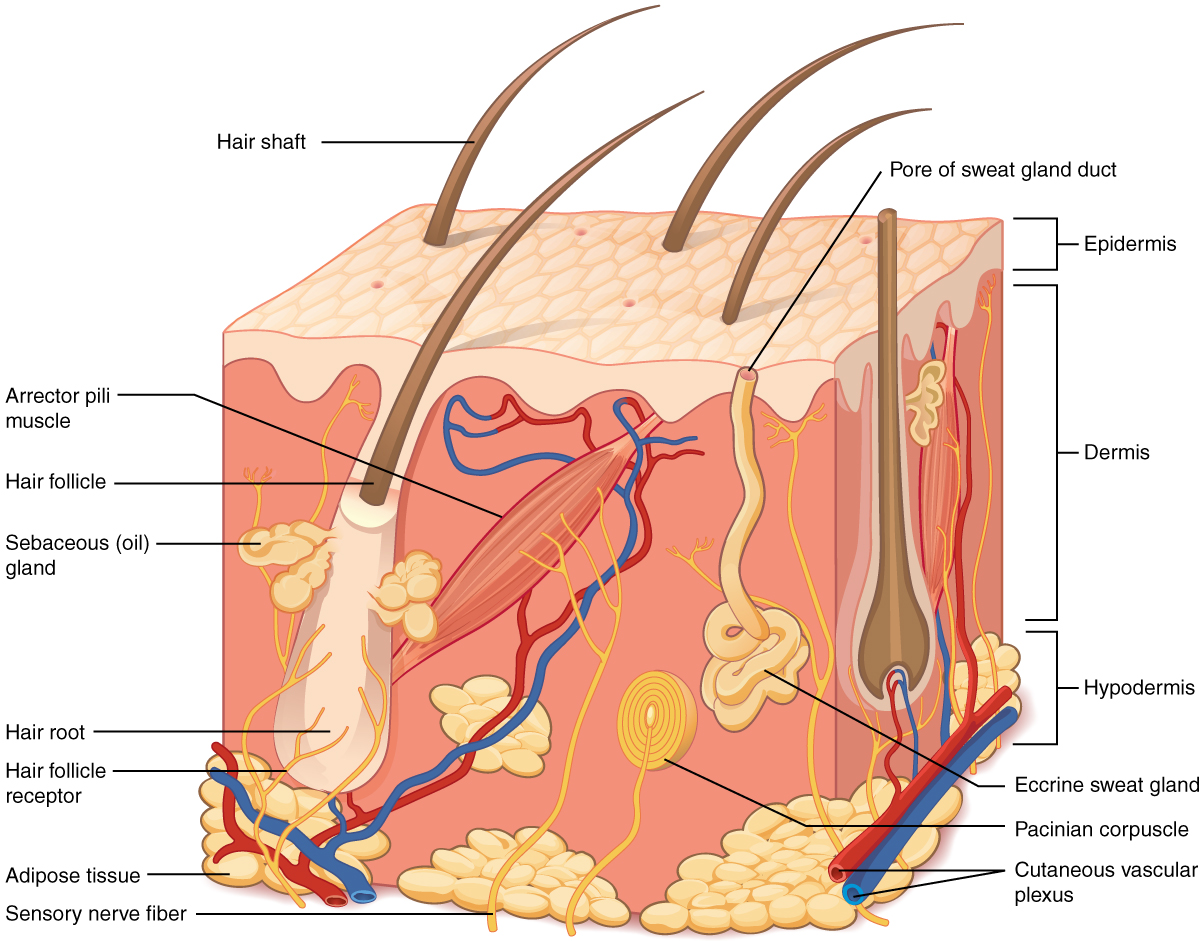
The layers of skin
- Epidermis: 0.05 to 0.1 mm, no blood vessels, renewed in about a month
- Dermis: 1 to 4 mm; vessels, nerves, glands, collagen
- Hypodermis: fat; thickness varies tenfold
- Bony prominences concentrate load deep
The epidermis and its barrier
- Keratinocytes form the barrier; Langerhans cells keep watch
- Melanocyte number is similar across populations; melanin amount differs
- That matters for optical sensors — see the pulse oximeter
- Strip the stratum corneum and the barrier fails before any wound is visible
- Medical adhesive-related skin injury is a design-caused harm
What skin does — and what that means for a design
| Function | Consequence |
|---|
| Barrier | Any breach changes the project; adhesive, resin, dye, or nickel is a chemical exposure |
| Sensation | Discomfort is a safety mechanism — absent if sensation is reduced |
| Thermoregulation | Covering skin is a thermal and microclimate decision |
| Water balance | Occlusion macerates and weakens skin |
Pressure is only the beginning
Distribution, depth, time, the person, and movement
Average pressure: a true and useful calculation
20 kPa
20 newtons over 10 square centimetres — about 150 mmHg
Use p = F/A to ask about force distribution. Never to invent a clinical threshold.
What the pressure calculation cannot establish
- Distribution — a ridge, seam, or fastener head carries the peak
- Depth — damage often starts near bone, before the surface shows it
- Time — load and duration trade off non-linearly
- The person — perfusion, age, moisture, sensation, mobility
- Movement — sliding adds shear and friction
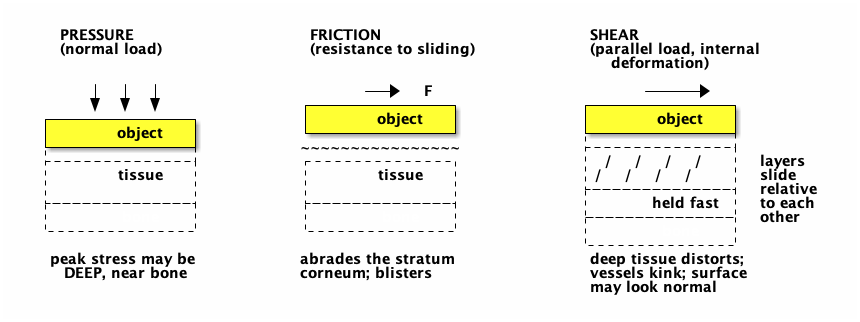
Pressure, friction, shear, and microclimate
- Pressure: compresses tissue; can occlude vessels
- Friction: abrades the surface; blisters
- Shear: layers slide; deep vessels kink; surface may look normal
- Microclimate: moisture macerates; heat raises demand
Soft tissue is not a metal
| Property | Why you care |
|---|
| Non-linear J-curve | No single modulus; low-strain stiffness underestimates |
| Viscoelastic | Creep and relaxation: a strap at 9am is different at 11am |
| Anisotropic | A symmetric part is not symmetric in its effect |
| Pre-stressed | Excised tissue data does not transfer to the living body |
| Adaptive | The tissue in week six is not the tissue in week one |
Stiffness, for intuition only
| Material | Approximate modulus |
|---|
| Fat | 1 to 10 kPa |
| Skin | 0.1 to 100 MPa depending on strain |
| Silicone elastomer | 0.1 to 10 MPa |
| Rigid polymers — acetal, ABS, PLA, nylon | 1 to 4 GPa |
| Tendon | 1 to 2 GPa |
| Cortical bone | 10 to 20 GPa |
| Stainless steel | about 200 GPa |
Every rigid object is much harder than what it touches. The compliance mismatch is where load concentrates.
Inflammation and repair
- Haemostasis — minutes: clot and platelet plug
- Inflammation — hours to days: redness, heat, swelling, pain
- Proliferation — days to weeks: new vessels and collagen
- Remodelling — weeks to months, or longer
- Swelling changes dimensions within hours
- Scar is not replacement
Preventing a 5 mm skin break matters more than being good at responding to one.
Engineering bridge: the contact category decides who reviews
| Category | Example | Implies |
|---|
| No body contact | Tabletop model, bench fixture, software | Workshop review; cleaning for handling |
| Intact skin, brief | Handle or control used for minutes | Human factors: edges, forces, cleaning |
| Intact skin, prolonged | Splint, strap, seating, worn device | Clinical assessment — not a maker decision alone |
| Compromised skin | Fragile, swollen, scarred, reddened | Specialist clinical involvement, always |
| Breached, mucosa, internal | Wound, airway, implant | A different universe — not a learning project |
A contact design checklist
The contact
- Where, over what area, for how long?
- What forces, in which directions?
- Is the skin intact? Who assessed it?
- What is beneath — bone, nerve, vessel?
- Does the limb change size?
The object and its life
- Edges, seams, parting lines, fasteners?
- Can the user feel and act on discomfort?
- How is it cleaned, and who re-checks it?
- What happens when it fails? How is it removed?
- Does a product already exist?
Design moves, and what each one costs
| Move | Intended effect | What it also does |
|---|
| Increase area | Lower average pressure | Bulk, new edges, more trapped moisture |
| Add padding | Distribute load | Changes grip, adds seams, absorbs fluid, hides a hard edge |
| Round the edges | Remove stress concentration | Almost always good |
| Softer material | Less compliance mismatch | May lose the function that justified the part |
| Make it adjustable | Accommodate swelling | Can be set wrongly; new failure modes |
| Change the method | Remove a process feature | Cost, lead time, cleanability change |
Write it honestly: "this changes X, and I have not established Y."
Clinical devices and software in this area
Devices
- Dressings: moisture management
- Negative pressure wound therapy: pump, seal, alarms
- Pressure-redistribution surfaces; pressure mapping
- Compression; orthoses; slide sheets; seating
Software
- Wound imaging and measurement apps
- Risk scores — a prompt, not a prediction
- AI lesion triage: skin-tone diversity is a known gap
- Orthotic CAD and 3D scanning
Training technology — and the maker's entry point
- Suture and skin pads: layered silicone, consumed by the hundred
- Moulage and wound-care trainers
- Instrumented interface rigs: force sensors under cast silicone
- Sewn demonstration straps that vary one thing each
The skill is mould making — and making the hundredth pad match the first.
Worked example: the awkward handle
| Mechanism | Evidence | Fix direction |
|---|
| Force at an edge or seam | Mark or pain at a line | Radius, redistribute, move the seam |
| Too little area | Diffuse pressure | Larger, contoured |
| Awkward wrist position | Pain in wrist or forearm | Change the angle |
| Excessive grip force | Muscle fatigue | Reduce force needed |
| Slipping | Gripping harder than needed | Friction, retaining feature |
| Heat or moisture | Clammy; worse when warm | Material and ventilation |
For three of these, padding makes it worse. Find the mechanism; don't apply the default fix.
Workshop exercise and exit criteria
- Build a layered skin model — label it schematic, not to scale
- Compare a narrow and a broad contact; mark where seams concentrate force
- Demonstrate shear with foam sheets — and list how it is unlike skin
- Draw a contact map for the elbow model
Do not run pressure or prolonged-contact experiments on yourself or anyone else.
What this chapter does not establish
- You cannot set a pressure limit
- You cannot assess anyone's skin
- A bench interface-pressure measurement is not a safety assessment
- "Skin-safe" needs evidence about a finished object in a specific use
- No part of this authorises prolonged-contact or wound-contact work
Next — Bones, joints, and movement.