Chapter 6
Bones, joints, and movement
Where your mechanics is most useful — and most dangerous
Human Biology for the Medical Maker
Why this chapter exists
What transfers directly
- Joints are pivots; muscles apply forces
- Tendons are tension members
- A free-body diagram of a forearm is a real one
What breaks the simple model
- Centres of rotation move
- Muscle force depends on length and speed
- Moment arms change through the motion
- Comfortable range is not maximum range
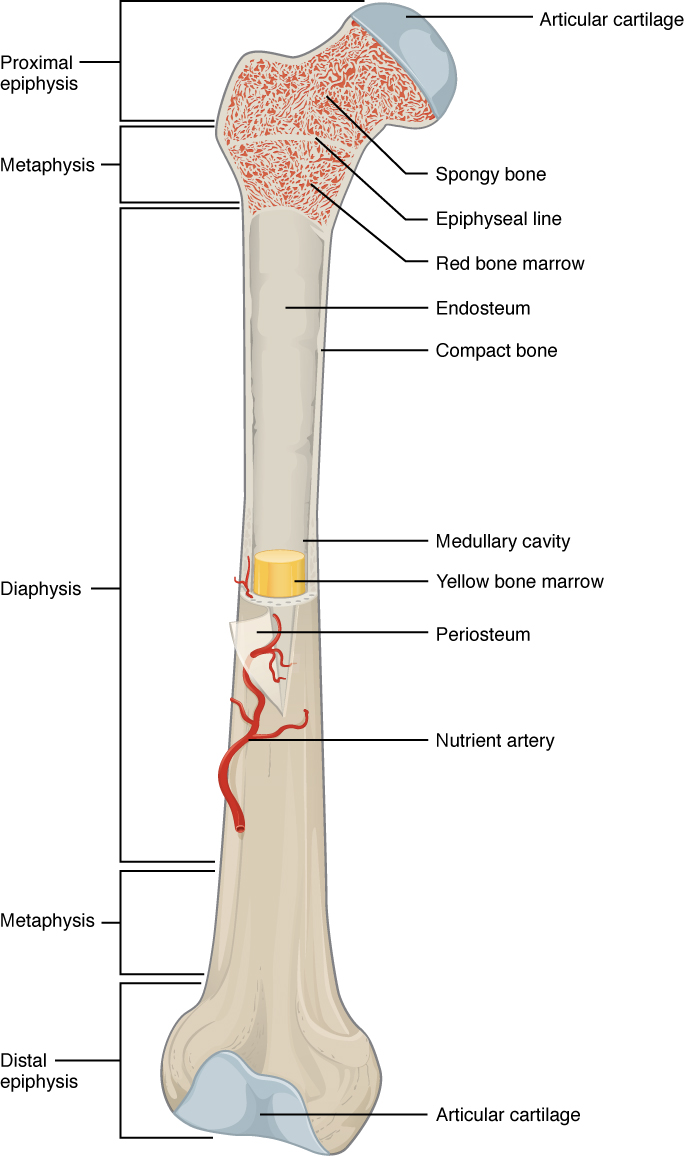
Bone is a living composite
- Collagen matrix (tough, tensile) plus hydroxyapatite mineral (stiff, brittle)
- Cortical bone: dense shell carrying bending and torsion
- Trabecular bone: a lattice aligned with habitual load paths
- Cells continuously build, resorb, and sense the structure
Correct in a bridge, wrong in a body
Bone responds to how it is loaded. A stiffer implant carries more load — so the bone carries less, and weakens.
Stress shielding, the practical consequence of remodelling
Mechanical properties, for intuition only
| Material | Elastic modulus | Note |
|---|
| Trabecular bone | 0.01 to 3 GPa | Varies over two orders of magnitude |
| Tendon | 1 to 2 GPa | Non-linear; compliant toe region |
| PLA, printed / acetal | 2 to 4 GPa | Printed parts weakest between layers |
| Cortical bone | 15 to 20 GPa | Anisotropic |
| Aluminium 6061 | about 69 GPa | About 4 times cortical bone |
| Ti-6Al-4V | about 110 GPa | Closest common metal to bone |
| Stainless 316L | about 200 GPa | About 10 times cortical bone |
Bone is anisotropic — and so is almost everything you make.
The skeleton you actually need
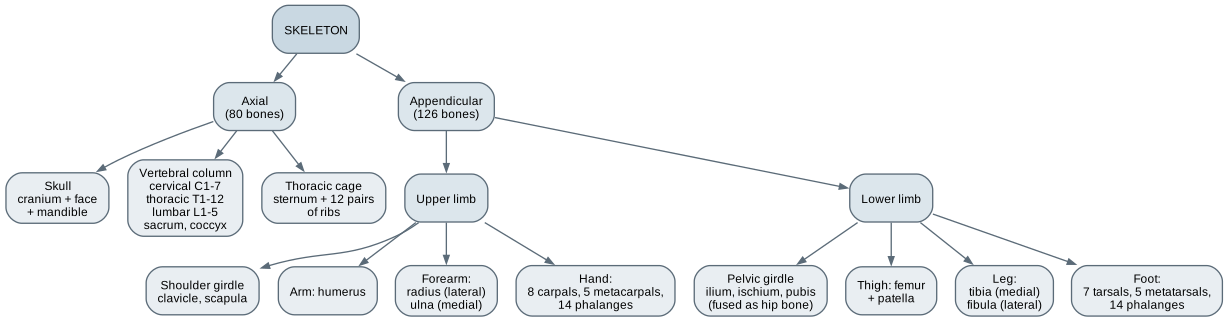
- Do not memorise 206 bones
- Axial: skull, vertebral column, thoracic cage
- Appendicular: girdles and limbs
- Learn your project's region in detail
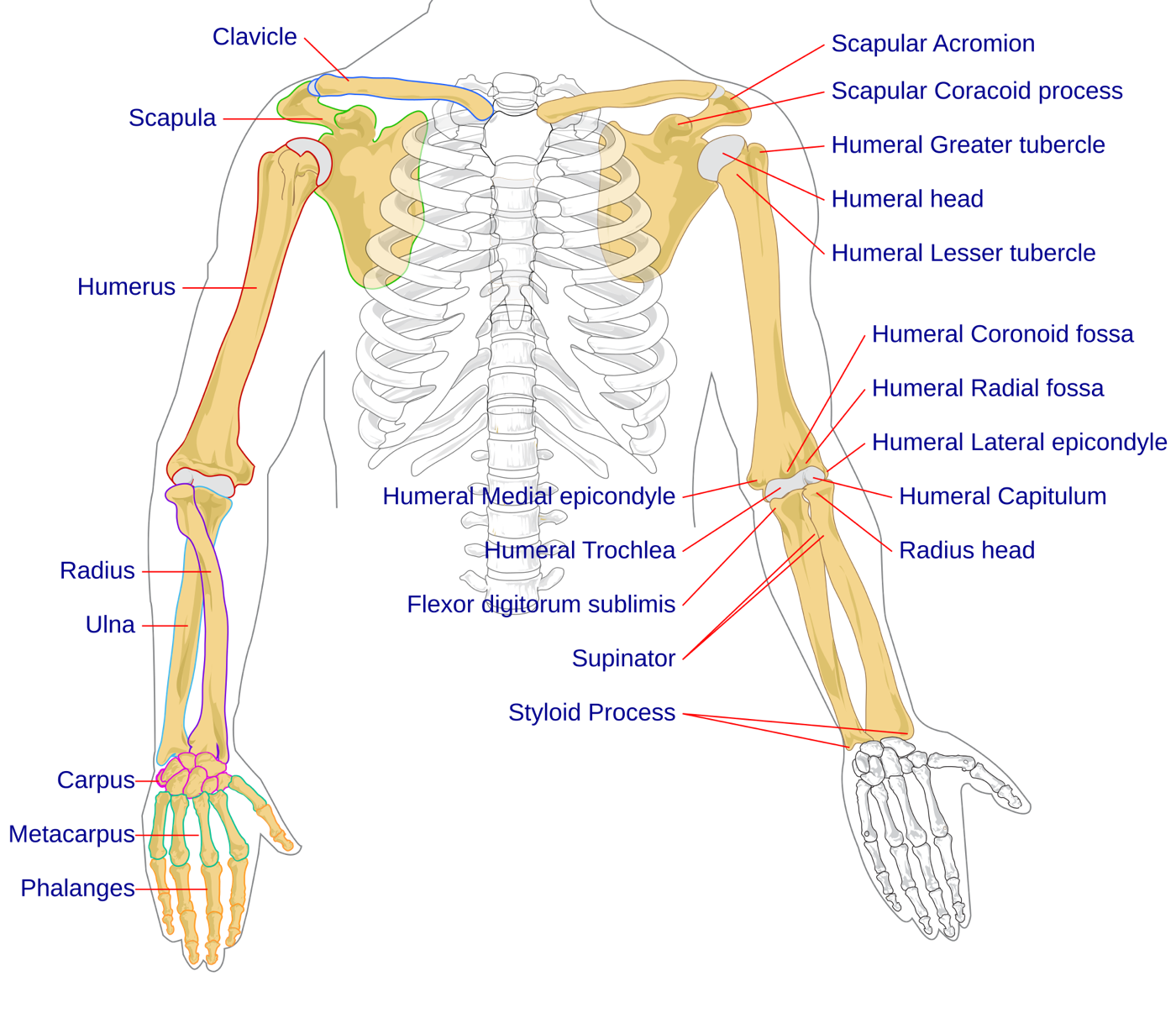
The upper limb
- Clavicle: the only bony strut to the trunk
- Scapula glides on the thorax — much of "shoulder" movement
- Radius is lateral, thumb side, and rotates
- Ulna is medial; its olecranon is the point of the elbow
- Eight carpals; the thumb's saddle joint gives opposition
The elbow is not one joint
- Humeroulnar: the main hinge for flexion and extension
- Humeroradial: also takes part in flexion and extension
- Proximal radioulnar: rotation for pronation and supination
- All three share one capsule
"This model omits forearm rotation" takes four seconds to say and prevents a wrong mental model.
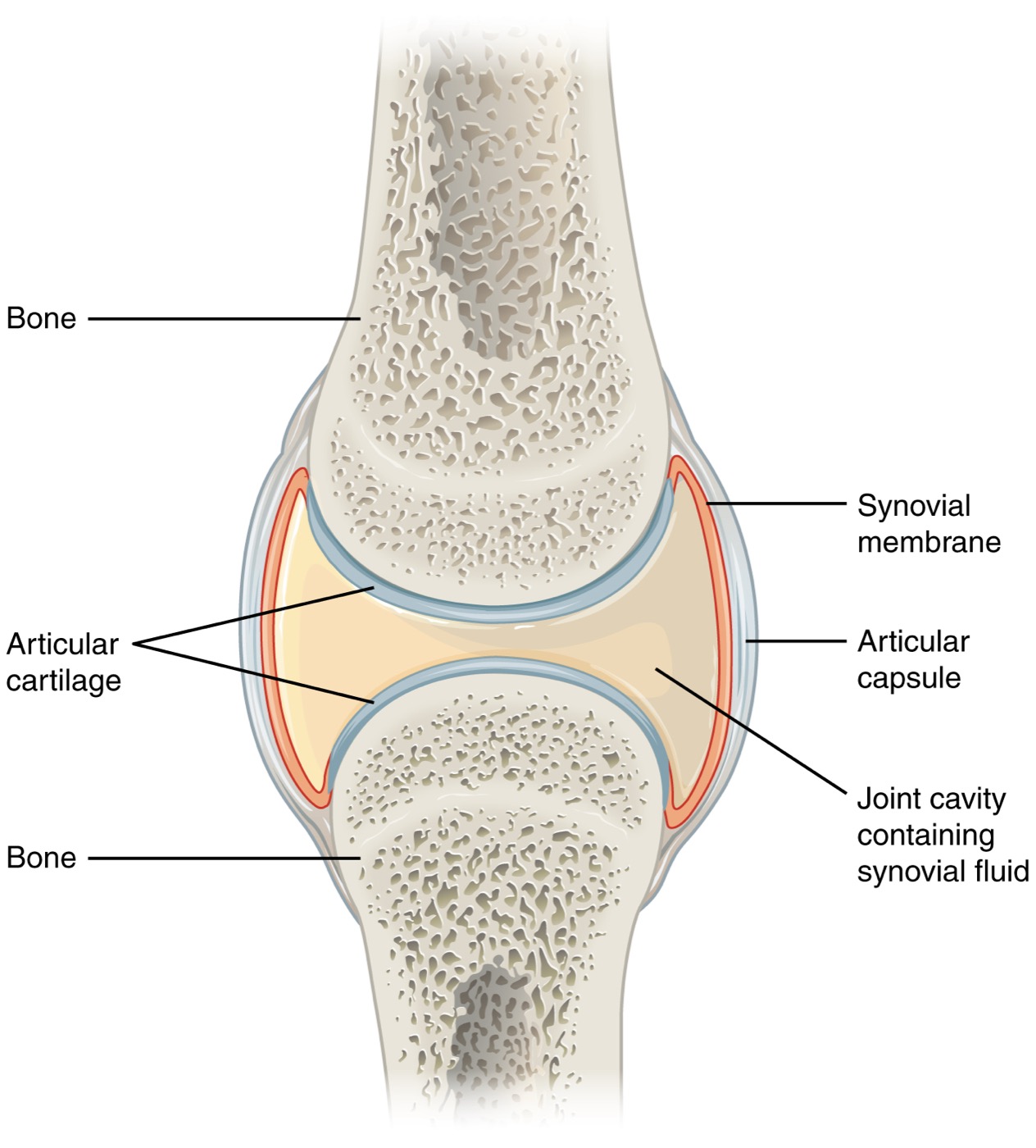
Anatomy of a synovial joint
- Articular cartilage: smooth, low friction, compressible
- Capsule and synovial membrane secreting fluid
- Plus ligaments, muscles, bursae, menisci, sensory nerves
- Friction coefficient roughly 0.003 to 0.02
What a metal hinge silently claims does not exist
- Cartilage, capsule, and synovial fluid
- Ligamentous constraint
- Active muscular stabilisation
- Sensory feedback
- A centre of rotation that moves through the range
Each omission is a claim your model makes unless you say otherwise.
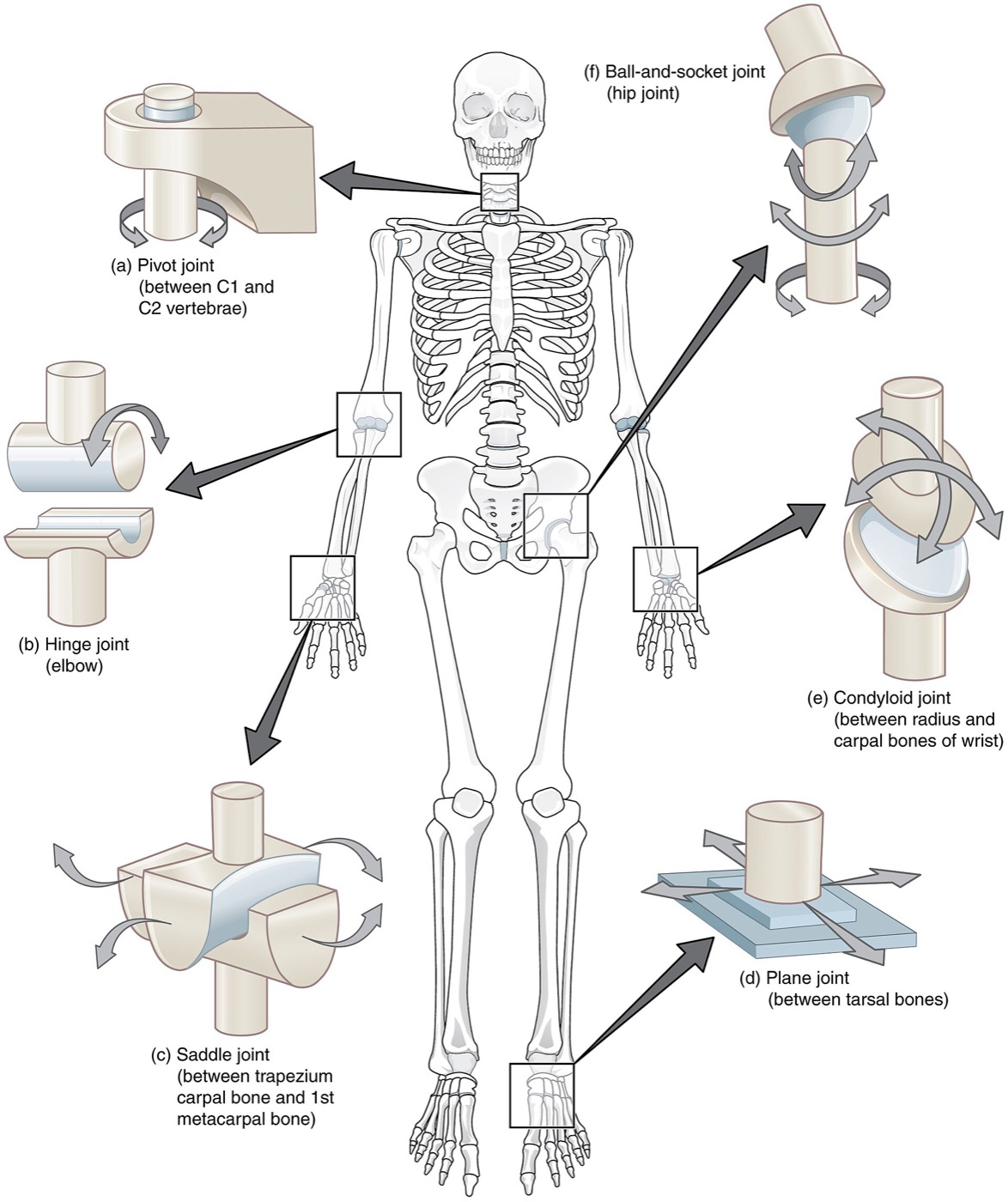
The six synovial joint types
- Plane: sliding — intercarpal
- Hinge: one axis — elbow, finger joints
- Pivot: rotation — radioulnar, head shake
- Condyloid and saddle: two axes — knuckle, thumb base
- Ball-and-socket: three axes — shoulder, hip
Mobility is bought with stability — the shoulder versus the hip.
Describing motion precisely
- Flexion decreases the joint angle; extension increases it
- Abduction away from the midline; adduction toward it
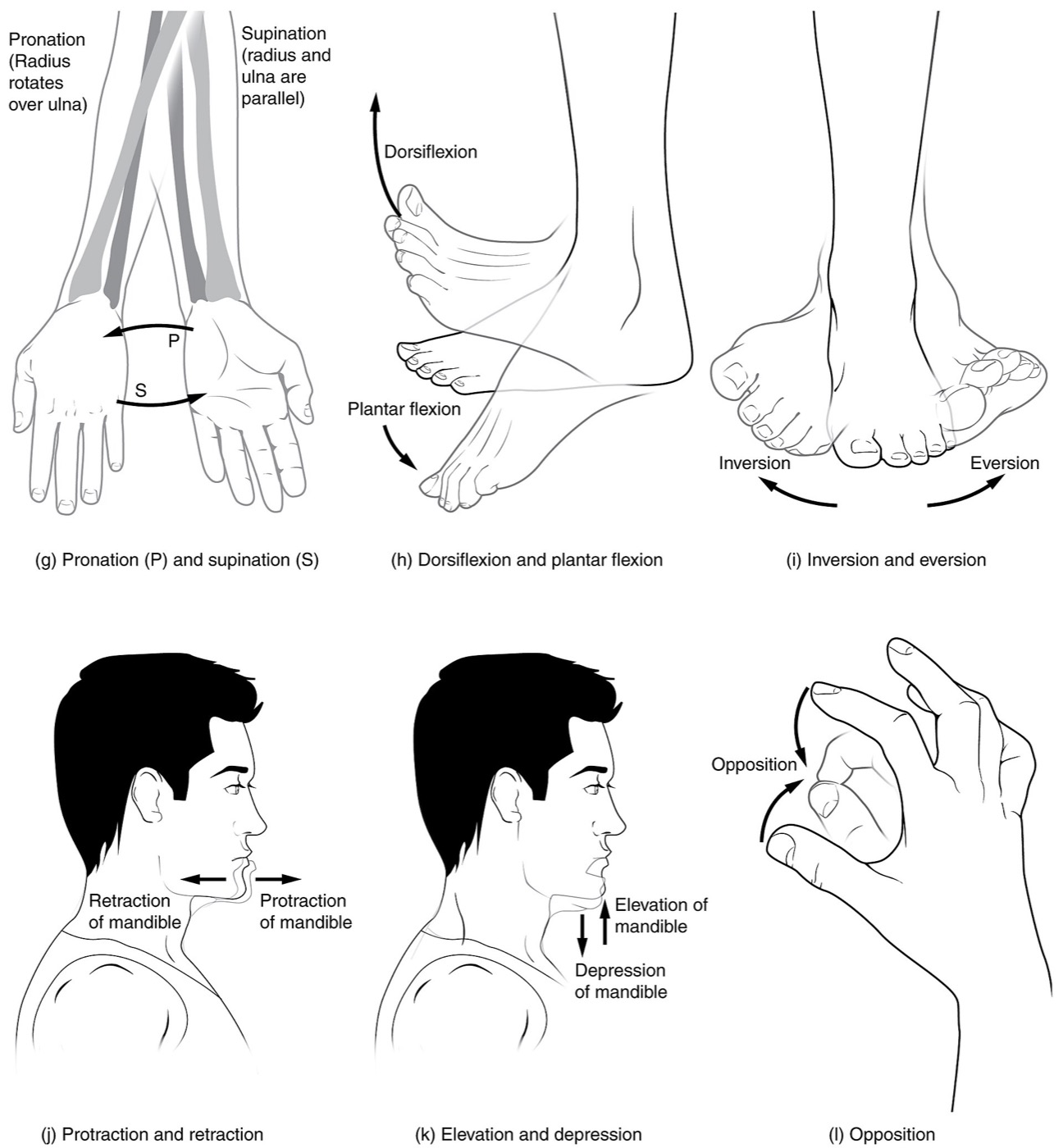
- Supination: palm up — carrying soup
- Pronation: palm down
- Opposition: thumb pad to fingertip
Active, passive, and functional range
| Term | Meaning |
|---|
| Active range (AROM) | What the person achieves with their own muscles |
| Passive range (PROM) | What the joint permits when moved by an external force |
| Functional range | What is used comfortably and repeatedly for a real task |
Being able to move a model through an angle tells you nothing about a person.
Typical adult ranges — orientation only
| Joint and motion | Approximate range | Caveat |
|---|
| Elbow flexion | 0 to 145 degrees | Many daily tasks use about 30 to 130 |
| Forearm pronation and supination | 80 to 90 degrees each | Measured with elbow flexed |
| Wrist flexion / extension | 70 to 80 / 60 to 70 degrees | Tasks use far less |
| Shoulder flexion | 0 to 180 degrees | Includes scapular movement |
| Knee flexion | 0 to 135 degrees | — |
Design for less than the person's maximum — and have a therapist measure them.
Muscle: how force is actually produced
The motor is the muscle; the tendon transmits
From whole muscle to filaments

Muscle, fascicle, fibre, myofibril, sarcomere, actin and myosin — calcium triggers, ATP powers
The fact a maker needs most
The motor is the muscle. The tendon is a tension member that transmits the force. They are not the same component.
The single most common misconception a simplified joint model creates
Types of contraction
| Type | What happens | Example |
|---|
| Isometric | Force, no change in length, no movement | Holding a bag still |
| Concentric | Muscle shortens while producing force | Lifting the bag |
| Eccentric | Muscle lengthens while producing force | Lowering it slowly; going downstairs |
Holding still is work. Sustained isometric holding is strongly fatiguing.
Muscle is not a linear actuator
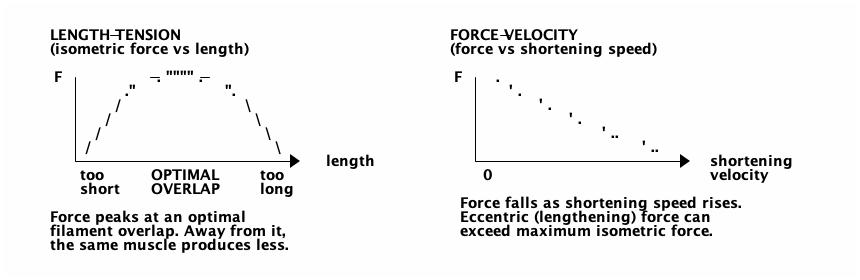
Force peaks at optimal overlap and falls with shortening speed — muscle is not a linear actuator
Muscles work in teams
| Role | Function | Elbow flexion example |
|---|
| Agonist | Produces the movement | Biceps, brachialis |
| Antagonist | Opposes and controls it | Triceps |
| Synergist | Assists and refines | Brachioradialis |
| Stabiliser | Holds the proximal segment steady | Scapular muscles |
Co-contraction stiffens a joint for precision — and costs energy.
Engineering bridge: levers and statics
Torque, moment arms, and why internal forces are large
Torque and the moment arm
- Torque = force times perpendicular distance to the line of action
- Load: 2 N at 0.20 m gives 0.40 N·m
- Cable at 0.04 m must pull 10 N
- Halve the moment arm: 20 N
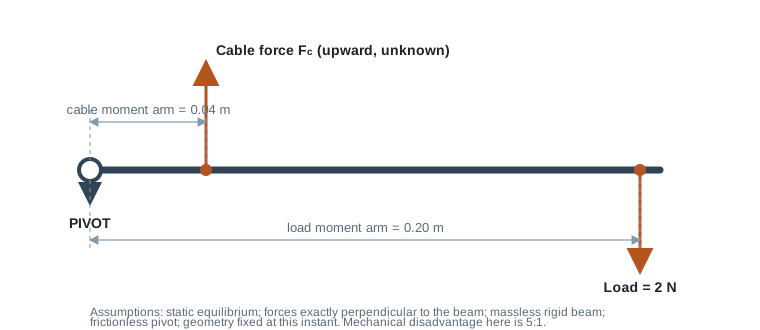
The moment arm is not the distance along the beam.
Including the limb's own weight
about 64 N
muscle force to hold a 2 N object with the forearm level
The forearm's own weight contributes nearly three times the torque of the object held.
Lever classes: the body chose speed and range
| Class | Arrangement | Body example |
|---|
| First | Fulcrum between effort and load | Nodding the head |
| Second | Load in the middle — force multiplier | Standing on tiptoe |
| Third | Effort in the middle — speed and range | Biceps flexing the elbow — the commonest |
"A terrible mechanical arrangement" is a correctly identified trade-off with its purpose missed.
Grip, strength figures, and percentiles
- Power, hook, precision, key, tripod, and spherical grips
- Maximum is not sustainable — design for as little force as possible
- Your users may be nowhere near the population figure
- Percentiles are per dimension: there is no 95th percentile person
- Design for a range; adjustability usually beats one optimised size
Devices, software, and training technology
Clinical devices
- Joint replacements; fracture fixation
- Orthoses, prostheses, mobility aids
- Assistive equipment — the classic maker-and-therapist collaboration
- Exoskeletons; dynamometers and goniometers
Software and training
- OpenSim musculoskeletal modelling; pose estimation
- Orthotic and prosthetic CAD, scan to fabrication
- Articulated models, fracture trainers, arthroscopy simulators
- Instrumented movement and strength rigs
The line to watch is load bearing
The moment an object supports weight, restricts a joint, or applies force to a limb, it has become a prescribed clinical device.
"Could you make it a bit stronger so they can lean on it?" is a change of project.
Worked example: moving the cord attachment
- Move the attachment from 40 to 20 mm: force roughly doubles
- Less cord travel for the same sweep — force traded for range
- The model feels strongest at a different angle
- Unlabelled, it teaches "the cord is the muscle"
- Label: input force = muscle action; cord = tendon; pivot = simplified joint
Workshop exercise and exit criteria
- Build the two-strip model; predict, then pull
- Vary the attachment and record force and sweep
- Calculate cord force for a 2 N load, then add segment weight
- List at least eight anatomical features the model omits
- Write a functional brief for a grip aid — without choosing a material
What this chapter does not establish
- You cannot assess range of motion
- You cannot specify forces for a person — order of magnitude only
- You cannot design load-bearing or motion-restricting devices unsupervised
- Strength and range tables are not design values
- Your model is one honestly labelled relationship, not an anatomy reference
Next — Nerves, sensation, and accessible design.