Chapter 7
Nerves, sensation, and accessible design
Perception, cognition, action, feedback — four capabilities that fail independently
Human Biology for the Medical Maker
Why this chapter exists
- "Can the user operate this control?" is at least four questions
- Ample strength, insufficient pinch precision
- Operates it perfectly, cannot see whether it latched
- Sees and understands it, cannot reach it
- Does it all, cannot feel the strap cutting in
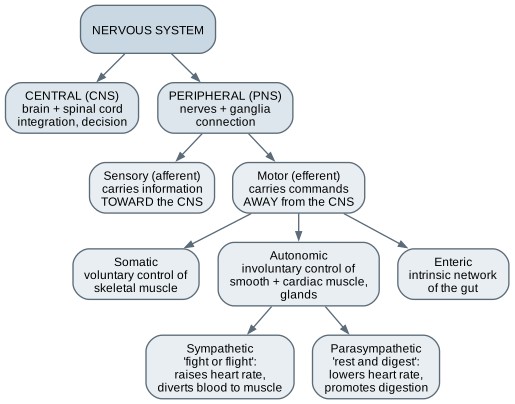
The nervous system, organised
- Central: brain and spinal cord; peripheral: the nerves
- Afferent carries information toward the centre
- Efferent carries commands away
- Autonomic: heart rate, glands, the physiology of anxiety
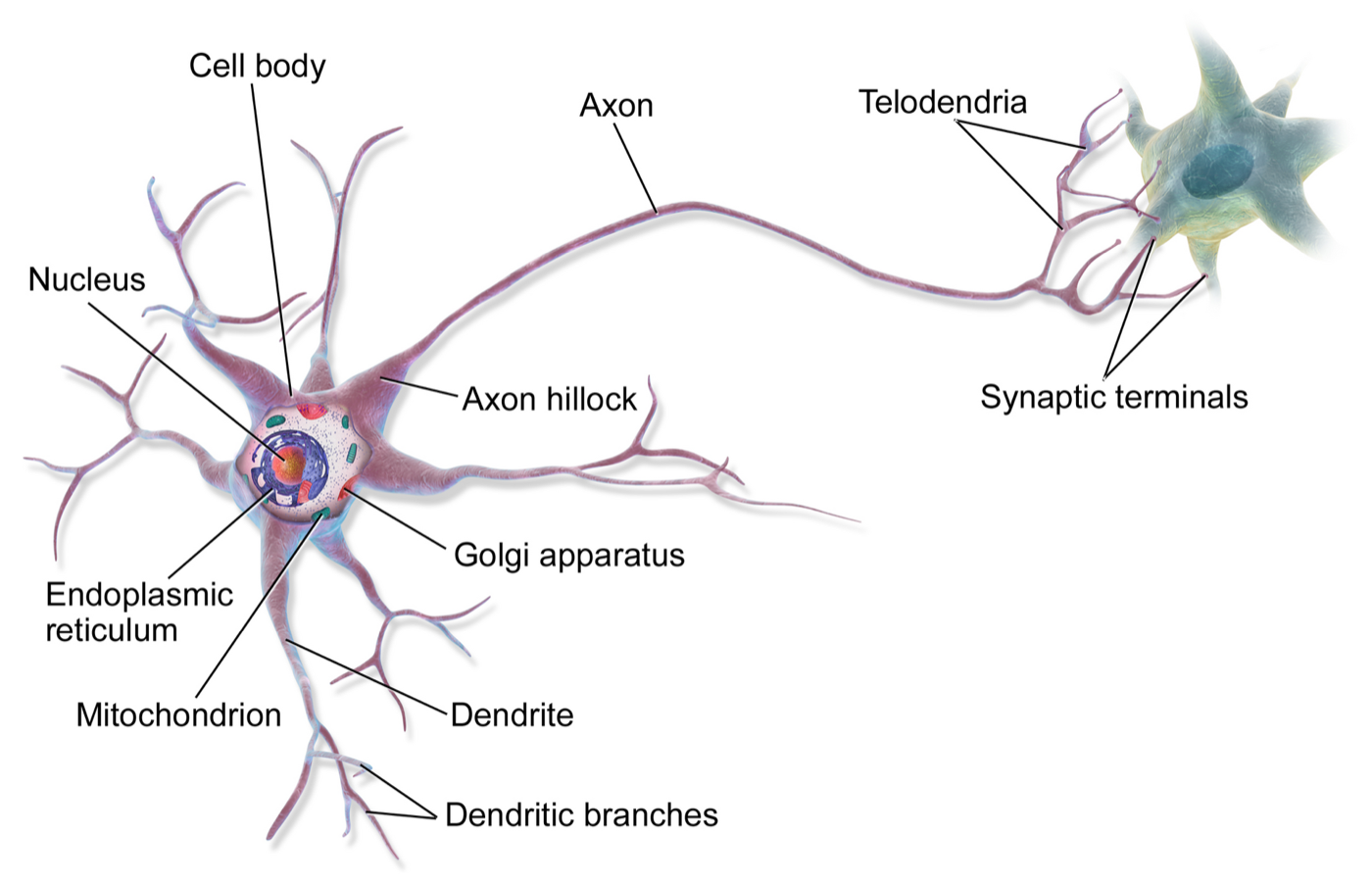
How a neuron works
- Dendrites receive; the cell body integrates
- The axon conducts, sometimes over a metre
- Myelin insulates in segments: the signal jumps
- Conduction from about 0.5 to 120 metres per second
The resting potential and the action potential
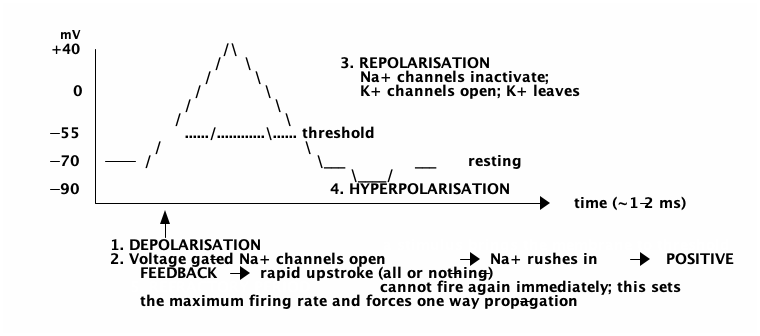
All or nothing — intensity is coded by firing frequency and by recruiting more fibres
Synapses and the neuromuscular junction
- Calcium entry releases neurotransmitter across a narrow cleft
- The receiving cell sums excitatory and inhibitory inputs
- Nerve to muscle: acetylcholine at the neuromuscular junction
- Many drugs and toxins act exactly here
The somatosensory receptors
| Receptor | Senses | Adaptation |
|---|
| Merkel complex | Sustained touch, edges, texture | Slow |
| Meissner corpuscle | Light touch, flutter, slip | Rapid |
| Pacinian corpuscle | Vibration, deep pressure | Very rapid |
| Ruffini ending | Skin stretch, sustained pressure | Slow |
| Free nerve endings | Warm, cold, potentially damaging stimuli | Varies |
| Muscle spindle / tendon organ | Muscle length / tension | Slow |
Rapidly adapting receptors stop reporting a constant stimulus — a design hazard.
Two-point discrimination: receptor density varies
| Site | Approximate threshold |
|---|
| Fingertip | 2 to 4 mm |
| Palm | about 10 mm |
| Forearm | 30 to 40 mm |
| Back | 40 to 50 mm or more |
Two raised dots 3 mm apart on a handle gripped by the palm are one dot.
Proprioception — the sense people forget
- Body position and movement: spindles, tendon organs, joint receptors
- Without it, you must watch to find your hand or grade a grip
- Every task then consumes visual attention
Controls operable by feel — distinct shapes, clear detents — help everyone whose eyes are busy.
Pain is not a sensor reading
Absence of a pain report is not evidence of absence of harm. A design must not use the user's discomfort as its safety mechanism.
Reflexes — faster than awareness
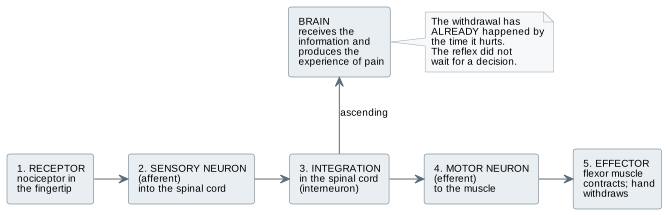
The withdrawal has already happened by the time it hurts — and sustained pressure triggers no reflex
Engineering bridge: biosignals
Why this table is introductory biomedical instrumentation
The signals and their sizes
| Signal | Typical amplitude | Bandwidth |
|---|
| ECG — heart | 0.5 to 4 mV | 0.05 to 150 Hz |
| Surface EMG — muscle | 0.05 to 5 mV | 10 to 500 Hz |
| EEG — brain | 10 to 100 microvolts | 0.5 to 100 Hz |
| EOG — eye movement | 50 to 3500 microvolts | 0 to 30 Hz |
| Nerve action potential | 1 to 20 microvolts | 100 to 2000 Hz |
| PPG — pulse | Optical | 0.5 to 20 Hz |
An absolute boundary
Never connect anything you have built to a person.
Patient-connected equipment is governed by IEC 60601-1. Bench and USB-powered equipment do not meet its isolation and leakage limits.
Psychophysics: the numbers behind "noticeable"
- Just-noticeable difference grows with the baseline — Weber's law
- A cue sized for a quiet workshop may vanish in a busy ward
- Simple visual reaction about 200 ms; choices take longer
- Your interface timeout is a design parameter with human limits behind it
Decompose any task: perception, cognition, action, feedback
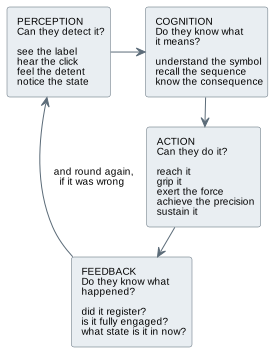
Each stage can fail independently, and each is a separate intervention
Worked through: "can use the control"
| Stage | Demand | Could fail because |
|---|
| Perception | See a small symbol | Acuity, contrast, lighting, glare |
| Cognition | Know what it means and the sequence | Unfamiliar convention, memory load |
| Action | Reach and pinch the latch | Range of motion; pinch force versus precision |
| Action | Hold it open; slide the part | Endurance; tremor; two hands needed |
| Feedback | Know it is fully engaged | Is there any indication at all? |
The same decomposition is why WCAG is perceivable, operable, understandable, robust.
Designing for variation, not for a diagnosis
A diagnostic label is not a specification. The person is the expert on their own experience, priorities, and context.
Ask: what are you trying to do? How do you do it now? What becomes difficult, and when?
Accessible feedback: redundancy, not substitution
| Single-channel cue | Fails for | Add |
|---|
| Colour only | Colour vision deficiency (about 8% of men of northern European descent), poor light | Shape, position, text, pattern |
| Sound only | Hearing loss, noisy ward, facing away | Visible state change, mechanical detent |
| Small text only | Low vision, wet or gloved hands | Larger type, contrast, tactile feature |
| Position only | Symmetrical parts get assembled wrongly | Asymmetric geometry |
The strongest control is one where the wrong thing cannot be done.
Devices, software, and training technology
Clinical devices
- EEG, EMG, nerve conduction, evoked potentials
- TENS, functional electrical stimulation, deep brain stimulation
- Cochlear implants and hearing aids
- AAC devices; switch and alternative access hardware
Software and training
- Screen readers — NVDA is free; accessibility test tools
- Eye gaze, switch scanning, AAC apps, MNE-Python
- Lumbar puncture and nerve block trainers
- Monofilaments, tuning forks, two-point discriminators
The highest-leverage contribution in the book
- Software: free tools, public standards, no patient contact
- Run axe over something; navigate with a screen reader
- Hardware: switch interfaces, mounting arms, wipeable enclosures, straps
- Each individual, each made with an OT and the user
Education-grade biosignal kits are for learning only — never for a clinical judgement.
Worked example: two identical cord ends
- First attempt: red and green — fails for colour deficiency
- Text: "PULL TO BEND" and "SUPPORT — DO NOT PULL"
- Different tab shapes, distinguishable by touch
- A curved arrow, a fixed position, a line from pull point to segment
- Keep colour — as a redundant cue
Then test it on someone who has never seen it, without hints.
Workshop exercise and exit criteria
- Decompose a touchscreen button press into at least eight demands
- Barrier review: five barriers, each tied to a stage, redesigned with costs
- Apply redundant coding to your model and test it
- Measure two-point discrimination on fingertip and forearm
- State ECG, EMG, and EEG amplitudes — and why nothing you build touches a person
What this chapter does not establish
- You cannot assess anyone's sensation, strength, or cognition
- You cannot build patient-connected electronics
- A one-handed or gloved trial generates hypotheses; it does not validate
- Accessibility for a particular person is established with that person
- You have not learned neurology
Next — The head and neck — eye, ear, nose, throat, and mouth.