Chapter 11
How disease works: from mechanism to symptom The small set of mechanisms behind most illness, and the arithmetic of risk
Human Biology for the Medical Maker
Welcome to chapter eleven. Every chapter so far has described the body working normally. But nobody commissions a device for a body that is working normally. Glucose monitors exist because of diabetes, compression stockings because of thrombosis, inhalers because of asthma. This chapter is pathophysiology for an engineer: not a catalogue of diseases, but the small number of mechanisms most of them are built from, and the arithmetic of risk that every clinical claim is expressed in. A diagnosis is a compressed specification "She has diabetic neuropathy" means: she cannot feel a pressure injury forming, may not see well enough to inspect for one, and heals slowly when one occurs. If you cannot decompress the label, you will design for the wrong person.
Disease is the hidden source of most requirements you will ever be given. When an occupational therapist says a patient has diabetic neuropathy, they are not giving you a label. They are giving you a specification in compressed form. This person cannot feel a pressure injury forming, may not see well enough to inspect for one, and heals slowly when one occurs. If you cannot decompress the label, you will design for the wrong person. This chapter teaches the mechanisms you need to do that decompression. The language of disease Aetiology → pathogenesis → lesion → symptoms and signs → outcome. Symptoms are reported; signs are observed or measured.
Clinical descriptions follow a fixed sequence. Aetiology is the cause, often multiple and partly unknown. Pathogenesis is the mechanism from cause to damage. That produces a lesion, then clinical features, then an outcome, whose expected course is the prognosis. Two pairs repay attention. A symptom is what the person reports; a sign is what an examiner observes or measures. A device that reports a sign is reporting evidence, not a diagnosis. And incidence is new cases over a period, while prevalence is existing cases at a point in time. Prevalence is roughly incidence times duration, so a sprained ankle and type one diabetes describe very different user populations. Cell injury and cell death Why oxygen supply is the commonest failure
Tolerance of complete ischaemia Tissue Tolerance Consequence Brain Minutes 2% of body mass, 20% of resting oxygen, almost no reserve Heart muscle Irreversible injury after about 20–40 min Time is muscle Kidney Tens of minutes to hours Transplantation and surgery Skeletal muscle A few hours Why tourniquet times are limited Skin Hours Sustained pressure keeps it ischaemic exactly that long
Untreated large-vessel stroke: an estimated 1.9 million neurons lost per minute.
Cut off a cell's oxygen, hypoxia, or its whole blood supply, ischaemia, and the energy supply fails within minutes. Pumps stop, the cell swells, membranes fail. Tissues differ enormously in tolerance. The brain is about two percent of body mass, uses about a fifth of resting oxygen, and has almost no reserve, so it fails in minutes. Heart muscle begins irreversible injury after roughly twenty to forty minutes. Skeletal muscle lasts a few hours, and skin hours, which is exactly why sustained pressure can injure it silently. These are rough orientation figures. For untreated large-vessel stroke a widely quoted estimate is the loss of nearly two million neurons a minute, and stroke services are built around that number. Two ways to die, and four ways to adapt Death Necrosis : uncontrolled, cells burst, provokes inflammationApoptosis : programmed, orderly, no inflammationFailure of apoptosis is a hallmark of cancer Adaptation Hypertrophy : cells grow largerHyperplasia : cells multiplyAtrophy : cells shrink — a limb in a castMetaplasia : cells change typeCells die in two ways. Necrosis is uncontrolled death from injury: cells swell, burst, spill their contents and provoke inflammation, as in a heart attack, a pressure injury or a burn. Apoptosis is programmed death, an orderly self-dismantling with no inflammation, used constantly to remove damaged cells and shape organs. Its failure is one of the hallmarks of cancer. A stressed cell that is not killed can adapt instead: grow larger, as heart muscle does against high blood pressure; multiply; shrink, as an unused limb in a cast does; or change type, as a smoker's airway lining does. Adaptations are reversible up to a point and then become disease in their own right. Inflammation Acute — minutes to hours Vessels dilate and leak; neutrophils arrive Redness, heat, swelling, pain, loss of function Chronic — weeks to years Macrophages and lymphocytes; scarring Drives arthritis, bowel disease, lung disease, atherosclerosis For a designer: inflamed tissue swells (the 9 a.m. fit fails at 5 p.m.) and is sensitised .
Inflammation is the body's general-purpose response to injury and infection, and the common pathway of a remarkable fraction of illness. Acute inflammation develops over minutes to hours: small vessels dilate and leak, fluid enters the tissue, and white cells migrate in. The classic signs follow directly: redness and heat from more blood, swelling from leaked fluid, pain, and loss of function. Chronic inflammation persists for weeks to years, tends to scar, and destroys the tissue it should protect. Two design consequences recur. Inflamed tissue is swollen, so the strap that fitted at nine in the morning does not fit at five. And it is sensitised, so a harmless contact becomes painful. Infection, sepsis, and shock When the response becomes the problem
Next, infection, and what happens when the body's response itself becomes the danger. Sepsis Life-threatening organ dysfunction from a dysregulated host response to infection Starts anywhere: lungs, urine, abdomen, skin, a line or catheter Vessels leak, pressure falls, organs fail Early features are vague: fever, fast heart and breathing, confusion Around ten million deaths a year worldwide Urgency plus vagueness is why hospitals use early warning scores — and why sepsis software is contested.
Whether an infection causes disease depends on both the organism's virulence and the person's defences, and much of the harm comes from the host response. Sepsis is life-threatening organ dysfunction caused by a dysregulated response to infection. It can start in the lungs, the urinary tract, the abdomen, the skin or a line or catheter, but the response becomes body-wide: vessels dilate and leak, blood pressure falls, and kidneys, lungs, brain and liver begin to fail. Global estimates are in the order of ten million deaths a year. It is time-critical, and its early features are vague. That combination is why hospitals use early warning scores, and why automated sepsis alerts are a large and contested software category. Shock: four failures of the circuit Type What fails Examples Hypovolaemic Volume Bleeding, severe dehydration, burns Cardiogenic The pump Major heart attack, severe heart failure Distributive The pipes dilate Septic, anaphylactic, spinal injury Obstructive Flow physically blocked Large pulmonary embolism, tension pneumothorax
A normal blood pressure does not exclude shock. A falling one is a late sign.
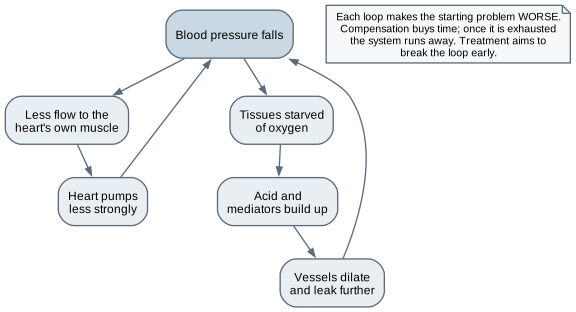
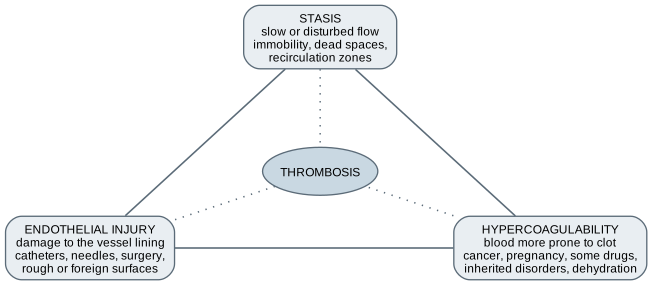
Shock is circulatory failure: tissues are not getting enough oxygen, whatever the blood pressure reads. Using chapter nine's circuit, there are four mechanisms, each a different term failing. Too little volume: bleeding, dehydration, burns. A failing pump: a major heart attack. Pipes that dilate so pressure collapses although volume is normal: sepsis and anaphylaxis. Or flow that is physically blocked: a large clot in the lungs. In every type the body compensates first, with a faster heart and constricted vessels, and blood pressure may be maintained until compensation is exhausted and then fall abruptly. So a normal blood pressure does not exclude shock. When negative feedback turns positive Low pressure starves the heart's own muscle Starved tissues release acid and mediators Each loop worsens the starting problem Intervene while the system is still recoverable Chapter one introduced negative feedback as the basis of homeostasis and positive feedback as a rare, self-limiting exception. Much of severe acute illness is negative feedback overwhelmed, so that loops which normally restore stability start to amplify the disturbance. In shock, low pressure reduces flow to the heart muscle, so the heart pumps less, so pressure falls further. Starved tissues release acid and mediators that dilate vessels, so pressure falls further again. An engineer will recognise a control system driven out of its stable region. The clinical lesson is the engineering one: intervene while the system is still recoverable. Thrombosis, embolism, and Virchow's triad Stasis : slow flow, dead spaces, immobilityEndothelial injury : catheters, needles, rough surfacesHypercoagulability : cancer, pregnancy, some drugsDVT, pulmonary embolism, atrial fibrillation A design checklist for anything in contact with flowing blood.
A thrombus is a clot formed inside a vessel when it should not be; an embolus is anything carried in the blood until it lodges and blocks a smaller vessel. Virchow described three conditions that favour thrombosis: stasis, injury to the vessel lining, and blood that is more prone to clot. Deep vein thrombosis forms during immobility, which is why compression stockings and pneumatic compression exist; a fragment can travel to the lungs as a pulmonary embolism. Atrial fibrillation leaves blood stagnant in the heart, a major cause of stroke. The triad is also a design checklist for any fluid path: does it create stasis, does it injure the wall, and is the user's blood prone to clot? Blocked pipes and failing pumps Atherosclerosis, heart attack, stroke, heart failure, airways
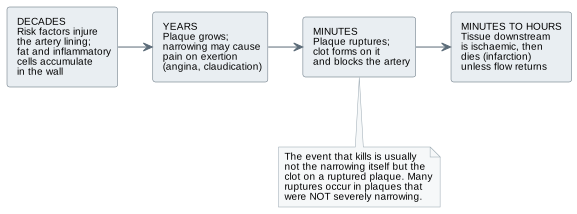
Now the diseases that kill most people in wealthy countries. Atherosclerosis and heart attack Decades of plaque, years of narrowing, minutes to rupture and clot, then infarction unless flow returns
Atherosclerosis is the slow build-up of fatty, inflammatory plaque inside artery walls, over decades, driven by smoking, high blood pressure, cholesterol, diabetes, age and inactivity. Plaques harm in two ways. Slowly, by narrowing; because resistance rises with the fourth power of radius, flow holds up surprisingly well until narrowing is severe, then pain on exertion appears. And suddenly, when a plaque ruptures and a clot forms on it within minutes. Many ruptures happen in plaques that were not severely narrowing. A heart attack is death of heart muscle downstream. Troponin in the blood and the ECG are the first tests, and treatment is a race to reopen the artery. Dead muscle becomes scar that does not contract. Stroke: two mechanisms, opposite treatments Ischaemic — about 85% A vessel is blocked Restore flow with drugs or clot retrieval Haemorrhagic A vessel bursts and bleeds Clot-dissolving drugs would be disastrous CT first, to exclude bleeding. Symptoms depend on where, not how — so every survivor's needs differ.
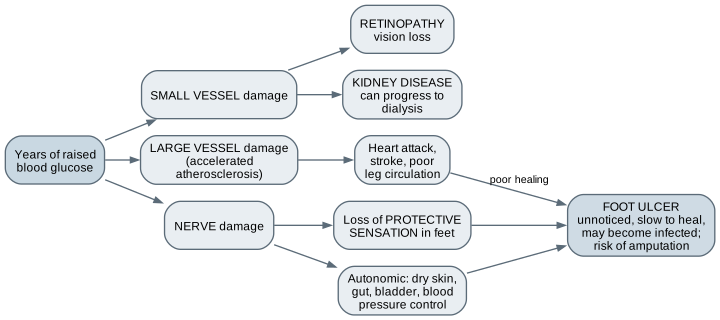
A stroke is sudden loss of brain function from a vascular cause. About eighty-five percent are ischaemic: a vessel is blocked, and treatment restores flow with clot-dissolving drugs or by pulling the clot out through a catheter. The rest are haemorrhagic: a vessel bursts, and clot-dissolving drugs would be disastrous. That is why the first test is a CT scan to exclude bleeding. The symptoms, one-sided weakness, facial droop, speech or vision loss, depend on which part of the brain lost its supply, not on the mechanism. So a stroke survivor's needs are highly individual: the clearest possible case for the rule that a diagnosis is not a specification. Heart failure, asthma, and COPD Heart failure Pump cannot meet demand at normal pressures Congestion: breathless lying flat; swollen legs Kidneys retain fluid — a maladaptive loop Daily weighing; telemonitoring Obstructive airways Asthma : variable, reversible narrowingCOPD : persistent, largely irreversibleTreatment is inhaled — technique is often poor Heart failure means the heart cannot pump enough to meet the body's needs at normal filling pressures. Pressure backs up behind the failing pump, so fluid gathers in the lungs, causing breathlessness lying flat, and in the legs. Reduced forward flow makes the kidneys retain salt and water, a maladaptive loop that worsens congestion. For a designer that means a user who tires quickly, whose legs change size through the day, and who weighs daily, because a rapid gain is fluid. Asthma and COPD both obstruct the airways. Asthma is variable and reversible; COPD is persistent and largely irreversible. Both are treated with inhalers, and a large share of people use them incorrectly. That is a human factors problem. Diabetes and the foot where everything converges Small-vessel, large-vessel, and nerve damage converge on the foot: lifetime ulcer risk about 1 in 5 to 1 in 3
The 10 g monofilament test: absence of a pain report is not evidence of absence of harm.
Diabetes is chronically raised glucose from failure of the insulin system; over half a billion adults live with it. Type one is autoimmune destruction of insulin-making cells; type two, about ninety percent, combines insulin resistance with failing secretion. The danger is mostly in the complications, from years of damage to vessels and nerves. On the foot they converge. Neuropathy removes the pain that would warn of a stone in the shoe. Autonomic damage dries and cracks the skin. Vascular disease slows healing. Retinopathy may stop the person inspecting their own feet. The lifetime ulcer risk is roughly one in five to one in three. Loss of protective sensation is screened with a ten-gram monofilament. Cancer What makes it cancer Accumulated genetic changes, mostly acquired Hallmarks: grow, ignore stop signals, resist death, spread Benign stays local; malignant invades and metastasisesStaging: TNM — tumour, nodes, metastasis Where makers fit Radiotherapy immobilisation masks and positioning aids Lymphoedema garments, prosthetics, head coverings Examination models with embedded findings Mostly thermoplastic, textile, sewn, and cast — not rigid parts Cancer is uncontrolled growth of cells that have accumulated genetic changes letting them escape the normal controls on division, location and death. Most changes are acquired during life, from copying errors, tobacco, radiation and some viruses; a minority are inherited. The hallmarks include growing without signals, ignoring stop signals, resisting apoptosis, recruiting a blood supply, and invading. A benign tumour stays local; a malignant one invades and can metastasise, which causes most cancer deaths. Staging by tumour, nodes and metastasis drives treatment. Cancer care is rich in physical needs, and notice how few are rigid parts: thermoplastic masks, compression textiles, sewn soft goods and cast silicone. Immunity turned inward, and wear Autoimmunity Type 1 diabetes, rheumatoid arthritis, MS, coeliac, lupus Chronic and relapsing: design for the flare Immunosuppressed users make cleanability more important Degeneration Osteoarthritis: the whole joint, not just wear Osteoporosis: T-score −2.5 or below; hip fractures Alzheimer's and Parkinson's: neuron loss In autoimmune disease the adaptive immune system attacks the body's own tissues, and the target determines the disease: insulin-producing cells, joint linings, myelin, the gut lining, the thyroid. These conditions are chronic and relapsing, so a device designed on a good day may be unusable during a flare, and many users take immune-suppressing drugs that make cleanability more important. Degenerative diseases include osteoarthritis, which involves the whole joint and directly affects grip and pinch; osteoporosis, where bones fracture from minor falls; and neurodegenerative disease such as Alzheimer's and Parkinson's, where particular neurons are lost and symptoms appear only after many have gone. Genes and inheritance Pattern How it works Examples Autosomal dominant One altered copy; 1/2 per child Huntington's, BRCA1/2 Autosomal recessive Two copies; carrier parents: 1/4 affected, 1/2 carrier Cystic fibrosis, sickle cell X-linked On the X chromosome; males affected more Haemophilia, red–green colour deficiency Multifactorial Many genes plus environment Type 2 diabetes, heart disease, most cancers
Pharmacogenomics: "the standard dose" is a population average.
The genome is about three billion base pairs in twenty-three pairs of chromosomes, with roughly twenty thousand protein-coding genes. A mutation changes the sequence; most have no effect, some change a protein's behaviour, and they may be inherited or acquired. In dominant inheritance one altered copy is enough, so an affected parent passes it to each child with probability one half. In recessive inheritance two copies are needed: two carrier parents have a quarter chance of an affected child with each pregnancy. Most common diseases are multifactorial, so "it runs in the family" usually means risk, not destiny. Genetic test results are often probabilistic, affect relatives, and are among the most sensitive data there are. Engineering bridge Failure modes, exponential growth, and risk
Now the engineering bridge. Disease as failure mode — and where the analogy breaks Engineering failure Disease mechanism Supply interruption Ischaemia: heart attack, stroke, pressure injury Blocked pipe Atherosclerosis, thrombosis, airway obstruction Pump failure Heart failure Control-loop failure Diabetes; runaway feedback in shock Sensor failure Neuropathy Uncontrolled replication Cancer Intrusion detection attacking its own system Autoimmunity
It breaks: tissue repairs, causes are probabilistic, and the system is a person with priorities.
Engineers think in failure modes, and the analogy is useful. Supply interruption is ischaemia. Blocked pipes are atherosclerosis and thrombosis. Pump failure is heart failure. Control-loop failure is diabetes. Sensor failure is neuropathy, and every injury it allows. Uncontrolled replication is cancer, and an intrusion detector attacking its own system is autoimmunity. It breaks in three places. Living tissue repairs and adapts, so damage is not simply cumulative. Causes are probabilistic and multifactorial. And the system is a person with their own priorities about which risks to take. Use the analogy to ask questions, not to predict outcomes. Exponential growth 30 doublings
From one 10-micrometre cell to a 1 cm tumour of about a billion cells — ten more reach a kilogram
By the time a tumour is detectable, most of its doublings have already happened.
Bacteria can double every twenty minutes or so; cancer cells take weeks to months, but the arithmetic is the same. A single cell about ten micrometres across needs roughly thirty doublings to reach a tumour of about a centimetre and a billion cells, around the smallest size many imaging methods reliably detect. Ten more doublings reach a trillion cells and a kilogram. So by the time a tumour is detectable, most of its doublings have already happened. That is the arithmetic behind screening. Run backwards, it explains why disinfection is specified in log reductions: kill ninety-nine percent of a doubling population and it regrows in under seven doublings. Relative and absolute risk Measure Placebo 2%, drug 1% over five years Relative risk 0.5 Relative risk reduction 50% — "halves your risk!" Absolute risk reduction 1 percentage point Number needed to treat 100 people for five years to prevent one Same 50%, baseline 0.2% ARR 0.1 points; NNT 1000
Relative risk without baseline risk is uninterpretable. State the baseline, the absolute difference, and the NNT.
Every claim about a disease, treatment or device is ultimately a statement about risk, and the same result can look very different. Suppose a heart attack occurs over five years in two percent of people on placebo and one percent on a drug. The relative risk reduction is fifty percent: halves your risk. The absolute reduction is one percentage point. The number needed to treat is a hundred: a hundred people take the drug for five years so that one avoids a heart attack; ninety eight would not have had one anyway. In a population with a baseline of point two percent, the same fifty percent is an absolute reduction of a tenth of a point and a number needed to treat of a thousand. Devices, software, and training Devices and software CGMs and pumps; home BP monitors; inhalers and spacers Compression devices; wearable rhythm monitors Early warning scores — explainable, tied to an action Sepsis alerts — a cautionary category; validate locally Where makers fit Examination models with embedded findings Silicone over machined or printed moulds, fabric reinforcement Electronics for a palpable pulse or pressure sensing Inhaler technique trainers Many devices exist to monitor, manage or prevent these mechanisms: continuous glucose monitors and pumps, home blood pressure monitors, inhalers and spacers, compression devices, and wearable rhythm monitors, whose screening role raises the positive predictive value problem directly. In software, early warning scores are a good model: simple, explainable and tied to a defined action. Automated sepsis alerts are a cautionary tale; at least one widely deployed model performed far worse on independent validation than claimed. The maker's way in is through training models with embedded findings: breast lumps of graded size and depth, diabetic foot lesions, swollen joints. Silicone over machined or printed moulds, fabric reinforcement, and electronics for what silicone cannot do. Worked example: a foot-inspection aid Mechanism Requirement it generates Neuropathy in feet No sharp edges where it meets the foot; nothing that heats Neuropathy in hands Large, high-friction grip; no fine pinch Retinopathy or cataract Magnification, lighting, or a large high-contrast camera display Arthritis or obesity Works with the foot on the floor; no bending Balance problems Usable seated Immune impairment Cleanable, no crevices
"And it could flag ulcers automatically" makes it software with a clinical claim — a different project.
A podiatrist asks for an aid to help patients inspect the soles of their own feet daily. The naive brief is a mirror on a stick. Decompress the diagnosis instead. Neuropathy in the feet means no sharp edges and nothing that heats. Neuropathy in the hands means a large, grippy handle. Retinopathy or cataract means magnification and lighting, or a camera with a large display. Arthritis or obesity means it must work with the foot on the floor. Balance problems mean usable seated. Immune impairment means cleanable. The mirror on a stick fails at least four rows. And if someone suggests it could flag ulcers automatically, record it: that is software making a clinical claim, a different project. Then check every row with the podiatrist and the patients. Workshop exercise and exit criteria Decompress one diagnosis into eight user implications, marked as hypotheses Draw the feedback loops in heart failure Apply Virchow's triad to a drawing of a fluid path Doublings to a 1 cm tumour; rewrite a headline as ARR and NNT Draw a recessive pedigree For the exercises: decompress one diagnosis, perhaps stroke, heart failure or Parkinson's, into at least eight implications for someone using an everyday object, and mark each as a hypothesis to verify. Sketch the feedback loops in heart failure. Apply Virchow's triad to a drawing of a fluid path. Calculate the doublings from a cell to a centimetre tumour. Find a news story claiming a percentage risk cut and rewrite it as an absolute reduction and a number needed to treat. And draw a three-generation recessive pedigree; the chance that an unaffected sibling is a carrier is not one half. What this chapter does not establish You cannot diagnose anyone You cannot advise anyone about their condition, risk, or treatment Your decompressed diagnosis is a list of hypotheses You cannot interpret genetic test results Next — Across the lifespan, and the mind.
The limits. Recognising a mechanism is not recognising the disease in a person; diagnosis is clinical work. You cannot advise anyone about their condition, their risk or their treatment, not even informally, and not even someone you are designing for; refer them to their clinical team. A diagnosis you decompress is a list of hypotheses, checked with the person and their clinicians. Genetic results need specialist interpretation and counselling. And the failure-mode analogies suggest questions, not answers. Next, across the lifespan, and the mind.