Chapter 12
Across the lifespan, and the mind
Children, older adults, and the minds that operate every interface
Human Biology for the Medical Maker
Why this chapter exists
- Children are not small adults
- Older adults change system by system, gradually and unevenly
- The mind: attention, memory, load, dementia, mental health, stress
- Every interface is operated by a mind
Design for the range of real users, not the middle of it.
Children are not small adults
Proportion, airway, physiology, behaviour
Size and proportion

Newborn about 3.5 kg and 50 cm; head a quarter of body length; 2–3 times the skin surface per kilogram
The airway: narrow, and the fourth power
16×
Resistance rise from 1 mm of swelling in a 4 mm infant airway — the same swelling in a 16 mm adult airway: 1.7×
The same insult that is trivial in an adult can be life-threatening in an infant.
Physiology by age
| Age | Heart rate | Breathing rate |
|---|
| Newborn | 110–160 | 30–60 |
| Infant | 100–160 | 30–40 |
| Toddler | 95–150 | 25–35 |
| Pre-school | 95–140 | 25–30 |
| School age | 80–120 | 20–25 |
| Adolescent and adult | 60–100 | 12–20 |
An alarm limit is a function of age. Typical orientation ranges only; sources differ.
Water, blood, heat, and skin in the newborn
- Body water 75–80% of mass; dehydration develops fast
- Blood volume about 300 mL in a 3.5 kg baby — samples matter
- Cannot shiver; heats with brown fat; cools in minutes
- Thin skin: absorbs more, tears when adhesive tape is removed
Behaviour, consent, and a field of its own
Capability races ahead of judgement
- Pincer grasp from 9–10 months; mouthing everything
- Climbing, opening, unscrewing, testing
- Small-parts, cord, and entrapment rules come from this
Paediatric devices
- Assent from the child, consent from the carer
- Weight-based everything: tenfold errors
- Many sizes; length-based tapes
- Small markets: much is adapted or off-label
Pregnancy, briefly
- Blood volume up about 40–50%; resting heart rate rises
- Lying flat late in pregnancy can compress the great vessels
- Ligaments soften, centre of mass moves, falls more likely
- Ionising imaging weighed especially carefully
Two people are affected by any intervention, and most devices are validated on neither.
Older adults
Gradual, uneven, individual — and reduced reserve
Ageing system by system
| System | Typical change | Design consequence |
|---|
| Skin | Thinner; layers separate easily | Skin tears from adhesives and edges |
| Muscle | Sarcopenia; power falls faster than strength | Lower operating forces |
| Bone | Osteoporosis | A minor fall can break a hip |
| Vision and hearing | Presbyopia; high-frequency loss | Larger text; lower-pitched, visual alarms |
| Balance and gait | Slower, shorter steps | Falls; no short time limits |
| Kidneys | Filtration falls on average | Drugs accumulate |
| Cognition | Slower processing; dementia is not normal ageing | Fewer steps, clearer feedback |
Frailty and falls
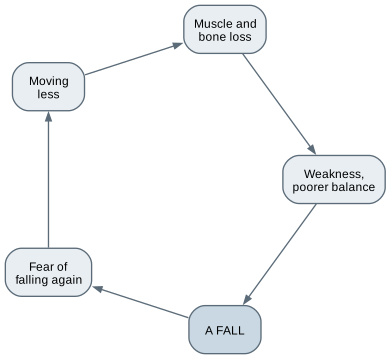
- Frailty: reduced reserve across systems; grip and gait speed are measured
- About a third of over-65s in the community fall each year
- Most contributors are environmental or design factors
- A trailing charging cable is a fall waiting to happen
Polypharmacy, and designing for older users
Many conditions, many medicines
- Five or more medicines is common
- Ageing changes drug handling
- Openable by arthritic hands, not by children — a real tension
Design rules
- Text sized for distance; high contrast
- Lower-pitched sounds, always duplicated visually
- Low forces, no fine pinch, no short timeouts
- Respect: adults reject childish designs
The mind
The resources every interface spends
Attention, working memory, executive function
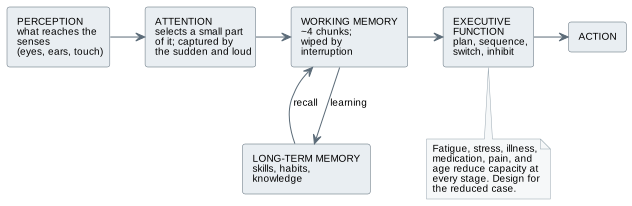
Attention is limited; working memory holds about four chunks and is wiped by interruption; executive function fails first under stress
Dementia and delirium
| Dementia | Delirium |
|---|
| Onset | Gradual, months to years | Sudden, hours to days |
| Course | Progressive | Fluctuates; often reversible |
| Attention | Often preserved early | Impaired — the core feature |
| Urgency | Long-term support | A medical emergency, often missed |
Clocks, lighting, glasses and hearing aids in use, familiar objects: delirium is partly a design topic.
Mental health, neurodiversity, and language
Mental health
- Around one adult in five in a given year
- Depression, anxiety, psychosis, and more
- "A person with schizophrenia"; "died by suicide"
Learning disability and autism
- Easy-read information with pictures
- Predictable sequences and previews
- Control over sound and light
- A bright, noisy clinic is itself a barrier
Stress and performance
- High stress narrows attention and shrinks working memory
- People fall back on habit — right or wrong for this device
- Make the critical action the obvious one
- Keep conventions; reduce alarms to those needing action
- Assume interruptions
Ligature risk in mental-health settings
Any object you make that will go onto a mental-health ward must be assessed against that environment before it is introduced.
Cords, cables, lanyards, and straps are ligatures; rigid fixtures may be ligature points. The ward's risk assessment decides.
Engineering bridge
Scaling, distributions, choice, and falls
Scaling: weight versus surface area
| Person | BSA by Mosteller | Per kilogram |
|---|
| Adult, 170 cm, 70 kg | 1.82 m² | 0.026 m²/kg |
| Newborn, 50 cm, 3.5 kg | 0.22 m² | 0.063 m²/kg |
"Per kilogram" is a modelling choice, not a law of nature — software must state which model it uses.
Distributions and choice
Growth charts and percentiles
- 2% of healthy children lie below the 2nd centile
- Trajectory matters more than the point
- 5th–95th on several dimensions excludes far more than 10%
Hick's law and working memory
- Decision time grows with log of options
- Its slope grows with age, fatigue, stress
- More than about four new items will fail for some users
- Recognise beats recall
The physics of a fall
- E = m × g × h: 70 kg, hip drops 0.9 m, about 620 J
- Hard floor: a few cm of stopping distance, kilonewtons of force
- Reduce h: a 20 cm low bed carries under a quarter of the energy
- Increase stopping distance: hip protectors, impact flooring
- Prevent the fall; shorten time on the floor
Devices, and three firm boundaries
Devices and entry points
- Incubators, length-based tapes, hip protectors, low beds
- Easy-read information, signage, ward clocks
- Paediatric manikin replacement parts
- Writing, graphics, sheet materials, fabrics, electronics, software
Boundaries
- Children: small parts, cords, entrapment, button cells, magnets
- Frail adults: anything load-bearing is prescribed
- Mental health: nothing enters without ligature assessment
Worked example: the elbow model goes to two new places
Children's ward
- Small parts: captive or redesigned; no coin cells
- Cord: short, no head loop, breakaway
- Hinge: guard finger traps
- Wipeable; picture labels
Falls-prevention group
- Labels for 1–2 m and 6/12 vision
- Whole-hand tab, low bending force
- One action: "Pull the red handle"
- Looks like equipment, not a toy
Who exactly will handle this, where, and with whom present? Could it ever reach a mental-health ward?
Workshop exercise and exit criteria
- Body surface area: you, a newborn, a ten-year-old
- Plot airway resistance against radius
- Fall energy at bed, chair, and hip height; a home hazard list
- Cognitive-load audit; an easy-read rewrite tested on someone
- A ligature walk at home — just to see
What this chapter does not establish
- You cannot assess development, frailty, cognition, or mental health
- You cannot calculate doses
- You cannot make anything ligature-safe by your own judgement
- Simulation suits do not give lived experience
- Work with children follows your host's safeguarding rules
Next — Infection control and choosing materials.