Chapter 14
Making it: choosing the technology and the method
Start from the need; the method is the last decision, not the first
Human Biology for the Medical Maker
Why this chapter exists
- A workshop shapes how its owner sees problems
- Printer: printable problems. Lathe: turned parts. Code: an app
- Useful in a clinic: several tools, and the judgement to pick one
- Three things: a decision framework, each family as a clinic sees it, prototype to product
The questions that choose the method
| Question | What it rules in or out |
|---|
| How many, how often? | Tooling pays only at volume; one-offs favour printing, machining, hand work, software |
| What does it touch, for how long? | Contact category may remove the method entirely |
| How is it cleaned, by whom, with what? | Porous materials, crevices, exposed electronics fail first |
| What loads; how does it fail? | Layered and bonded parts are weak across joins; glass gives no warning |
| How accurate; what does it mate with? | Tolerance sets process and inspection |
| Who maintains it, for how long? | Standard parts, spares, documentation |
| Power, sensing, logic? | Electronics, firmware, batteries, EMC |
| Which risk tier? | Tier 3 is not a fabrication question for you |
The options before fabrication
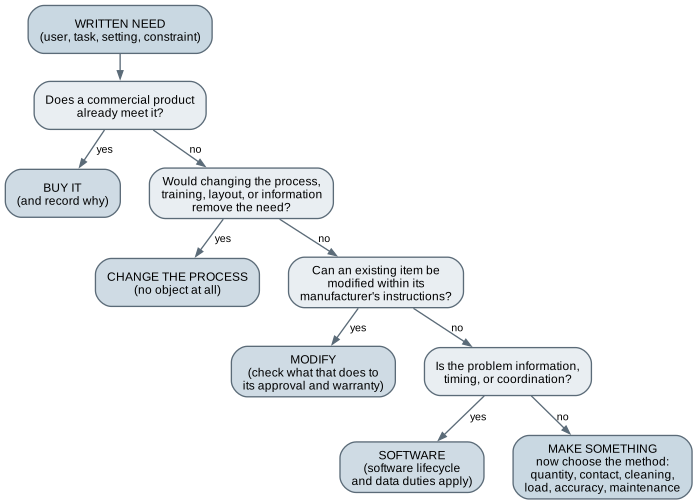
- Buy it — finding an existing product is a success
- Change the process — move the storage, add a checklist
- Modify — but that can void the manufacturer's evidence
- Software — if the problem is knowing
A made object arrives with you, and you will not be on the ward at three in the morning.
The technology families
As a clinical setting sees them
Software and electronics
Software
- Good at information, coordination, teaching, change
- Bad at force, protection, failing when power or login does
- Intended use can make it a medical device
Electronics and embedded
- Sense, decide, signal — and the most new obligations
- Patient connection is IEC 60601-1 territory
- Battery, low-voltage, self-contained is the realistic space
- Firmware is software; electronics fail silently
Electronics in a clinical environment
| Concern | In practice |
|---|
| Batteries | Protected cells, certified chargers, room to swell |
| EMC | Must neither disrupt nor be disrupted by nearby equipment |
| Ingress | IPX4 resists splashing; IP67 survives brief immersion |
| Cleaning chemicals | Crack polycarbonate and acrylic; lift labels; wick into seams |
| Realistic examples | Switch-adapted toys, timers, feedback trainers, test fixtures, equipment loggers |
Additive manufacturing — one family among many
| Process | Accuracy | Surface Ra | Character |
|---|
| FDM / FFF | ±0.2–0.5 mm | 10–25 μm+ | Cheap, fast; weak between layers; porous |
| SLA / DLP resin | ±0.05–0.15 mm | 1–5 μm | Fine detail; cure and washing critical |
| SLS / MJF nylon | ±0.2–0.3 mm | 5–15 μm | Strong, no supports; trapped powder |
| Metal powder bed | ±0.05–0.2 mm | 5–15 μm | Titanium lattices; industrial, heavy post-processing |
Strong for complex one-offs, imaging-derived geometry, and jigs. Wrong for repeatedly cleaned items, cross-layer loads, and volume.
CNC machining and subtractive methods
Strengths
- Certified stock, fully dense, no voids
- ±0.02–0.1 mm routinely; Ra 0.8–3.2 μm, finer polished
- Repeatable once the program is proven
- Laser, waterjet, routing for sheet
Clinical traps
- Burrs and sharp edges tear gloves and skin
- Coolants must be removed
- Deep tapped holes trap soil
- Never laser-cut PVC; machined acrylic crazes with alcohol
Moulding, casting, and forming
| Method | Good at | Watch for |
|---|
| Injection moulding | Thousands to millions of identical parts | Tooling cost and lead time; draft, uniform walls |
| Overmoulding | Soft grips, sealed electronics | Crevices at the interface |
| Silicone casting | Soft, skin-like parts in small batches | Cure inhibition, bubbles, tears |
| Polyurethane casting | Short runs from silicone moulds | Isocyanate safety |
| Thermoforming | Shells, trays, splints, orthoses | Thinning at corners; trimmed edges |
Silicone casting and vacuum forming are the most accessible members — and among the most medically useful.
Metalwork
| Material | Strengths | Clinical traps |
|---|
| 304 stainless | General purpose, weldable | Pits with chlorine disinfectants and saline |
| 316L stainless | Chloride resistant; usual for wiped equipment | Needs passivation after fabrication |
| Martensitic stainless | Hardenable cutting instruments | Lower corrosion resistance |
| Titanium | Light, strong, biocompatible | Cost; galling; inert welding |
| Aluminium | Light; anodised | Alkaline detergents attack anodising; galvanic corrosion |
Passivate stainless; make welds continuous and ground; match fasteners to the base metal.
Glasswork and textiles
Glass
- Borosilicate: inert, heat- and shock-resistant
- Scientific glassblowing: one-off apparatus a printer cannot make
- Optics: endoscopes, microscopes, eye models
- Breaks into sharps — enclose or avoid in patient areas
Textiles and soft goods
- Straps, slings, covers, positioning aids, garments
- Every stitch hole is a path for fluid: weld or tape seams
- Design for the real laundry: 65 °C for 10 min or 71 °C for 3
- Hook-and-loop collects soil; a strap edge is a pressure source
Wood, and combining methods
- Wood, cork, leather, card: concept models, jigs, home and community aids
- Generally excluded from clinical areas — porous; when used, enclosed and covered
- Most good objects are hybrid: each interface is a crevice, bond, or galvanic couple
- DFMA: fewer parts, standard stock, wrong assembly impossible, every part traceable
From prototype to product
Each step adds obligations that have nothing to do with the workshop
The ladder

Prototype → one-off for use → batch → product: each step adds documentation, repeatability, and finally a manufacturer
Process validation and material certificates
Process validation
- For output you cannot fully inspect
- IQ: installed as specified
- OQ: acceptable across the allowed settings
- PQ: consistent in normal production
Where material came from
- Mill certificates and certificates of conformity
- Medical-grade polymers: test data and change notification
- Hardware-store sheet: neither
"We tested one and it was fine" is not an answer for welding, moulding, sealing, or bonding.
Why the hospital may prefer to buy, and what you hand over
Continuity
- A manufacturer who answers for it
- Evidence, validated cleaning, spares, service, recall
- Make continuity part of what you deliver
The handover pack
- Drawings, native and neutral CAD, Gerbers, patterns
- Bill of materials with grades and suppliers
- Process notes, programs, firmware versions
- Inspection, cleaning, spares, limitations
Engineering bridge
Costs, tolerances, surfaces, and energy
The cost model
≈ 1,540 parts
Break-even for an invented clip: printed at £6 each with no tooling, versus moulded at £0.80 after an £8,000 tool
Cost is incomplete without suitability: the moulded part is dense, smooth, repeatable, and certified.
Tolerances and surfaces
| Surface | Typical Ra |
|---|
| Electropolished stainless | 0.1–0.4 μm |
| Injection moulded, polished tool | 0.05–0.4 μm |
| Machined | 0.8–3.2 μm |
| Resin print | 1–5 μm |
| Powder bed, as built | 5–15 μm |
| FDM print, as built | 10–25 μm or worse |
| A bacterium, for scale | about 1 μm |
Four parts at ±0.1 mm: worst case ±0.4 mm, statistically about ±0.2 mm.
Battery energy and process capability
Batteries
- One 18650 cell: about 9–13 Wh
- Four-cell pack: 40–50 Wh, about 150–180 kJ
- Thermal runaway: very hard to extinguish
- Protected cells, proper chargers, no improvised packs near oxygen
Process capability
- Not "is this part good?" but "will the next hundred be?"
- Cpk = distance from mean to nearest limit ÷ 3σ
- 1.0 just fits; 1.33 is a common target
- Measure ten consecutive parts and find out
Where making happens in healthcare
| Setting | How a maker fits |
|---|
| Clinical engineering workshops | The natural host; they own review and risk |
| Hospital and university maker spaces | Entry point; check governance for anything leaving the room |
| Orthotics and prosthetics labs | Thermoforming, lamination, CAD/CAM; prescription stays clinical |
| Rehabilitation engineering | Electronics, metalwork, textiles together; user-led |
| Dental laboratories | Milled, printed, cast, pressed — a mature digital workflow |
| Sterile services | Decide whether your object survives reprocessing — ask early |
Range is the asset: present your skills as options weighed against a need, not access to a machine.
Worked example: thirty elbow models
| Candidate | Problem for this need |
|---|
| FDM printing | 120 parts with soil-trapping layers; variable pivot fit; labels wear |
| Laser-cut acrylic | Crazes with alcohol wipes at stressed edges |
| CNC acetal or HDPE | Programming and fixturing; acetal does not glue |
| Casting | Unnecessary for rigid segments |
| Injection moulding | Tooling far beyond break-even at 30–60 |
Choice: CNC-routed acetal or HDPE, a 316 shoulder bolt pivot, a replaceable polyester cord, engraved labels.
The lesson of the worked example
The method that made the best prototype was not the method that made the best batch.
The decisive fact — the wipes would crack acrylic — came from asking how it would be cleaned, not how it would be made.
Workshop exercise and exit criteria
- Run three needs through the decision diagram — one ends without fabrication
- Compare four methods for a real object, with cleaning agent and quantity
- Break-even plot from real quotes, 1 to 10,000 units
- Wipe test five materials 200 times; inspect for crazing
- Cpk from ten parts; a handover pack someone else can use
What this chapter does not establish
- You are not a manufacturer
- A process you have run is not a validated process
- Material compatibility is a test result, not a datasheet line
- A small voltage does not establish electrical safety
- Range of skill does not replace the team
Next — Measurement, imaging, and the diagnostic laboratory.