Chapter 18
Discovering a clinical need
Hear the proposed solution, set it gently aside, and find the problem underneath
Human Biology for the Medical Maker
Why this chapter exists
"Could you make us a holder for these?" — "Could you write us an app?" — "Could you put a sensor on it so it beeps?" — "Could you sew a cover for it?"
Requests arrive shaped like the requester's guess at what you can make
The skill, and the timescale
- Hear a proposed solution and set it gently aside
- Find the problem underneath — without being tiresome
- Never substitute your guess for their expertise
- Finding a collaborator takes longer than learning the biology
Start outreach in week one.
Who is who
| Role | What they can tell you |
|---|
| Nurse | How the task really happens; what gets improvised; the night shift |
| Doctor | Clinical context; what is and is not negotiable |
| Occupational therapist | Key partner for assistive technology: function in context |
| Physiotherapist | Range, strength, safe loading, progression |
| Prosthetist or orthotist | The closest professional equivalent to a skilled maker |
| Simulation educator | Key partner for training aids: objectives and misconceptions |
| Clinical engineer | Local standards, electrical safety, who approves what |
Who is who: the gatekeepers
| Role | Why they matter |
|---|
| Infection prevention and control | Must review anything shared or reusable |
| Pharmacist | Anything touching medicines |
| Procurement | What exists, what it costs, why it was chosen |
| Information governance | Must approve anything with real data or photographs |
| Quality and regulatory | Whether a locally made item can be used at all |
| Innovation office | Often your actual route in |
| The intended user | The only expert on their own experience and priorities |
Two inputs, not one
The clinician
- Professional assessment
- "Limited pinch strength"
The user
- Lived experience, priorities, context
- "I want to fasten my own coat before my grandchild arrives"
Neither is sufficient alone. A device needing two hands to put on defeats the purpose.
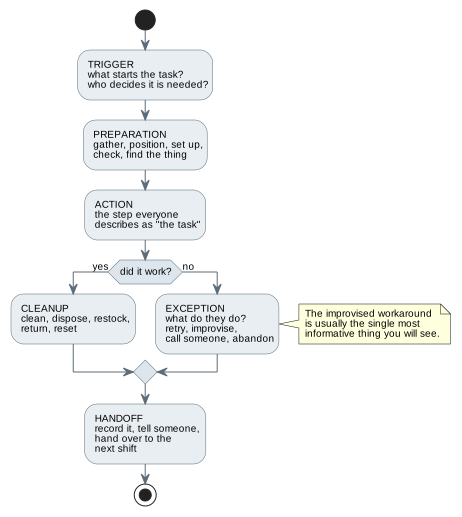
Map the whole task, not the difficult moment
- Trigger, preparation, action, exception, cleanup, handoff
- Newcomers watch the action step
- The difficulty is usually elsewhere: finding it, cleaning it, recovering
- Ask: who, how long, how often, what goes wrong, what is improvised
Look for the tape
The workaround
Tape, an elastic band, a cardboard wedge, a bent paperclip, a second person holding something
A solution someone already built under the real constraints. It tells you more than any amount of asking.
Interviewing: ask for a specific recent instance
| Instead of | Ask | Because |
|---|
| "Would this help?" | "Tell me about the last time this happened." | An account you can analyse beats politeness |
| "Is the current one bad?" | "Walk me through how you did it this morning." | Concrete and recallable |
| "Would an app help?" | "What makes this part of the job difficult?" | Does not pre-commit to a solution |
| "How often does it happen?" | "When did it last happen? And before that?" | People recall instances better than frequencies |
| "Would you use it?" | "What do you do now instead?" | The workaround is the real baseline |
Summarise back, and stay within the process
- "So the problem is X, it happens about Y, you do Z now, and W would help. Have I got that wrong?"
- People correct a wrong summary more readily than they volunteer a right one
- Observation and interviews only through the host's authorised process
- No patient identifiers; no photographs without permission — check the background
- If unsure whether it is permitted, it is not — until you ask
Write a need without choosing the answer
A way to [who] to [achieve what outcome] that [overcomes what constraint].
Who, what difficulty, what outcome — then stop. No technology, material, or mechanism.
Bad and good need statements
| Statement | Verdict |
|---|
| ✗ | "We need a motorised elbow model with an app." | Commits to actuation, electronics, software |
| ✗ | "Learners don't understand the elbow." | Too broad to design or assess |
| ✗ | "Nurses need an app." | Names a technology and no problem |
| ✓ | Learners need to distinguish muscle force generation from tendon transmission | Population, difficulty, understanding; solutions open |
| ✓ | A way for a person with limited pinch to open their own medication packaging | Who, outcome, constraint; nothing about how |
Then gather the constraints
Use and environment
- Where: light, noise, space, water, interruptions
- Who: trained or not, gloved, one hand or two
- How often, how long; setup and reset time
- Storage, portability, power, cleaning
Life after you
- Maintenance and consumables in two years
- Existing solutions — and why they were rejected
- Cost, procurement, training
- Who owns it after you leave?
Separate evidence from interpretation
| Record type | Example | Next step |
|---|
| Observation | "A learner pointed at the cord and called it a muscle." | Record the task and explanation given |
| Interpretation | "The label may be unclear." | Generate at least one alternative |
| Assumption | "A coloured sleeve will fix it." | Mark untested; build a cheap comparison |
| Requirement | "Learners must distinguish force source from transmission." | Agree an observable test |
Write "one learner, on one occasion, said X" — not "learners find this confusing".
A sample conversation
| Speaker | What they said |
|---|
| Educator | "We need a better elbow model." |
| Maker | "What's difficult with the one you use now?" |
| Educator | "Learners watch me pull the cable, and think the cable is a muscle." |
| Maker | "When did that last come up?" |
| Educator | "Last Tuesday. Two out of six described the cord as contracting." |
| Maker | "And what do you do when that happens?" |
| Educator | "Explain it again. It costs me five minutes I don't have." |
What six questions produced
- Opening request: a solution with an unstated problem
- Actual difficulty: force generation versus transmission
- Baseline: about a third of learners, one session
- Workaround and its cost: five minutes of scarce time
- An unasked constraint: time
It ruled out the obvious "better model" — a more detailed shell would not fix this misconception.
Engineering bridge: filtering needs
| Criterion | Ask |
|---|
| Is it real? | Two independent people? An improvised workaround? |
| Does it matter? | Time, safety, dignity, cost — how often? |
| Is the outcome observable? | Could you tell it had improved? |
| Can you scope it? | Your time, skills, and supervision |
| Right risk class? | Walk away from invasive, life-supporting, decision-making |
| A sponsor? | A named person who wants it, reviews it, owns it |
| Does something exist? A route to use? | Find out why it was rejected |
"No" is useful information
- If a product exists and was rejected, understand why first
- Cost, availability, policy — none fixed by making one yourself
- A declined project is three months you did not waste
- Intellectual property: ask at the start who owns what
- For volunteer work: an open licence, and the host owns deployment
Worked example: "Can you make us a holder?"
What the conversation found
- Items roll off a trolley about twice a week
- 90 seconds to re-fetch; concentration broken
- Workaround: a folded blue-roll wedge
- Commercial tray doesn't fit; three users; wipes; no setup time
Need statement
- Keep items stable and reachable on the existing trolley
- Cleanable with the current process
- Requiring no setup time
Five answers, and the requirements that fall out
- Change the trolley layout, agreed among the three users — no making
- A non-slip silicone mat, bought or cast to fit
- A welded stainless wire rack or folded sheet-metal tray
- A machined or thermoformed insert; a moulded or printed tray
- Checks: threshold test, timed setup, IPC review, fit, unprompted use
Pending, and recorded as pending — IPC review, sponsor confirmation, ownership.
Workshop exercise and exit criteria
- Rewrite "build an app for nurses" as three questions
- Write a need statement for the elbow model — no material or mechanism
- Map a task you can observe: lathe set-up or soldering works
- Constraint sweep, each answer known, assumed, or unknown
- Get the brief corrected; send one outreach email this week
What this chapter does not establish
- You cannot observe clinical work on your own initiative
- You cannot handle patient data without formal approval
- One conversation is not requirements gathering
- A confirmed brief is not permission to deploy
- You are not the person who decides what matters
Next — Requirements, hazards, and useful tests.