Chapter 21
Making a model that teaches
Design the learning first; the object serves it
Human Biology for the Medical Maker
Begin with what the learner must do
| Topic | Objective |
|---|
| "Understand the elbow" | After using the model, the learner will identify flexion and explain that a tendon transmits force produced by muscle |
| "Appreciate anatomy" | The learner will name the humerus, radius, and ulna and state which rotates during pronation |
| "Learn about joints" | The learner will predict the direction of movement and justify it by the attachment point |
An objective names an observable behaviour, by a specified learner, under specified conditions, to a standard.
Use verbs you can observe
Observable
- Identify, name, state, explain
- Describe, demonstrate, predict
- Compare, distinguish, justify, perform
Not observable
- Understand, appreciate, know
- Be aware of, be familiar with
- Grasp
If you cannot see it happen, you cannot tell whether your aid worked.
Bloom's taxonomy, briefly
| Level | Learner can | Elbow model example |
|---|
| Remember | Recall facts | Name the three bones at the elbow |
| Understand | Explain ideas | Explain what a tendon does |
| Apply | Use it in a new situation | Predict the motion when the attachment moves |
| Analyse | Find relationships | Why a shorter moment arm needs more force |
| Evaluate | Judge against criteria | What the model misrepresents and why it matters |
| Create | Produce something new | Design a modification that teaches pronation |
Your assessment must sit at the same level as your objective.
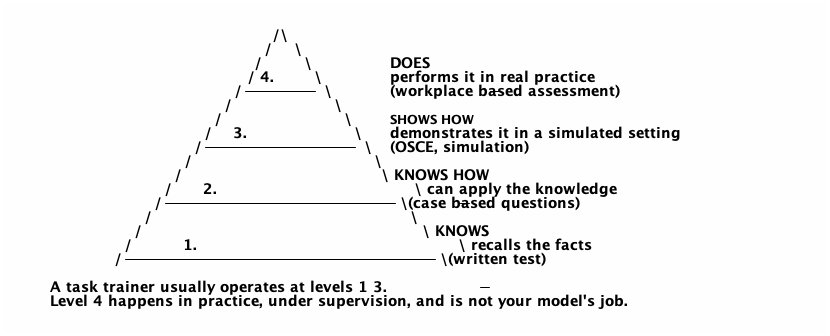
Miller's pyramid: knowing is not doing
- Knows; knows how; shows how; does
- A task trainer usually works at levels one to three
- Level four happens in practice, under supervision
- Be clear which level your aid addresses
Choose the realism that serves the objective
Fidelity is not one thing
Six kinds of fidelity
| Dimension | What it means | When it matters |
|---|
| Visual | Looks right: colour, texture, proportion | Recognising a structure or abnormal appearance |
| Anatomical / spatial | Correct structures in correct relationships | Locating something; what lies next to what |
| Tactile | Feels right: compliance, resistance, the pop of a layer | Procedural skills guided by feel |
| Mechanical / functional | Behaves right: motion, force path, cause and effect | How something works — the elbow model |
| Environmental | Noise, time pressure, the team | Performance under realistic conditions |
| Emotional | The learner behaves as they would for real | Decisions under stress |
Choose, then sacrifice
The question is never "how realistic should this be?" It is "realistic in which dimension, and why that one?"
For a force-path objective, a transparent or open construction teaches better than a lifelike one.
Each kind of fidelity is made a different way
| Fidelity | Typically made by |
|---|
| Visual | Moulage; pigmented cast silicone; vacuum-formed or printed surfaces; dyed fabrics; displays |
| Anatomical | Cast or printed from imaging; machined or laser-cut location features; sewn compartments |
| Tactile | Layered silicones and gels; fabric and mesh membranes; foams; embedded tubing |
| Mechanical | Turned pins and bushings; machined or laser-cut linkages; springs and cord; glass or acrylic fluid paths |
| Instrumented feedback | Force, pressure, and angle sensors with a microcontroller and a display |
| Environmental | Props, garments, lighting, sound; wearable hybrid trainers — mostly sewing |
Often the machined or printed part is a tool — a mould, a jig — not what the learner touches.
What our model needs, and does not
| Feature | Needed? | Why |
|---|
| Visible pivot | Yes | The joint must be identifiable |
| Clearly labelled force input, distinct from the cord | Yes | This is the objective |
| Visible relationship between pull and movement | Yes | Cause and effect must be observable |
| Exact bone contours; skin colour | No | Irrelevant; skin actively obscures the mechanism |
| Motorisation | No | Hides the force source — defeats the objective |
| Electronic angle readout | Optional | Only if the objective needs a number |
| Forearm rotation; true tendon insertion | Deliberately omitted | Out of scope — and must be stated |
Deliberate omissions are not failures. Undeclared omissions are.
Design the explanation as carefully as the object
The object does not teach; the interaction does
Predict, observe, explain
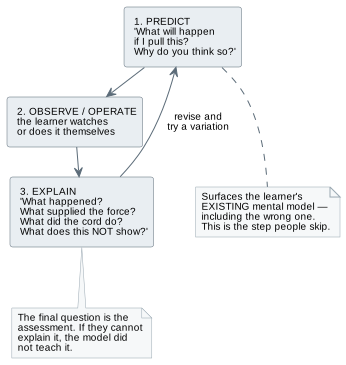
Predict surfaces the existing mental model; explain is the assessment
Always include: name something this model does not show.
A worked teaching script
| Stage | Script |
|---|
| Before movement | "Point to the upper arm and the forearm. Predict what happens if I pull this cord. Why?" |
| During movement | "Watch where the cord pulls, relative to the pivot. What changes?" |
| After movement | "What supplied the force? What does the cord represent? Name one thing this model does not show." |
| If they say the tendon contracts | Do not correct and move on. Record it, change the design, try another learner |
Their error is data about your design.
The irresistible mistake
Do not explain the answer while assessing whether the learner can produce it.
"Completed with two prompts" is honest and useful. "Completed" is not.
Evaluate learning and maintenance separately
Learning checklist
- Did they predict? Did the explanation match the objective?
- Did they name a limitation? What misconception appeared?
- Failure: a beautiful object that teaches the wrong thing
Object checklist
- Setup, reset time, damage, loose parts
- Cleaning, storage, visibility across a room, who maintains it
- Failure: a great demo that takes six minutes to reset
Reset time
18 minutes
lost to a 90-second reset in a class of twelve
Ask: "How long have you got between learners?" The answer is a first-class requirement.
Misleading cues: the real hazard
| Simplification | Might quietly teach | Mitigation |
|---|
| Single pivot | The elbow is one hinge with one degree of freedom | State the omission of pronation and supination every time |
| Cord pulled by hand | The tendon generates force | Label force input and transmission separately and redundantly |
| Guide loop placed for convenience | This is the tendon's real route | Label: model convenience, not an anatomical route |
| Manual reset | Extension is passive | State that reset is an external action |
| Rigid uniform strips | Bone is uniform; the limb is rigid | "Schematic, not to scale" |
| No cartilage or ligaments | A joint is just a pivot | List these among the stated omissions |
An anatomically qualified educator must review the anatomy, labels, and limitations — or it is recorded as pending.
Engineering bridge: materials and methods for simulation
Tissue simulants and trainer construction
Materials for simulation
| Material | Used for | Notes |
|---|
| Platinum-cure silicone | Skin, soft tissue, organ surfaces | Choose by the behaviour the objective needs |
| Gelatin, ballistic gel, agar | Needle insertion, ultrasound phantoms | Cheap, castable, perishable |
| Foams | Bulk, padding | Open-cell absorbs fluid — usually unsuitable where cleaning matters |
| Textiles | Fascia and membranes, wearable trainers, covers | Sewing gives strength and easy replacement; coated fabrics wipe clean |
| Glass, acrylic, polycarbonate | Vessels, transparent chambers, phantom containers | Glass is inert but breaks; acrylic crazes with alcohol cleaners |
| Machined and laser-cut parts | Skeleton, joints, frames, jigs | Acetal and brass make low-friction pivots |
| Printed polymers; sensors and microcontrollers | Complex shapes and moulds; measured feedback | Orientation against load; record the firmware version |
Realistic feel is a judgement
"Realistic feel" is an educator's judgement, not a durometer reading.
Make two or three candidates; the educator compares them; record which they chose and why.
Worked example: one objective
- Objective: identify flexion; explain that a tendon transmits muscle force
- Must make visible: the motion, the force input, the transmitter, the relationship
- May omit: appearance, exact anatomy, pronation, extension, scale
- Task: predict, watch, then say what supplied the force and one thing missing
The likely result, honestly recorded
Observed
- Understands flexion
- Thinks the cord supplies its own energy
- A partial result, not a failed project
Response
- Separate force source and transmitter further
- A distinct "muscle": sewn sleeve or cast silicone in a contrasting colour
- Re-test with a different learner
Workshop exercise and exit criteria
- Write one observable objective and an assessment at the same Bloom level
- Fidelity audit: every feature, its dimension, and whether it is needed
- Method map: two ways to make each kept feature, and which serves it better
- Write and run a predict–observe–explain script; record prompts verbatim
- Two checklists, a measured reset time, and educator review — or pending
What this chapter does not establish
- You cannot certify anatomical accuracy
- You cannot design a procedural trainer unsupervised
- One learner is not evidence of effectiveness
- Learner satisfaction is not learning
- A model that demonstrates is not a model that teaches
Next — Building and reviewing your first project.