Volume 3: Discrete and Probabilistic Mathematics · Part VI: Discrete Mathematics
Chapter 22. Proof and Induction
A program that passes a thousand tests can still be wrong; a statement that holds for forty cases can fail on the forty-first. This chapter is about the one tool that settles a question for every case at once: proof. We start with why checking examples is not enough, take apart what a proof actually is, and then build a toolkit of techniques: direct proof, contrapositive, contradiction, cases, and counterexamples. The second half is devoted to mathematical induction, the technique that is to proof what recursion is to programming, and ends by using the same ideas to prove that real code (binary search, insertion sort) is correct.
22.1. Why prove anything?
22.1.1. The problem
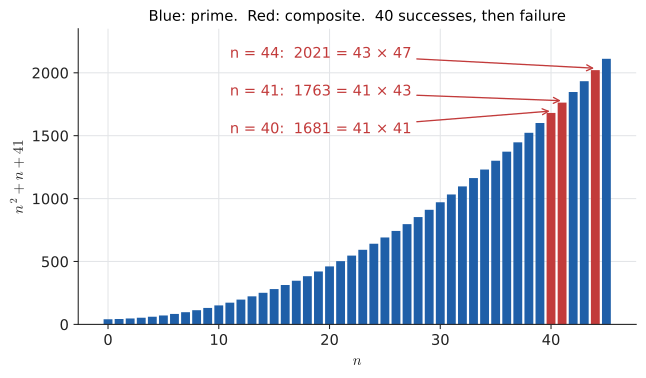
Here is a formula that looks like a prime-number generator:
Try it. \(f(0) = 41\), prime. \(f(1) = 43\), prime. \(f(2) = 47\), prime. \(f(3) = 53\), prime. \(f(4) = 61\), prime. Keep going and you will find prime after prime. Leonhard Euler noticed this in 1772. If you were writing a unit test for the claim "\(f(n)\) is always prime", you would probably stop at ten cases and declare victory. A more careful engineer might check a hundred.
Let the computer check:
def is_prime(n):
    if n < 2:
        return False
    d = 2
    while d * d <= n:
        if n % d == 0:
            return False
        d += 1
    return True

for n in range(100):
    value = n * n + n + 41
    if not is_prime(value):
        print(f"n = {n}: {value} is composite")
        break
else:
    print("no counterexample below 100")
n = 40: 1681 is composite
Forty consecutive successes, and then \(f(40) = 1681 = 41^2\). In hindsight it is obvious: when \(n = 40\),
And \(f(41) = 41^2 + 41 + 41 = 41 \cdot 43\) is plainly divisible by 41 too.
22.1.2. Intuition: evidence versus certainty
Checking examples gives you evidence. A proof gives you certainty. The difference is the difference between "it works on my machine" and "it works on every input the type system allows".
Mathematics cares about statements of the form "for all \(n\)", and "all" is infinitely many. No finite amount of testing covers infinitely many cases. A proof is a finite argument that covers them all at once, because it reasons about a general \(n\) rather than any particular one.
That is also why a single failing case is decisive. "For all \(n\), \(f(n)\) is prime" is destroyed by one \(n\) that fails. Proving a universal claim is hard; disproving one needs just one counterexample.
|
Theorem, lemma, corollary, conjecture
|
|
Conjectures that failed very late
The Euler polynomial fails at 40. Some patterns hold for far longer. In 1919 George Pólya conjectured that, for every \(N \ge 2\), at least half of the numbers up to \(N\) have an odd number of prime factors (counted with repetition). It was checked extensively by hand and was widely believed. The smallest counterexample, found by computer in 1980, is \(N = 906{,}150{,}257\). No amount of hand testing would ever have found it. |
22.1.3. Where you’d use this
Proof is not only for mathematicians. Wherever a mistake is expensive and the cases are too many to test, people reach for it.
-
Hardware. In 1994 Intel’s Pentium processor was found to divide slightly wrongly for rare inputs: 4,195,835 / 3,145,727 came out as 1.333739 instead of 1.333820. The flaw sat in five missing entries of a lookup table that random testing had not hit. Replacing the chips cost Intel a $475 million charge, and the company turned heavily to machine-checked proofs for its floating-point hardware afterwards.
-
Distributed systems. Engineers at Amazon Web Services write precise specifications of protocols (in the language TLA+) and check them exhaustively. In one published case a model checker found a bug in a DynamoDB replication design whose shortest triggering sequence was 35 steps long, far deeper than any test or code review had reached.
-
Engineering and everyday reasoning. A structural calculation showing that a beam carries its design load is a direct proof from stated assumptions (the material strengths, the load cases); the safety factor exists because the assumptions, not the logic, are uncertain. In daily life the same skill is spotting when an argument jumps from "it worked the last five times" to "it always works".
22.2. Anatomy of a proof
22.2.1. The problem
Claim: the sum of two odd numbers is even. You "know" this, and you can check that \(3 + 5 = 8\) and \(7 + 11 = 18\). But how would you prove it, for every pair of odd numbers?
The first obstacle is not cleverness; it is precision. To prove anything about odd numbers you need a definition of "odd" that you can compute with. "Not divisible by 2" is true but hard to manipulate. "Ends in 1, 3, 5, 7 or 9" depends on base ten. The definition mathematicians use is algebraic.
|
Even, odd, divides
|
22.2.2. Intuition
A proof is like a program that takes the hypotheses as input and produces the conclusion as output, where each line must "type-check" against a definition, an earlier result or a rule of logic. The definitions are the API. A proof that says "odd numbers are, like, not even, so…" does not compile. A proof that says "let \(a = 2j + 1\)" does.
Here is the proof of the claim, written in the standard style.
Claim. If \(a\) and \(b\) are odd integers, then \(a + b\) is even.
Proof. Let \(a\) and \(b\) be odd integers. By the definition of odd, there are integers \(j\) and \(k\) with \(a = 2j + 1\) and \(b = 2k + 1\). Then
Since \(j + k + 1\) is an integer, \(a + b\) is two times an integer, so \(a + b\) is even by definition. \(\blacksquare\)
22.2.3. The parts, named
Look at the structure:
-
Statement of the claim, as an implication "if (hypotheses) then (conclusion)".
-
Assume the hypotheses for arbitrary objects: "Let \(a\) and \(b\) be odd integers." Note the word arbitrary: we did not pick \(a = 3\). Whatever we conclude about this unnamed \(a\) therefore holds for every odd \(a\). This is how a finite argument covers infinitely many cases.
-
Unpack definitions into algebra: \(a = 2j + 1\).
-
Manipulate towards the form the conclusion needs: \(2(\text{integer})\).
-
Repack into the conclusion’s definition: "so \(a + b\) is even".
-
Mark the end: \(\blacksquare\), or "QED".
Notice one subtle point: we used different letters \(j\) and \(k\). Writing \(a = 2k + 1\) and \(b = 2k + 1\) would secretly assume \(a = b\), and the "proof" would only cover adding a number to itself.
|
QED and the tombstone
QED abbreviates the Latin quod erat demonstrandum, "which was to be demonstrated". Modern texts usually end a proof with a small filled square \(\blacksquare\), called a tombstone or Halmos symbol after the mathematician Paul Halmos who popularised it. Either mark says "the proof is complete; you can stop checking here". |
|
Proof vocabulary you will see
|
22.3. Direct proof
22.3.1. The method
The sum-of-odds proof was a direct proof: to prove \(P \Rightarrow Q\), assume \(P\) and derive \(Q\) by a chain of valid steps. It is the default technique; reach for it first.
Input: a claim of the form "for all \(x\), if \(P(x)\) then \(Q(x)\)".
Steps:
-
Write "Let \(x\) be arbitrary and suppose \(P(x)\)."
-
Replace every term in \(P(x)\) by its definition (introduce new variables for any "there exists").
-
Write down what \(Q(x)\) means by definition: this is your target form.
-
Manipulate the information from step 2 until it matches the target form from step 3. If stuck, work backwards from the target on scrap paper, then write the steps forwards.
-
Conclude "therefore \(Q(x)\)" and mark the end.
Output: a proof that \(P(x) \Rightarrow Q(x)\) for every \(x\).
22.3.2. Worked example 1: the square of an odd number is odd
Claim. If \(n\) is odd, then \(n^2\) is odd.
Target form: \(n^2 = 2(\text{integer}) + 1\).
Proof. Let \(n\) be odd, so \(n = 2k + 1\) for some integer \(k\). Then
Since \(2k^2 + 2k\) is an integer, \(n^2\) is odd. \(\blacksquare\)
22.3.3. Worked example 2: divisibility is transitive
Claim. For integers \(a, b, c\) with \(a, b \neq 0\): if \(a \mid b\) and \(b \mid c\), then \(a \mid c\).
Target form: \(c = a \cdot (\text{integer})\).
Proof. Suppose \(a \mid b\) and \(b \mid c\). By definition there are integers \(r\) and \(s\) with \(b = ar\) and \(c = bs\). Substitute the first into the second:
Since \(rs\) is an integer, \(a \mid c\). \(\blacksquare\)
22.3.4. Worked example 3: a geometric direct proof of Gauss’s sum
Direct proofs need not be algebra. Here is a claim we will prove again by induction later:
Draw the sum as a staircase of squares: one square in the first row, two in the second, up to \(n\) in the last. Take a second copy, rotate it by 180°, and fit it against the first. The two staircases tile an \(n \times (n+1)\) rectangle. So twice the sum is \(n(n+1)\), and the sum is \(n(n+1)/2\).
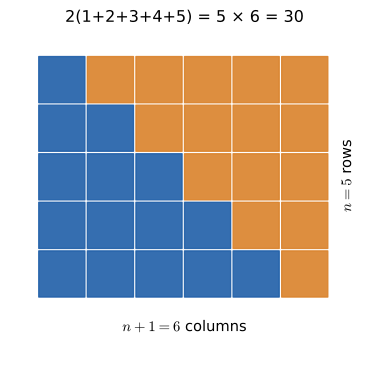
The algebraic version of the same idea: write the sum forwards and backwards, and add column by column.
|
Gauss and the schoolroom sum
The story (probably embellished in the retelling) is that the young Carl Friedrich Gauss, set the task of adding 1 to 100 to keep him quiet, wrote 5050 on his slate almost at once, having paired 1 with 100, 2 with 99, and so on: 50 pairs each summing to 101. Whether or not it happened, the pairing trick is exactly the forwards-and-backwards argument above. |
|
Working backwards, writing forwards
A common mistake is to start from the conclusion and manipulate until you reach something true, such as \(\quad n^2 \text{ is odd} \Rightarrow \ldots \Rightarrow 1 = 1, \text{ which is true, so done.}\) This proves nothing: you can derive a true statement from a false one (\(-1 = 1\) squares to \(1 = 1\)). Working backwards is a fine way to discover a proof, but the written proof must run from hypotheses to conclusion, and every step must be valid in that direction. |
|
Proof by example is not proof
"\(3 + 5 = 8\), which is even, so the sum of two odds is even" is not a proof of a universal statement. Examples are excellent for understanding and for finding the right algebra, but they belong on scrap paper. (An example is a complete proof of an existence claim, such as "there is an even prime": exhibit 2, done.) |
22.4. Proof by contrapositive
22.4.1. The problem
Claim: if \(n^2\) is even, then \(n\) is even.
Try a direct proof. Suppose \(n^2 = 2k\). Then \(n = \sqrt{2k}\)… and now what? Square roots are awkward, and there is no obvious way to show \(\sqrt{2k}\) is an even integer. The direct route is stuck.
22.4.2. Intuition
Recall from Chapter 21 that an implication \(P \Rightarrow Q\) is logically equivalent to its contrapositive \(\neg Q \Rightarrow \neg P\). "If it rained, the ground is wet" says exactly the same as "if the ground is dry, it did not rain". Both statements rule out the same single situation: \(P\) true and \(Q\) false.
So instead of proving "\(n^2\) even \(\Rightarrow\) \(n\) even" we may prove "\(n\) not even \(\Rightarrow\) \(n^2\) not even", that is, "\(n\) odd \(\Rightarrow\) \(n^2\) odd". And we have already proved that in the previous section. The hypothesis "\(n\) is odd" gives us something concrete to work with (\(n = 2k+1\)), whereas "\(n^2\) is even" gave us a square root.
|
Contrapositive, converse, inverse
For the implication \(P \Rightarrow Q\) ("if \(P\) then \(Q\)"):
The symbol \(\neg\) means "not". See Chapter 21 for the truth tables. |
22.4.3. Worked example 1
Claim. For every integer \(n\), if \(n^2\) is even then \(n\) is even.
Proof (by contrapositive). We prove the equivalent statement: if \(n\) is odd then \(n^2\) is odd. Let \(n\) be odd, so \(n = 2k + 1\). Then \(n^2 = 4k^2 + 4k + 1 = 2(2k^2 + 2k) + 1\), which is odd. Hence, by contraposition, if \(n^2\) is even then \(n\) is even. \(\blacksquare\)
We will use this as a lemma in the proof that \(\sqrt 2\) is irrational.
22.4.4. Worked example 2: a pigeonhole-flavoured claim
Claim. If \(x\) and \(y\) are real numbers with \(x + y \ge 100\), then \(x \ge 50\) or \(y \ge 50\).
Directly, it is not clear where to start: "or" conclusions are awkward because you do not know which half holds.
The contrapositive negates both sides. By De Morgan’s law, \(\neg(x \ge 50 \lor y \ge 50)\) is \(x < 50 \land y < 50\). So the contrapositive is: if \(x < 50\) and \(y < 50\), then \(x + y < 100\).
Proof (by contrapositive). Suppose \(x < 50\) and \(y < 50\). Adding the two inequalities,
So \(x + y < 100\), which is the negation of the hypothesis. \(\blacksquare\)
22.4.5. When to choose the contrapositive
Use the contrapositive when:
-
the conclusion \(Q\) is a negative ("is not divisible", "is irrational") or an "or", so that \(\neg Q\) is a positive, concrete fact;
-
the hypothesis \(P\) is hard to unpack (a square, a square root, an inequality in the wrong direction), while \(\neg Q\) is easy.
|
Proving the converse by mistake
The classic error is to prove \(Q \Rightarrow P\) and claim you proved \(P \Rightarrow Q\). For example, to show "if \(n^2\) is even then \(n\) is even" you might write "let \(n = 2k\); then \(n^2 = 4k^2\) is even". That proves the converse: "if \(n\) even then \(n^2\) even". True, but not what was asked. Always write the claim you are proving at the top, and check that your first line assumes its hypothesis. |
22.5. Proof by contradiction
22.5.1. The problem
Is \(\sqrt 2\) a fraction? Your calculator says \(\sqrt 2 \approx 1.41421356\), and decimals that stop are fractions, but the calculator’s display stops only because it ran out of digits. The claim "\(\sqrt 2\) is irrational" is a negative: it says there is no pair of integers \(p, q\) with \(\sqrt2 = p/q\). How can you prove that something does not exist, when you cannot check all the infinitely many pairs?
22.5.2. Intuition
Assume the opposite, and follow the consequences until something impossible happens. If assuming \(\neg S\) leads to a statement that is definitely false (such as "this number is both even and odd", or "\(1 < 0\)"), then \(\neg S\) cannot be true, so \(S\) is true.
This is how a debugger thinks: "suppose this pointer really were null here; then line 40 would have crashed; but line 40 ran; so the pointer was not null". It is also how a detective thinks.
|
Rational, irrational, lowest terms
|
22.5.3. The method
Input: a statement \(S\) to prove.
Steps:
-
Write "Suppose, for contradiction, that \(\neg S\)." State \(\neg S\) precisely (use Chapter 21 rules to negate quantifiers and connectives).
-
Unpack definitions in \(\neg S\) to get concrete objects and equations.
-
Derive consequences until you reach a contradiction: some statement \(R\) together with its negation \(\neg R\), or a known falsehood.
-
Conclude "This is a contradiction, so \(\neg S\) is false, and therefore \(S\) is true."
Output: a proof of \(S\).
22.5.4. Worked example 1: \(\sqrt 2\) is irrational
Claim. \(\sqrt 2\) is irrational.
Proof. Suppose, for contradiction, that \(\sqrt 2\) is rational. Then we can write \(\sqrt 2 = p/q\) where \(p, q\) are positive integers and the fraction is in lowest terms, so \(p\) and \(q\) have no common factor greater than 1.
So \(p^2\) is two times an integer, i.e., \(p^2\) is even. By the lemma proved by contrapositive in Section 22.4, \(p\) is even. Write \(p = 2r\) and substitute:
So \(q^2\) is even, and by the same lemma \(q\) is even.
Now \(p\) and \(q\) are both even, so 2 is a common factor greater than 1. This contradicts our choice of \(p/q\) in lowest terms. Hence \(\sqrt 2\) is not rational. \(\blacksquare\)
Notice how the pieces of the chapter fit together: a direct proof (odd squared is odd) gave a contrapositive lemma (\(n^2\) even implies \(n\) even), which powered a contradiction. Real mathematics is built from lemmas like this, much as software is built from tested functions.
|
The secret of the Pythagoreans
The discovery that the diagonal of a unit square is not a ratio of whole numbers is attributed to the Pythagorean school in ancient Greece, whose philosophy held that "all is number" (meaning whole numbers and their ratios). Legend says Hippasus of Metapontum was drowned at sea for revealing it. The legend is almost certainly fiction, but the shock was real: Greek mathematics afterwards treated geometric magnitudes and numbers as separate things for centuries. |
22.5.5. Worked example 2: there are infinitely many primes
This proof, from Euclid’s Elements (around 300 BCE), is one of the oldest and most admired in mathematics.
|
Prime
A prime is an integer \(p > 1\) whose only positive divisors are 1 and \(p\). The first few are \(2, 3, 5, 7, 11, 13\). An integer \(n > 1\) that is not prime is composite. A fact we will prove by strong induction in Section 22.10: every integer \(n > 1\) has at least one prime divisor. |
Claim. There are infinitely many primes.
Proof. Suppose, for contradiction, that there are only finitely many primes, and list all of them: \(p_1, p_2, \ldots, p_k\). Consider
\(N > 1\), so \(N\) has some prime divisor \(p\). Since our list contains every prime, \(p = p_i\) for some \(i\). Then \(p\) divides the product \(p_1 p_2 \cdots p_k\), and \(p\) divides \(N\). So \(p\) divides their difference:
But no prime divides 1 (primes are greater than 1). This is a contradiction, so the list could not have contained every prime: there are infinitely many. \(\blacksquare\)
|
Euclid’s N need not be prime
A very common misreading is "the product of the first \(k\) primes, plus one, is always prime". The proof does not say that. It says \(N\) has a prime factor not in the list. Indeed \(\quad 2 \cdot 3 \cdot 5 \cdot 7 \cdot 11 \cdot 13 + 1 = 30031 = 59 \cdot 509,\) which is composite, but its prime factors 59 and 509 are not among 2, 3, 5, 7, 11, 13, exactly as the proof predicts. |
22.5.6. Alternative approaches: contradiction versus contrapositive
Every proof by contrapositive can be rewritten as a contradiction ("suppose \(P\) and \(\neg Q\); …; then \(\neg P\); contradiction"). So which should you use?
-
If your argument goes cleanly from \(\neg Q\) to \(\neg P\), write it as a contrapositive. It is clearer, because every intermediate statement is actually true and can be reused.
-
Use contradiction when the statement is not naturally an implication ("\(\sqrt 2\) is irrational", "there are infinitely many primes"), or when you need to use both \(P\) and \(\neg Q\) together.
-
Try a direct proof first when the hypothesis gives you something concrete to compute with.
22.6. Proof by cases
22.6.1. The problem
Claim: for every integer \(n\), \(n^2 + n\) is even.
You cannot write \(n = 2k\) (that assumes \(n\) is even) or \(n = 2k+1\) (that assumes \(n\) is odd). But every integer is one or the other. So handle each separately.
22.6.2. The method
Input: a claim \(S\) about objects that fall into a known finite list of types.
Steps:
-
Choose cases \(C_1, C_2, \ldots, C_m\) and justify that they are exhaustive (every object falls into at least one). They need not be exclusive, but usually are.
-
For each case \(C_i\), assume \(C_i\) and prove \(S\).
-
Conclude that \(S\) holds in all cases.
Output: a proof of \(S\).
22.6.3. Worked example 1
Claim. For every integer \(n\), \(n^2 + n\) is even.
Proof. Every integer is even or odd.
Case 1: \(n\) is even. Write \(n = 2k\). Then
which is even.
Case 2: \(n\) is odd. Write \(n = 2k + 1\). Then
which is even. In both cases \(n^2 + n\) is even. \(\blacksquare\)
22.6.4. Alternative approach
Factor first: \(n^2 + n = n(n+1)\). Of two consecutive integers, one is even, and an even number times anything is even. This is shorter, but notice that "one of two consecutive integers is even" is itself a proof by cases, just hidden. When you find a factorisation like this, use it: it is clearer and generalises (the product of three consecutive integers is divisible by 3, for the same reason).
22.6.5. Worked example 2: last digits of squares
Claim. No perfect square ends in the digit 2, 3, 7 or 8.
Proof. The last digit of \(n^2\) depends only on the last digit of \(n\) (because \(n = 10a + d\) gives \(n^2 = 100a^2 + 20ad + d^2\), and the first two terms are multiples of 10). So there are ten cases, \(d = 0, 1, \ldots, 9\):
| \(d\) | 0 | 1 | 2 | 3 | 4 | 5 | 6 | 7 | 8 | 9 |
|---|---|---|---|---|---|---|---|---|---|---|
\(d^2\) |
0 |
1 |
4 |
9 |
16 |
25 |
36 |
49 |
64 |
81 |
last digit |
0 |
1 |
4 |
9 |
6 |
5 |
6 |
9 |
4 |
1 |
The possible last digits are 0, 1, 4, 5, 6, 9. None is 2, 3, 7 or 8. \(\blacksquare\)
This is a perfectly rigorous proof even though it is just a table, because the ten cases are exhaustive. That is the key difference from "proof by example": here the examples provably cover everything.
|
Non-exhaustive cases
Proofs by cases fail silently when a case is missing. "Case \(x > 0\) … Case \(x < 0\) …" forgets \(x = 0\). "Case \(n\) prime … Case \(n\) composite" forgets \(n = 1\) (which is neither) and \(n \le 0\). Before writing the cases, write the sentence that justifies exhaustiveness. |
|
A proof with 1,936 cases
The Four Colour Theorem (any map can be coloured with four colours so that neighbouring regions differ) was proved in 1976 by Kenneth Appel and Wolfgang Haken as a proof by cases: they reduced the problem to 1,936 configurations and checked them by computer. It was the first major theorem whose proof no human could check by hand, and it caused real controversy. In 2005 Georges Gonthier verified the whole proof in the Coq proof assistant, which settled most remaining doubts. You will meet graph colouring in Chapter 25. |
22.7. Counterexamples
22.7.1. The problem
Is the following true? If \(p\) is prime, then \(2^p - 1\) is prime. Check: \(2^2 - 1 = 3\), \(2^3 - 1 = 7\), \(2^5 - 1 = 31\), \(2^7 - 1 = 127\). All prime. Should you try to prove it?
22.7.2. Intuition
Before investing in a proof, spend a few minutes trying to break the claim. Recall from Chapter 21 how a universal statement negates:
"It is not true that every \(x\) has property \(P\)" means "some \(x\) lacks property \(P\)". So to disprove a "for all" claim you need exactly one counterexample: a specific object for which the claim fails. No general argument is needed.
Try the next prime: \(p = 11\) gives \(2^{11} - 1 = 2047 = 23 \times 89\). The claim is false. (Numbers of the form \(2^p - 1\) that are prime are called Mersenne primes; the largest known primes are of this form.)
22.7.3. The method
Input: a universal claim "for all \(x\) in \(D\), \(P(x)\)".
Steps:
-
Try the edge cases first: 0, 1, negative numbers, the smallest allowed value, equal inputs, the empty set or empty list.
-
Try special values: 2 (the only even prime), perfect squares, numbers just below powers of ten, fractions between 0 and 1 (where squaring makes things smaller).
-
If those pass, search systematically, by hand or with a short program.
-
If you find \(x_0\) with \(\neg P(x_0)\), verify it carefully and state it: "The claim is false: take \(x = x_0\); then …".
-
If a long search finds nothing, that is evidence (not proof) that the claim is true. Ask why it keeps working; the reason is often the proof.
Output: a counterexample, or a well-founded belief that it is time to attempt a proof.
22.7.4. Worked example
Claim. For all real \(x\), \(x^2 \ge x\).
Edge cases: \(x = 0\) gives \(0 \ge 0\), true. \(x = 1\) gives \(1 \ge 1\), true. \(x = -3\) gives \(9 \ge -3\), true. Special values: a fraction between 0 and 1. \(x = \tfrac12\) gives \(\tfrac14 \ge \tfrac12\), false.
Disproof. The claim is false: for \(x = \tfrac12\), \(x^2 = \tfrac14 < \tfrac12 = x\). \(\blacksquare\)
One clean counterexample is the whole disproof. You do not need to describe all the failures (here, every \(x\) with \(0 < x < 1\)), though doing so can be illuminating.
|
Counterexamples to existence claims, and to implications
|
|
Euler wrong again
In 1769 Euler conjectured that you need at least \(k\) \(k\)-th powers to sum to another \(k\)-th power (generalising Fermat’s Last Theorem). It stood for nearly two centuries, until in 1966 L. J. Lander and T. R. Parkin found, by computer search, a counterexample whose paper is one of the shortest ever published: \(\quad 27^5 + 84^5 + 110^5 + 133^5 = 144^5.\) Four fifth powers summing to a fifth power. One line disproved a conjecture by one of history’s greatest mathematicians. |
|
Counterexample hunter
Type a claim as a Python predicate (for example Try it: Hunt counterexamples in Python |
22.7.5. Where you’d use this
Contradiction, on your desk. A4 paper is designed so that halving a sheet gives the same shape, which forces the ratio of the sides to be \(\sqrt 2\). Because \(\sqrt 2\) is irrational, no sheet with whole-millimetre sides can have exactly that ratio. The standard picks 210 mm by 297 mm, and \(297/210 = 1.41428\ldots\) against \(\sqrt 2 = 1.41421\ldots\): off by about 0.005%, which is the best the proof allows at that precision.
Cases, as a quick check. The last-digit table proves that a number ending in 2, 3, 7 or 8 cannot be a perfect square. So 7,423,898 is not a square, with no square root needed. Fast perfect-square tests in big-number libraries use the same idea with remainders mod 64 or mod 256 (there are only 44 possible remainders mod 256 for squares, out of 256) to reject most non-squares before computing anything expensive.
Infinitely many primes, in your browser. Every HTTPS connection that uses RSA relies on a fresh supply of large primes; Euclid’s proof guarantees the supply never runs out, and the prime number theorem (Chapter 23) says how dense it is: about one in \(\ln 2^{1024} \approx 710\) numbers near \(2^{1024}\) is prime.
Counterexamples, at work. A single failing case refutes a universal claim, so a bug report with one reproducible input is worth more than a hundred "works for me" reports. Medicine works the same way: one well-documented serious reaction is enough to withdraw the claim that a drug is safe for everyone.
22.8. Exercises: direct, contrapositive, contradiction, cases
-
Recognition. For each claim, name the technique you would try first and say why: (a) If \(a \mid b\) then \(a \mid 3b\). (b) If \(n^2\) is odd then \(n\) is odd. (c) \(\sqrt 3\) is irrational. (d) For every integer \(n\), \(n^3 - n\) is divisible by 3. (e) Every prime is odd.
-
Application. Prove that the product of two odd integers is odd.
-
Application. Prove: if \(n^2\) is odd then \(n\) is odd.
-
Application. Prove that \(n^3 - n\) is divisible by 3 for every integer \(n\).
-
Problem solving. Prove that \(\sqrt 3\) is irrational. (You will first need a lemma: if \(3 \mid p^2\) then \(3 \mid p\). Prove it by contrapositive, with cases.)
-
Problem solving. Disprove: "for integers \(a, b, c\) with \(a \ne 0\), if \(a \mid bc\) then \(a \mid b\) or \(a \mid c\)."
-
Problem solving. Prove that there is no largest even integer.
Answers
-
(a) Direct: \(b = ak\) so \(3b = a(3k)\). (b) Contrapositive: "if \(n\) even then \(n^2\) even" is easy to compute. (c) Contradiction: the statement is a negative ("not a fraction"). (d) Cases on the remainder of \(n\) modulo 3, or factor \(n^3 - n = (n-1)n(n+1)\). (e) It is false: look for a counterexample (\(2\)).
-
Let \(a = 2j + 1\), \(b = 2k + 1\). Then \(ab = 4jk + 2j + 2k + 1 = 2(2jk + j + k) + 1\), which is odd.
-
Contrapositive: if \(n\) is even, \(n = 2k\), then \(n^2 = 4k^2 = 2(2k^2)\) is even. So if \(n^2\) is odd, \(n\) is odd.
-
\(n^3 - n = n(n^2 - 1) = (n-1)n(n+1)\), a product of three consecutive integers. Every integer leaves remainder 0, 1 or 2 when divided by 3. If \(n = 3k\), then \(3 \mid n\). If \(n = 3k + 1\), then \(n - 1 = 3k\). If \(n = 3k + 2\), then \(n + 1 = 3k + 3 = 3(k+1)\). In every case one factor is divisible by 3, so the product is.
-
Lemma (contrapositive): if \(3 \nmid p\) then \(3 \nmid p^2\). If \(3 \nmid p\), then \(p = 3m + 1\) or \(p = 3m + 2\). Case 1: \(p^2 = 9m^2 + 6m + 1 = 3(3m^2 + 2m) + 1\). Case 2: \(p^2 = 9m^2 + 12m + 4 = 3(3m^2 + 4m + 1) + 1\). Either way \(p^2\) leaves remainder 1, so \(3 \nmid p^2\). Main proof: suppose \(\sqrt 3 = p/q\) in lowest terms. Then \(3q^2 = p^2\), so \(3 \mid p^2\), so \(3 \mid p\) by the lemma. Write \(p = 3r\): \(3q^2 = 9r^2\), so \(q^2 = 3r^2\), so \(3 \mid q^2\) and \(3 \mid q\). Then 3 divides both \(p\) and \(q\), contradicting lowest terms.
-
Take \(a = 4\), \(b = 2\), \(c = 2\). Then \(bc = 4\) and \(4 \mid 4\), but \(4 \nmid 2\). (The statement is true when \(a\) is prime; that is Euclid’s lemma, see Chapter 23.)
-
Suppose, for contradiction, that \(M\) is the largest even integer. Then \(M = 2k\), and \(M + 2 = 2(k + 1)\) is even and larger than \(M\). Contradiction.
22.9. Mathematical induction
22.9.1. The problem
Here are some sums of odd numbers:
They are the perfect squares. It seems that the sum of the first \(n\) odd numbers is \(n^2\). We have learned to distrust patterns, so we need a proof for every \(n\). A direct algebraic manipulation is not obvious. But there is something we can say: if the pattern holds up to some \(n = k\), then adding the next odd number, \(2k + 1\), gives \(k^2 + 2k + 1 = (k + 1)^2\). So the pattern propagates: each case hands its truth to the next.
That idea, made precise, is mathematical induction.
22.9.2. Intuition: dominoes
Imagine an infinite row of dominoes, one for each natural number. Two facts guarantee they all fall:
-
The first domino is pushed over. (Base case.)
-
Whenever any domino falls, it knocks over the next one. (Inductive step.)
You do not need to watch each domino. Fact 2 is a single statement about a general domino \(k\); together with fact 1 it reaches every domino in the row.
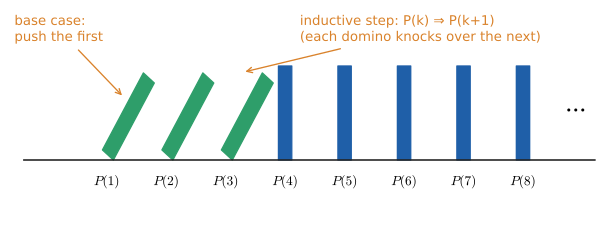
Both facts are essential. Without the base case, every domino would knock over its neighbour, but nothing starts the chain. Without the inductive step, the first domino falls and nothing follows.
22.9.3. Vocabulary and notation
|
Sigma notation
The symbol \(\Sigma\) (capital Greek sigma, for "sum") abbreviates long sums:
\[\sum_{i=1}^{n} a_i = a_1 + a_2 + \cdots + a_n.\]
Read it as "the sum, for \(i\) from 1 to \(n\), of \(a_i\)". The index \(i\) is a dummy variable (like a loop variable: it has no meaning outside the sum), the numbers below and above \(\Sigma\) are its starting and ending values, and \(a_i\) is the term, an expression in \(i\). For example \(\sum_{i=1}^{4} (2i - 1) = 1 + 3 + 5 + 7 = 16\). In Python:
\[\sum_{i=1}^{k+1} a_i = \left(\sum_{i=1}^{k} a_i\right) + a_{k+1}.\]
Sigma notation is covered in more depth in Chapter 14. |
|
Induction vocabulary
|
22.9.4. Why it works
Why is induction a valid proof technique, and not just a nice story about dominoes? Suppose the base case and inductive step are proved, but \(P(n)\) is false for some \(n \ge n_0\). Among all the \(n\) for which \(P(n)\) fails, there is a smallest one; call it \(m\). (Every non-empty set of natural numbers has a least element. This is the well-ordering principle, an axiom of the natural numbers.) \(m \ne n_0\), because the base case holds. So \(m - 1 \ge n_0\), and \(P(m - 1)\) is true, because \(m\) was the smallest failure. But then the inductive step, with \(k = m - 1\), gives \(P(m)\). Contradiction. So there is no failure.
In other words: induction is a packaged proof by contradiction about the "first bad case". That viewpoint is often useful when you are stuck: ask "what would the smallest counterexample look like?"
22.9.5. The method
Input: a claim "for all integers \(n \ge n_0\), \(P(n)\)".
Steps:
-
State \(P(n)\) explicitly as a sentence or equation.
-
Base case. Verify \(P(n_0)\) by direct computation. Show both sides.
-
Inductive hypothesis. Write "Let \(k \ge n_0\) and assume \(P(k)\)." Write out \(P(k)\) in full.
-
Target. Write out \(P(k+1)\) in full by substituting \(k+1\) for \(n\). Simplify the target if helpful.
-
Inductive step. Starting from one side of \(P(k+1)\), find \(P(k)\) inside it (for sums: peel off the last term), apply the IH, and simplify until you reach the other side. Label the line where the IH is used.
-
Conclude: "By induction, \(P(n)\) holds for all \(n \ge n_0\)."
Output: a proof for every \(n \ge n_0\).
22.9.6. Worked example 1: the sum of the first \(n\) odd numbers
Claim. For all integers \(n \ge 1\), \(\displaystyle\sum_{i=1}^{n} (2i - 1) = n^2\).
Step 1. \(P(n)\): \(1 + 3 + \cdots + (2n - 1) = n^2\).
Step 2: base case \(n = 1\). Left side: \(\sum_{i=1}^{1}(2i-1) = 2(1) - 1 = 1\). Right side: \(1^2 = 1\). Equal, so \(P(1)\) holds.
Step 3: inductive hypothesis. Let \(k \ge 1\) and assume
Step 4: target. We must show \(\sum_{i=1}^{k+1} (2i - 1) = (k+1)^2\).
Step 5: inductive step.
Step 6. By induction, \(\sum_{i=1}^{n}(2i - 1) = n^2\) for every \(n \ge 1\). \(\blacksquare\)
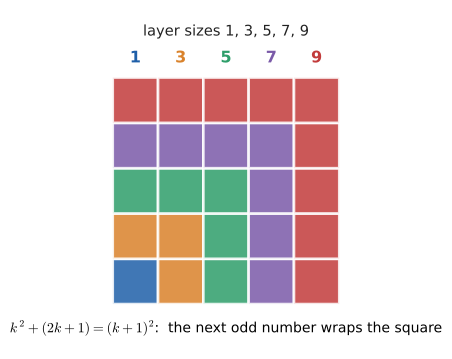
The inductive step has a picture. A \(k \times k\) square of dots grows into a \((k+1) \times (k+1)\) square by adding an L-shaped border of \(k\) dots along the top, \(k\) down the side and one in the corner: \(2k + 1\) dots, the next odd number.
22.9.7. Worked example 2: the sum of squares
Claim. For all \(n \ge 1\),
Base case \(n = 1\). Left: \(1^2 = 1\). Right: \(\frac{1 \cdot 2 \cdot 3}{6} = \frac{6}{6} = 1\). Equal.
Inductive hypothesis. Assume \(\sum_{i=1}^{k} i^2 = \frac{k(k+1)(2k+1)}{6}\) for some \(k \ge 1\).
Target. Substitute \(n = k + 1\) into the right-hand side:
Inductive step.
That is the target, so by induction the formula holds for all \(n \ge 1\). \(\blacksquare\)
The tactical lesson: factor out the common piece early (here \(k+1\)) instead of expanding everything into a cubic. You know what the target looks like, so steer towards it.
22.9.8. Worked example 3: an inequality
Induction is not just for equations.
Claim. \(2^n > n^2\) for all integers \(n \ge 5\).
Why start at 5? Check small values: \(2^1 = 2 > 1\), \(2^2 = 4 = 4\) (not greater), \(2^3 = 8 < 9\), \(2^4 = 16 = 16\), \(2^5 = 32 > 25\). The claim is false for \(n = 2, 3, 4\), so the base case must be \(n_0 = 5\).
Base case \(n = 5\): \(2^5 = 32 > 25 = 5^2\). True.
Inductive hypothesis. Assume \(2^k > k^2\) for some \(k \ge 5\).
Target. \(2^{k+1} > (k+1)^2\).
Inductive step. With inequalities, the trick is to bridge from what the IH gives you to what the target needs:
Now it suffices to show \(2k^2 \ge (k+1)^2\), i.e., \(2k^2 \ge k^2 + 2k + 1\), i.e., \(k^2 - 2k - 1 \ge 0\). Complete the square: \(k^2 - 2k - 1 = (k-1)^2 - 2\). For \(k \ge 5\), \((k - 1)^2 \ge 16\), so \((k-1)^2 - 2 \ge 14 > 0\). Therefore
which gives \(2^{k+1} > (k+1)^2\). By induction, \(2^n > n^2\) for all \(n \ge 5\). \(\blacksquare\)
22.9.9. Worked example 4: divisibility
Claim. \(3 \mid 4^n - 1\) for all \(n \ge 0\).
Base case \(n = 0\): \(4^0 - 1 = 0 = 3 \cdot 0\), divisible by 3.
Inductive hypothesis. Assume \(4^k - 1 = 3m\) for some integer \(m\).
Inductive step. The trick is to make \(4^k - 1\) appear inside \(4^{k+1} - 1\):
So \(3 \mid 4^{k+1} - 1\). By induction the claim holds for all \(n \ge 0\). \(\blacksquare\)
(Chapter 23 gives a one-line alternative: \(4 \equiv 1 \pmod 3\), so \(4^n \equiv 1^n = 1\).)
22.9.10. Alternative approaches and choosing a method
Induction verifies a formula; it does not discover it. To prove \(\sum i^2 = n(n+1)(2n+1)/6\) you must already know the right-hand side. So the realistic workflow is:
-
Discover the formula: compute small cases, guess a pattern, or derive it (pairing, as Gauss did; telescoping sums; fitting a polynomial of the right degree to the first few values).
-
Check it numerically for many \(n\) (a quick script).
-
Prove it, usually by induction.
When a direct derivation exists (the Gauss pairing for \(\sum i\), the geometric series formula derived in Chapter 14), it is often more illuminating than induction because it explains why. Induction is the reliable fallback that works when you have the answer but not the insight, and it is the natural tool whenever the objects are defined step by step (recurrences, recursive functions, data structures).
|
Forgetting the base case
"Claim: \(n = n + 1\) for all \(n\). Inductive step: assume \(k = k + 1\). Adding 1 to both sides, \(k + 1 = k + 2\). So \(P(k) \Rightarrow P(k+1)\)." The inductive step is valid. The claim is absurd. What is missing is the base case: \(0 = 1\) is false, so no domino is ever pushed. Always prove the base case, even when it looks trivial. |
|
Assuming what you want to prove
The inductive hypothesis is "assume \(P(k)\) for one arbitrary \(k\)", not "assume \(P(n)\) for all \(n\)", which would be assuming the theorem. If your write-up says "assume the formula is true for all \(n\)", it is circular. |
22.9.11. Where you’d use this
Games: a winning strategy is an induction proof. Twenty coins are on the table. Players take turns removing 1, 2 or 3 coins, and whoever takes the last coin wins. Claim: the player to move loses exactly when the number of coins is a multiple of 4. With 0 coins the player to move has already lost. If the count is a multiple of 4, any move leaves a non-multiple; if it is not, you can take 1, 2 or 3 to leave a multiple of 4. By (strong) induction the claim holds for every count, so with 20 coins you should let your opponent go first and then always make each round total 4.
Finance: why the compound-interest formula is right. If a balance starts at \(B_0 = P\) and each year \(B_{k+1} = B_k(1 + r)\), induction proves \(B_n = P(1 + r)^n\) for every \(n\): the base case is \(B_0 = P\), and the step is \(B_{k+1} = P(1 + r)^k (1 + r) = P(1 + r)^{k+1}\). So $1,000 at 5% for 3 years becomes \(1000 \times 1.05^3 = 1157.63\), and the formula, not a spreadsheet of 30 rows, is what you trust for a 30-year mortgage.
Medicine: drug accumulation. A patient takes 100 mg of a drug once every half-life, so half of what is in the body is cleared between doses. Just after the \(n\)-th dose the amount is \(100(1 + \tfrac12 + \cdots + \tfrac1{2^{n-1}})\), which induction shows equals \(200(1 - 2^{-n})\) mg. After 5 doses that is \(200 \times \tfrac{31}{32} = 193.75\) mg, and the level never exceeds 200 mg however long treatment continues. Pharmacologists use exactly this "steady state" rule of thumb (about five half-lives to get within a few percent).
Computing. Every recursive function and every divide-and-conquer running time (merge sort’s \(T(n) = 2T(n/2) + n\) gives \(n \log_2 n\) comparisons, roughly) is justified by induction; Section 22.11 makes the link explicit.
|
Proof by induction, checked by a script
An "induction workbench": enter a conjectured closed form such as |
|
Induction everywhere
The first clear use of induction is usually credited to Francesco Maurolico (1575) and Blaise Pascal, who used it around 1654 in his work on the arithmetic triangle. The name "mathematical induction" came much later, from Augustus De Morgan in 1838. It is unrelated to inductive reasoning in science (generalising from observations), which is exactly the kind of reasoning the Euler polynomial warns against. Mathematical induction is fully deductive. |
22.10. Strong induction
22.10.1. The problem
Claim: every integer \(n \ge 2\) is a product of one or more primes. (A prime by itself counts as a product of one prime.)
Try ordinary induction. Assume \(k\) is a product of primes; show \(k + 1\) is. But \(k\) and \(k + 1\) have no useful relationship here: knowing \(14 = 2 \cdot 7\) tells you nothing about 15. What does help: if \(k + 1\) is composite, say \(k + 1 = ab\), then \(a\) and \(b\) are smaller numbers, and we would like to know they are products of primes. We need the hypothesis for all smaller numbers, not just the one immediately before.
22.10.2. Intuition
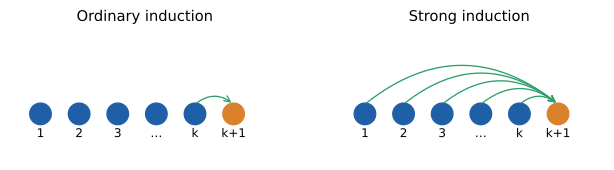
Strong induction (also called complete induction) lets the inductive step use every earlier case:
In domino terms: each domino is knocked over by the combined weight of all the dominoes before it. It is no more powerful than ordinary induction (you can convert one to the other by using the statement "\(P\) holds for all values up to \(n\)"), but it is far more convenient whenever \(P(k+1)\) depends on cases further back.
22.10.3. The method
Input: a claim "for all integers \(n \ge n_0\), \(P(n)\)".
Steps:
-
Base case(s). Prove \(P(n_0)\), and as many further cases as the inductive step needs (if the step reaches back \(j\) places, prove \(j\) base cases).
-
Strong inductive hypothesis. Let \(k\) be at least the last base case and assume \(P(i)\) for all \(i\) with \(n_0 \le i \le k\).
-
Inductive step. Prove \(P(k+1)\), using any of the \(P(i)\) that you need. Check that every \(i\) you use is in the range \(n_0 \le i \le k\).
-
Conclude by strong induction.
Output: a proof for all \(n \ge n_0\).
22.10.4. Worked example 1: every integer \(n \ge 2\) is a product of primes
Base case \(n = 2\): 2 is prime, so it is a product of one prime.
Strong IH. Let \(k \ge 2\) and assume every integer \(i\) with \(2 \le i \le k\) is a product of primes.
Inductive step. Consider \(k + 1\). There are two cases.
Case 1: \(k+1\) is prime. Then it is a product of one prime. Done.
Case 2: \(k+1\) is composite. Then \(k + 1 = ab\) for integers with \(2 \le a, b \le k\). (Composite means it has a divisor \(a\) other than 1 and itself; then \(b = (k+1)/a\) is also strictly between 1 and \(k+1\).) By the strong IH, \(a = p_1 \cdots p_r\) and \(b = q_1 \cdots q_s\) are products of primes. So \(k + 1 = p_1 \cdots p_r \, q_1 \cdots q_s\) is a product of primes.
By strong induction, every integer \(n \ge 2\) is a product of primes. \(\blacksquare\)
In particular every \(n \ge 2\) has at least one prime divisor, which is the fact Euclid’s proof used. This is the existence half of the Fundamental Theorem of Arithmetic; uniqueness of the factorisation is proved in Chapter 23.
22.10.5. Worked example 2: postage stamps
Claim. Every amount of postage of 12 cents or more can be made using only 4-cent and 5-cent stamps.
Here \(P(n)\): "there are non-negative integers \(a, b\) with \(n = 4a + 5b\)".
The idea: if we can make \(n - 4\) cents, add one 4-cent stamp to make \(n\). That reaches back four places, so we need four base cases.
Base cases.
Strong IH. Let \(k \ge 15\) and assume \(P(i)\) for all \(12 \le i \le k\).
Inductive step. Since \(k \ge 15\), \(k + 1 \ge 16\), so \(12 \le (k+1) - 4 \le k\). By the IH, \((k + 1) - 4 = 4a + 5b\). Then \(k + 1 = 4(a + 1) + 5b\). Done. \(\blacksquare\)
Why 12? Because 11 cannot be made (11 is not of the form \(4a + 5b\): try \(b = 0, 1, 2\), giving remainders 11, 6, 1, none a multiple of 4). This is the Frobenius coin problem; for two coin values \(x, y\) with no common factor the largest unpayable amount is \(xy - x - y = 20 - 4 - 5 = 11\).
22.10.6. Worked example 3: a bound on Fibonacci numbers
The Fibonacci numbers are defined by \(F_1 = 1\), \(F_2 = 1\), and \(F_n = F_{n-1} + F_{n-2}\) for \(n \ge 3\): \(1, 1, 2, 3, 5, 8, 13, \ldots\)
Claim. \(F_n < 2^n\) for all \(n \ge 1\).
The recurrence reaches back two places, so two base cases. \(F_1 = 1 < 2 = 2^1\) and \(F_2 = 1 < 4 = 2^2\).
Strong IH. Let \(k \ge 2\), and assume \(F_i < 2^i\) for all \(1 \le i \le k\).
Inductive step.
\(\blacksquare\)
|
Too few base cases
If the inductive step for \(P(k+1)\) uses \(P(k-1)\), then with only one base case \(P(1)\) the step for \(k + 1 = 2\) would need \(P(0)\), which you never proved (and \(F_0\) may not even be defined). The rule: if the step reaches back \(j\) places, you need \(j\) consecutive base cases. Check the smallest \(k\) for which you invoke the step and make sure everything it uses is covered. |
22.11. Structural induction and recursion
22.11.1. The problem
Programmers rarely work with "for all integers \(n\)". They work with lists, trees, expressions and JSON documents. How do you prove something about every binary tree, or every well-formed expression?
22.11.2. Intuition
These objects are defined recursively: a list is either empty or an element followed by a list. A full binary tree is either a single leaf, or a root node with two full binary subtrees. Every object is built from smaller objects of the same kind, and the building process starts from base objects.
Structural induction follows the definition:
-
Base case: prove the property for each base object (empty list, single leaf).
-
Inductive step: for each way of building a bigger object from smaller ones, assume the property for the smaller pieces and prove it for the result.
This is ordinary strong induction in disguise (induct on the size of the object), but it is much more natural to write.
|
Recursive definition, full binary tree
|
22.11.3. Worked example: leaves versus internal nodes
Claim. In every full binary tree, the number of leaves \(L\) equals the number of internal nodes \(I\) plus one: \(L = I + 1\).
Base case. A single node is a leaf and has no children: \(L = 1\), \(I = 0\), and \(1 = 0 + 1\).
Inductive step. Let \(T\) be built from a new root with subtrees \(T_1\) and \(T_2\), and assume (structural IH) that \(L_1 = I_1 + 1\) and \(L_2 = I_2 + 1\). The leaves of \(T\) are exactly the leaves of \(T_1\) and \(T_2\) (the root is not a leaf). The internal nodes of \(T\) are those of \(T_1\) and \(T_2\) plus the root. So
By structural induction, \(L = I + 1\) for every full binary tree. \(\blacksquare\)
Application: a knockout tournament is a full binary tree whose leaves are the \(L\) players and whose internal nodes are the matches. So a tournament with 64 players has exactly 63 matches, regardless of how the bracket is arranged. Another: a Huffman code tree (used in compression formats such as DEFLATE) with \(L\) symbols has \(L - 1\) merge steps.
22.11.4. Induction and recursion are the same idea
Compare a recursive function with an induction proof:
def sum_to(n):
    """1 + 2 + ... + n, defined recursively."""
    if n == 1:                 # base case
        return 1
    return sum_to(n - 1) + n   # "inductive step": trust sum_to(n-1)

assert all(sum_to(n) == n * (n + 1) // 2 for n in range(1, 500))
print(sum_to(100))
5050
To convince yourself sum_to is correct you reason exactly by induction: it is correct for \(n = 1\) (base case); and if sum_to(n - 1) returns \((n-1)n/2\) (inductive hypothesis), then sum_to(n) returns
The assert line is a test, valuable but not a proof. The algebra is the proof.
|
Recursion tree and proof tree
Build a full binary tree by clicking leaves to split them. The lab keeps live counts of leaves and internal nodes (watch \(L - I\) stay at 1), and shows the structural-induction proof annotating each split: "this split turns one leaf into an internal node and adds two leaves: \(L\) goes up by 1, \(I\) goes up by 1". |
22.12. Exercises: induction
-
Recognition. In the proof that \(F_n < 2^n\), why are two base cases needed? What would go wrong with only \(F_1 < 2\)?
-
Application. Prove by induction that \(\displaystyle\sum_{i=1}^{n} i = \frac{n(n+1)}{2}\) for all \(n \ge 1\).
-
Application. Prove that \(\displaystyle\sum_{i=0}^{n-1} 2^i = 2^n - 1\) for all \(n \ge 1\). (Interpret this in binary.)
-
Application. Prove that \(n! > 2^n\) for all \(n \ge 4\). (\(n! = 1 \cdot 2 \cdots n\), "\(n\) factorial".)
-
Problem solving. Prove by induction that \(6 \mid n^3 - n\) for all \(n \ge 0\). (Use the result of Section 22.6.)
-
Problem solving. Prove that every integer \(n \ge 8\) can be written as \(3a + 5b\) with non-negative integers \(a, b\).
-
Problem solving. A perfect binary tree of height \(h\) is a single node if \(h = 0\), and otherwise a root with two perfect subtrees of height \(h - 1\). Prove it has \(2^{h+1} - 1\) nodes.
Answers
-
The step proves \(P(k+1)\) from \(P(k)\) and \(P(k-1)\), and is first used at \(k + 1 = 3\), which needs \(P(2)\) and \(P(1)\). With only \(P(1)\) proved, the step for \(k+1 = 2\) would need \(P(0)\), and the recurrence \(F_2 = F_1 + F_0\) is not part of the definition. Without \(P(2)\) the chain never starts.
-
Base: \(1 = 1 \cdot 2 / 2\). Step: \(\sum_{i=1}^{k+1} i = \frac{k(k+1)}{2} + (k+1) = \frac{k(k+1) + 2(k+1)}{2} = \frac{(k+1)(k+2)}{2}\).
-
Base \(n = 1\): \(2^0 = 1 = 2^1 - 1\). Step: \(\sum_{i=0}^{k} 2^i = (2^k - 1) + 2^k = 2 \cdot 2^k - 1 = 2^{k+1} - 1\). In binary, \(111\ldots1\) (\(n\) ones) plus 1 is \(1000\ldots0\) (a 1 followed by \(n\) zeros), which is \(2^n\). This is why the largest unsigned \(n\)-bit integer is \(2^n - 1\).
-
Base \(n = 4\): \(4! = 24 > 16 = 2^4\). Step: assume \(k! > 2^k\) with \(k \ge 4\). Then \((k+1)! = (k+1)\,k! > (k+1)\,2^k \ge 2 \cdot 2^k = 2^{k+1}\), using \(k + 1 \ge 2\).
-
Base \(n = 0\): \(0 - 0 = 0 = 6 \cdot 0\). Step: \((k+1)^3 - (k+1) = k^3 + 3k^2 + 3k + 1 - k - 1 = (k^3 - k) + 3k(k+1)\). By the IH, \(6 \mid k^3 - k\). By Section 22.6, \(k(k+1)\) is even, so \(k(k+1) = 2t\) and \(3k(k+1) = 6t\). A sum of two multiples of 6 is a multiple of 6.
-
Strong induction with three base cases: \(8 = 3 + 5\), \(9 = 3 \cdot 3\), \(10 = 5 \cdot 2\). For \(k \ge 10\), \(k + 1 \ge 11\), so \(8 \le (k+1) - 3 \le k\); by the IH \((k+1) - 3 = 3a + 5b\), hence \(k + 1 = 3(a+1) + 5b\).
-
Structural induction on \(h\). Base \(h = 0\): one node, and \(2^1 - 1 = 1\). Step: a tree of height \(h + 1\) is a root plus two perfect trees of height \(h\), each with \(2^{h+1} - 1\) nodes by the IH. Total: \(1 + 2(2^{h+1} - 1) = 2^{h+2} - 1 = 2^{(h+1)+1} - 1\).
22.13. Proving programs correct: loop invariants
22.13.1. The problem
Binary search is ten lines long and notoriously easy to get wrong: off-by-one errors in lo, hi and mid, infinite loops, wrong results on empty arrays. Jon Bentley reported that when he set it as an exercise for professional programmers, around 90% of their solutions contained a bug. Tests catch some of these errors. How do we know a correct version is correct?
22.13.2. Intuition
A loop is induction in disguise. Each iteration is an inductive step; the state before the first iteration is the base case. The statement being proved is a loop invariant: a condition on the program’s variables that is true before the loop starts and stays true after every iteration. When the loop stops, the invariant plus the stopping condition should give you exactly what you wanted.
|
Loop invariant, variant, pre- and postcondition
|
22.13.3. The method
Input: a loop, its precondition, and the desired postcondition.
Steps:
-
Choose an invariant \(I\): typically "the work done so far is correct" or "the answer, if it exists, is still in the region we have not excluded". A good invariant mentions every variable the loop changes.
-
Initialisation (base case). Show \(I\) holds just before the first iteration, using the precondition and the initial assignments.
-
Maintenance (inductive step). Assume \(I\) holds at the top of an iteration and the loop condition is true. Show \(I\) holds again after the body runs. Do this for every branch of the body.
-
Termination. Exhibit a variant: a non-negative integer that strictly decreases on every iteration. Then the loop must stop.
-
Exit (conclusion). Show that \(I\) together with the negation of the loop condition implies the postcondition. Also check any early
return.
Output: a proof of total correctness.
22.13.4. Worked example: binary search
def binary_search(a, target):
    """Return an index i with a[i] == target, or -1. `a` must be sorted."""
    lo, hi = 0, len(a) - 1
    while lo <= hi:
        # Invariant: if target is in a, then it is in a[lo..hi].
        mid = (lo + hi) // 2
        if a[mid] == target:
            return mid
        elif a[mid] < target:
            lo = mid + 1      # a[0..mid] are all < target: discard them
        else:
            hi = mid - 1      # a[mid..] are all > target: discard them
    return -1                 # a[lo..hi] is empty, so target is not in a

a = [2, 5, 8, 12, 16, 23, 38, 56, 72, 91]
print(binary_search(a, 23), binary_search(a, 7))
5 -1
Here a[lo..hi] means the elements with indices from lo to hi inclusive; it is empty when lo > hi.
Precondition: a is sorted in non-decreasing order. Postcondition: the result r satisfies a[r] == target, or r == -1 and target does not occur in a.
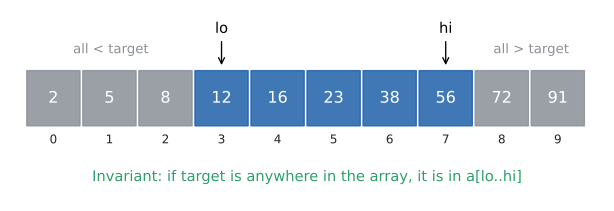
Step 1: invariant. \(I\): "if target occurs in a, then it occurs in a[lo..hi]."
Step 2: initialisation. Before the loop, lo = 0 and hi = len(a) - 1, so a[lo..hi] is the whole array. "If target is in a then it is in `a`" is trivially true.
Step 3: maintenance. Assume \(I\) and lo ⇐ hi. Then mid = (lo + hi) // 2 satisfies lo ⇐ mid ⇐ hi, so a[mid] is a valid element of the window. Three branches:
-
a[mid] == target: we return, so there is no next iteration to worry about (it is handled in step 5). -
a[mid] < target: sinceais sorted, every elementa[j]withj ⇐ midsatisfiesa[j] ⇐ a[mid] < target, so none of them equalstarget. Iftargetis ina[lo..hi], it must therefore be ina[mid+1..hi]. Settinglo = mid + 1keeps \(I\) true. -
a[mid] > target: symmetric. Everya[j]withj >= midis at leasta[mid] > target, sotarget(if present in the window) is ina[lo..mid-1]. Settinghi = mid - 1keeps \(I\) true.
Step 4: termination. Use the variant \(V = \texttt{hi} - \texttt{lo} + 1\), the number of elements in the window. While the loop runs (lo ⇐ hi), \(V \ge 1 > 0\). In the second branch the new window is a[mid+1..hi], which excludes at least a[mid]; in the third it is a[lo..mid-1], also excluding a[mid]. So \(V\) decreases by at least 1 on every iteration that does not return. A positive integer cannot decrease for ever, so the loop terminates.
Step 5: exit. There are two ways out.
-
Early return in the first branch:
a[mid] == target, so the postcondition holds withr = mid. -
The loop condition fails:
lo > hi, soa[lo..hi]is empty. By \(I\), iftargetwere inait would be in this empty window, which is impossible. Sotargetis not ina, and returning-1is correct.
Both exits satisfy the postcondition, so binary search is totally correct. \(\blacksquare\)
Trace for target = 23 on the array above (indices 0–9):
lo |
hi |
mid |
a[mid] |
action |
|---|---|---|---|---|
0 |
9 |
4 |
16 |
\(16 < 23\): |
5 |
9 |
7 |
56 |
\(56 > 23\): |
5 |
6 |
5 |
23 |
found: return 5 |
And for target = 7: (0, 9, mid 4, 16 > 7, hi = 3), (0, 3, mid 1, 5 < 7, lo = 2), (2, 3, mid 2, 8 > 7, hi = 1), and now \(\texttt{lo} = 2 > 1 = \texttt{hi}\), so return -1. The window size went \(10 \to 4 \to 2 \to 0\): the variant at work.
22.13.5. A second example: insertion sort
For insertion sort the natural invariant is "the prefix a[0:i] is sorted". You can even turn the invariant into a runtime check:
def insertion_sort(a):
    a = list(a)
    for i in range(1, len(a)):
        # Invariant: a[0:i] is sorted (and is a permutation of the original a[0:i]).
        assert all(a[j] <= a[j + 1] for j in range(i - 1))
        key = a[i]
        j = i - 1
        while j >= 0 and a[j] > key:
            a[j + 1] = a[j]   # shift larger element right
            j -= 1
        a[j + 1] = key
    return a

print(insertion_sort([5, 2, 9, 1, 5, 6]))
[1, 2, 5, 5, 6, 9]
-
Initialisation: when \(i = 1\),
a[0:1]has one element, and a one-element list is sorted. -
Maintenance: the inner loop shifts every element of the sorted prefix that is larger than
keyone place right and dropskeyinto the gap, soa[0:i+1]is sorted. (A full proof gives the inner loop its own invariant: "`a[j+2..i]` are all greater thankey, and the prefix with the gap removed is sorted".) -
Termination: a
forloop over a finite range always terminates; the innerwhilehas variant \(j + 1\), which decreases by 1 each time and stays non-negative while the loop runs. -
Exit: the outer loop ends with \(i = n\) (the length), so the invariant says
a[0:n], the whole list, is sorted.
assert statements like the one above turn your proof sketch into a check that runs during testing. They do not prove anything, but a failing invariant assertion pinpoints where the reasoning breaks, which is far more useful than a wrong final answer.
|
Termination is a separate obligation
An invariant proves the answer is right if the loop stops. It says nothing about whether it stops. Write |
|
The proof assumed mathematical integers
In 2006 Joshua Bloch reported that the binary search in Java’s standard library, which had shipped for about nine years, had a bug. The line |
22.13.6. Termination arguments
Every termination proof is the same argument: find a quantity in a well-ordered set (usually the non-negative integers) that strictly decreases. Because there is no infinite decreasing sequence of non-negative integers, the process must stop. That is the well-ordering principle again, the same fact that justified induction.
Euclid’s algorithm for the greatest common divisor (studied in Chapter 23) is a good example:
def gcd(a, b):
    while b != 0:
        # Variant: b is a non-negative integer that strictly decreases.
        a, b = b, a % b
    return a

print(gcd(252, 105))
21
For non-negative inputs, the new \(b\) is \(a \bmod b\), the remainder of dividing \(a\) by \(b\), which always satisfies \(0 \le a \bmod b < b\). So \(b\) strictly decreases and stays non-negative: the loop must reach \(b = 0\).
Sometimes no variant is known:
def collatz_steps(n):
    steps = 0
    while n != 1:
        n = n // 2 if n % 2 == 0 else 3 * n + 1
        steps += 1
    return steps

print([collatz_steps(n) for n in range(1, 11)])
print(collatz_steps(27))
[0, 1, 7, 2, 5, 8, 16, 3, 19, 6] 111
|
A four-line loop nobody can prove terminates
The Collatz conjecture says the loop above terminates for every positive integer \(n\). It has been checked by computer for every \(n\) up to beyond \(2^{68}\), yet nobody has a proof, and the value of \(n\) does not decrease steadily (starting from 27, it takes 111 steps and climbs as high as 9232 before falling to 1). Paul Erdős reportedly said "mathematics may not be ready for such problems". It is a sobering reminder that "does this loop terminate?" can be beyond the reach of current mathematics, and, by Turing’s halting theorem, no algorithm can answer it for all programs. |
22.13.7. Where you’d use this
Invariants are not a programming invention. Double-entry bookkeeping maintains the invariant "total debits = total credits" through every transaction; when the trial balance disagrees, an entry broke the invariant, and you know to look for it. Physics simulations check conservation laws the same way: in a game-physics or orbital simulation, total energy and momentum should stay constant (up to rounding), so a drifting total is the first sign of a bad time step. And a bank transfer between two accounts must preserve the sum of the balances at every observable moment, which is the invariant that database transactions exist to protect.
|
Invariant tracer
Step through binary search on an array you choose. At each iteration the lab shades the excluded regions grey (as in the figure), displays the invariant and the variant \(\texttt{hi} - \texttt{lo} + 1\), and turns red if you edit the code (for example to Try it: Trace binary search in Python |
22.14. Exercises: programs
-
Recognition. What is a suitable invariant for this loop, which finds the largest element of a non-empty list
a?best = a[0] for i in range(1, len(a)): if a[i] > best: best = a[i] -
Application. After the following loop has completed \(i\) iterations, what is the value of
s? State and prove an invariant.s = 0 for i in range(n): s += 2 * i + 1 -
Application. Prove that
while x > 0: x = x // 2terminates for every integerx. -
Problem solving. A colleague writes binary search with
while lo < hi:(instead of⇐) but otherwise identical code. Find an input where it gives the wrong answer, and say which proof step fails.
Answers
-
Invariant: "at the top of the iteration with index \(i\),
bestis the maximum ofa[0:i]`". Initialisation: \(i = 1\), `best = a[0]is the maximum of the one-element prefix. Maintenance: the newbestis the larger of the old maximum anda[i], which is the maximum ofa[0:i+1]. Exit: \(i = n\), sobestis the maximum of the whole list. -
Invariant: after \(i\) iterations, \(s = i^2\). Initially \(s = 0 = 0^2\). If \(s = i^2\) before the iteration with loop variable \(i\), it becomes \(i^2 + 2i + 1 = (i+1)^2\), and \(i + 1\) iterations have now completed. At the end, \(s = n^2\). (This is the sum-of-odd-numbers theorem as a program.)
-
If \(x \le 0\) the loop does not run. Otherwise the variant \(x\) is a positive integer, and \(x // 2 < x\) for \(x \ge 1\) (it is at most \(x/2\)), and \(x // 2 \ge 0\). A strictly decreasing sequence of non-negative integers is finite, so the loop ends.
-
Take
a = [5],target = 5. Thenlo = hi = 0, the test0 < 0is false, the loop never runs, and the function returns -1 although 5 is present. The exit step fails:lo < hibeing false meanslo >= hi, and whenlo == hithe windowa[lo..hi]has one element, not zero, so the invariant does not imply thattargetis absent.
22.15. Common proof errors
Most wrong proofs fail in a handful of recognisable ways. Learning the patterns is the fastest way to check your own work and to read other people’s.
22.15.1. Dividing by zero in disguise
Let \(a = b\), with \(b \neq 0\). Then:
Every line is correct except the fourth. Since \(a = b\), \(a - b = 0\), and cancelling a zero factor is not allowed. Whenever you cancel or divide, ask: could this be zero?
22.15.2. The broken bridge: all horses are the same colour
"Claim: in any set of \(n \ge 1\) horses, all horses are the same colour. Base case: one horse is the same colour as itself. Step: given \(k + 1\) horses, remove the first: the remaining \(k\) are the same colour by the IH. Remove the last instead: those \(k\) are also the same colour. The two groups overlap, so all \(k + 1\) share a colour."
The base case is right, and the step is right for \(k \ge 2\). It fails at \(k = 1 \to 2\): with two horses, removing the first leaves {horse 2}, removing the last leaves {horse 1}, and these groups do not overlap. One broken link and the whole chain collapses. Lesson: check that the inductive step works for the smallest \(k\), not just "typical" large \(k\).
22.15.3. A catalogue of errors
|
The usual suspects
|
|
Spot the bug
A gallery of short "proofs", each with exactly one flaw (division by zero, missing base case, non-exhaustive cases, proving the converse, a broken small case). Click the line you think is wrong; the lab explains the error and shows a counterexample or a corrected proof. A good self-test before the mastery check. |
22.16. Choosing a proof technique
You now have six tools. Which should you pick? The flowchart summarises the heuristics developed in this chapter. It is a starting point, not an algorithm: real proofs often combine techniques (the \(\sqrt 2\) proof used a direct proof inside a contrapositive inside a contradiction).
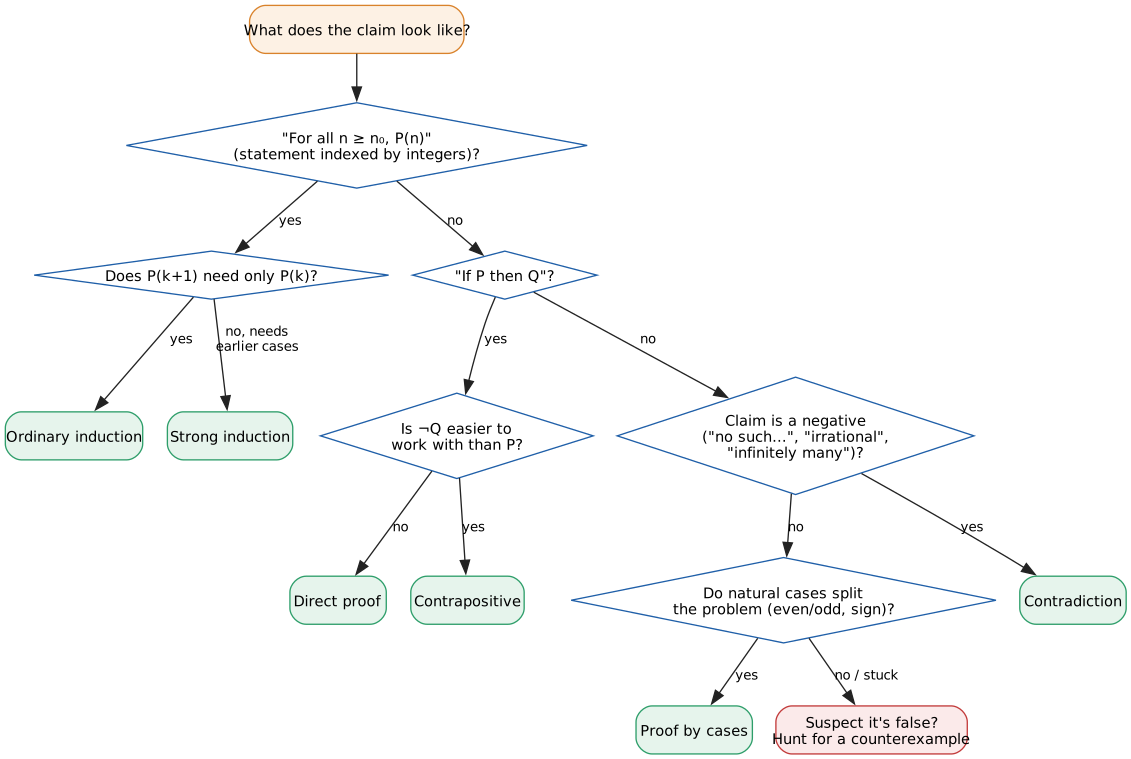
In words:
-
Is it false? Try edge cases and a quick script first.
-
Indexed by integers or defined recursively? Induction; strong induction if the step needs more than the previous case; structural induction for trees, lists and expressions.
-
"If \(P\) then \(Q\)" with a concrete \(P\)? Direct proof.
-
Conclusion is negative, or an "or", or \(P\) is awkward to unpack? Contrapositive.
-
Claim is a bare negative or about non-existence or infinitude? Contradiction.
-
Objects split naturally into types? Cases, with an exhaustiveness check.
-
Is it code? Invariant + variant, which is induction plus well-ordering.
22.17. Interactive tools
Browser tools on the companion website that go with this chapter. Each example link in the chapter opens one of them with that example already set up.
22.18. Mastery check
-
Prove that the sum of any three consecutive integers is divisible by 3.
-
Prove: for every integer \(n\), if \(5n + 4\) is odd then \(n\) is odd. Name the technique.
-
Prove that \(\log_2 3\) is irrational.
-
Disprove: "for every real number \(x\), \(x^2 > x\)."
-
Prove by induction that \(\displaystyle\sum_{i=1}^{n} i(i+1) = \frac{n(n+1)(n+2)}{3}\) for all \(n \ge 1\).
-
Prove by induction that \(3^n \ge 2n + 1\) for all \(n \ge 0\).
-
State a loop invariant and a variant for the following function (assume
e >= 0), and use them to prove it returns \(b^e\).def power(b, e): result, i = 1, 0 while i < e: result *= b i += 1 return result -
Find the error: "Claim: every positive integer is less than 100. Inductive step: assume \(k < 100\). Then \(k + 1 < 101\)… and so on, so \(k + 1 < 100\)."
Decision rule: All correct without hesitation → move on to Chapter 23, where you will use these techniques constantly. Stuck on 1–4 → reread Section 22.3, Section 22.4 and Section 22.5. Stuck on 5–6 → reread Section 22.9 and redo its exercises. Stuck on 7 → reread Section 22.13. Stuck on 8 → reread Section 22.15.
Mastery check answers
-
Direct. Three consecutive integers are \(n - 1, n, n + 1\). Their sum is \((n-1) + n + (n+1) = 3n\), which is divisible by 3.
-
Contrapositive: if \(n\) is even then \(5n + 4\) is even. Let \(n = 2k\); then \(5n + 4 = 10k + 4 = 2(5k + 2)\), which is even. Hence if \(5n + 4\) is odd, \(n\) is odd.
-
Contradiction. Suppose \(\log_2 3 = p/q\) with integers \(p, q\), \(q > 0\). Since \(\log_2 3 > 0\) (because \(3 > 1\)), also \(p > 0\). Then \(2^{p/q} = 3\), and raising both sides to the power \(q\) gives \(2^p = 3^q\). The left side is even (\(p \ge 1\)) and the right side is odd (a product of odd numbers). Contradiction.
-
Counterexample: \(x = 1\) gives \(1 > 1\), false. (Any \(x\) with \(0 \le x \le 1\) works, e.g. \(x = \tfrac12\).)
-
Base \(n = 1\): left \(1 \cdot 2 = 2\), right \(\frac{1 \cdot 2 \cdot 3}{3} = 2\). Step:
\[\begin{aligned} \sum_{i=1}^{k+1} i(i+1) &= \frac{k(k+1)(k+2)}{3} + (k+1)(k+2) \qquad\text{(IH)} \\ &= \frac{k(k+1)(k+2) + 3(k+1)(k+2)}{3} \\ &= \frac{(k+1)(k+2)(k+3)}{3}. \qquad\text{(factor out } (k+1)(k+2)\text{)} \end{aligned}\] -
Base \(n = 0\): \(3^0 = 1 \ge 1 = 2 \cdot 0 + 1\). Step: assume \(3^k \ge 2k + 1\). Then \(3^{k+1} = 3 \cdot 3^k \ge 3(2k + 1) = 6k + 3 \ge 2k + 3 = 2(k+1) + 1\), using \(6k \ge 2k\) for \(k \ge 0\).
-
Invariant: \(\texttt{result} = b^{\,i}\) and \(0 \le i \le e\). Initialisation: \(1 = b^0\), \(i = 0\). Maintenance: if \(\texttt{result} = b^i\) and \(i < e\), then after the body \(\texttt{result} = b^{i+1}\) and \(i + 1 \le e\). Variant: \(e - i\), a non-negative integer that decreases by 1 each iteration, so the loop terminates. Exit: \(i \ge e\) and \(i \le e\) give \(i = e\), so \(\texttt{result} = b^e\).
-
The base case is missing (\(1 < 100\) is true, so that part is easy to add), but the real error is in the inductive step, which does not follow: \(k < 100\) gives only \(k + 1 < 101\), which allows \(k + 1 = 100\); "and so on" hides the gap. Indeed \(k = 99\) satisfies the hypothesis while \(k + 1 = 100\) fails the conclusion, so \(P(k) \Rightarrow P(k+1)\) is false. (The claim is false: 100 is a counterexample.)