Volume 1: Foundations to Precalculus · Part III: Geometry
Chapter 9. Euclidean Geometry: Shapes, Angles, Similarity, and Proof
A carpenter checks that a corner is square by measuring 3, 4 and 5 along the boards. A game engine decides whether a bullet hit a player by comparing two squared distances. A phone shrinks a 4000-pixel photo to fit a 1000-pixel screen without distorting anyone’s face. All three are the same small body of ideas: angles, triangles, similarity, the Pythagorean theorem, circles, area and volume. This chapter rebuilds that toolkit, and it also reintroduces the habit geometry is famous for: proving things from a short list of starting rules.
9.1. Points, lines, planes, and the rules of the game
9.1.1. The problem
Around 300 BCE, Euclid of Alexandria set out to do something unusual. Instead of collecting useful facts about shapes, which the Egyptians and Babylonians had been doing for over a thousand years, he wanted every fact to follow from a handful of statements so obvious that nobody could reasonably reject them. If you accept the starting rules, you must accept everything built from them.
That is exactly how a software engineer thinks about a type system or a set of database constraints: fix a small set of axioms, and every guarantee downstream is earned rather than assumed. Geometry was the first place humans did this systematically.
9.1.2. Vocabulary and notation
Three words are undefined: we describe them, but we don’t define them in terms of anything simpler. Every other term is defined from them.
|
Point, line, plane
A point is a location with no size. Points are named with capital letters: \(A\), \(B\), \(P\). A line is straight, has no thickness, and extends forever in both directions. The line through \(A\) and \(B\) is written \(\overleftrightarrow{AB}\). A plane is a flat surface with no thickness that extends forever in every direction. A sheet of paper is a finite piece of one. Points on the same line are collinear; points (or lines) in the same plane are coplanar. |
|
Segment, ray, length, midpoint
A line segment \(\overline{AB}\) is the part of a line between endpoints \(A\) and \(B\). Its length is written \(AB\) (no bar). A ray \(\overrightarrow{AB}\) starts at \(A\) and continues forever through \(B\). The midpoint of \(\overline{AB}\) is the point \(M\) on it with \(AM = MB\). Two segments with equal lengths are congruent, written \(\overline{AB} \cong \overline{CD}\). |
|
Axiom, postulate, theorem, lemma, corollary
An axiom or postulate is a statement accepted without proof (Euclid used "postulate" for geometric ones, "common notion" for general logic such as "things equal to the same thing are equal to each other"). A theorem is a statement proved from axioms and earlier theorems. A lemma is a small theorem proved mainly as a step towards a bigger one. A corollary is a result that follows almost immediately from a theorem. A conjecture is a statement believed true but not yet proved. |
Euclid’s five postulates, in modern language:
-
A straight segment can be drawn between any two points.
-
A segment can be extended indefinitely into a line.
-
A circle can be drawn with any centre and any radius.
-
All right angles are equal.
-
(The parallel postulate.) Through a point not on a given line, there is exactly one line parallel to the given line.
The first four look like rules for using a ruler and compass. The fifth is different in character, and it is the one that powers most of this chapter: the angle sum of a triangle, similarity, and the Pythagorean theorem all depend on it.
|
The postulate that wouldn’t go away
For two thousand years mathematicians tried to prove the parallel postulate from the other four and failed. In the 1820s Lobachevsky, Bolyai and Gauss realised why: you can replace it with "there are many parallels through the point" and get a perfectly consistent hyperbolic geometry, where triangle angles add to less than 180°. On the surface of a sphere, where "lines" are great circles, there are no parallels and triangle angles add to more than 180°. Draw a triangle from the North Pole down to the equator, a quarter of the way around, and back up: it has three right angles. Einstein’s general relativity uses non-Euclidean geometry to describe curved spacetime, and GPS satellites must correct for it. |
9.2. Angles and angle facts
9.2.1. The problem
Two roads cross. One makes a 63° angle with the other. What are the other three angles at the junction? Now a third road runs parallel to the first. What angles does it make with the second road? You should be able to answer both without a protractor, and the reasons are worth knowing because they are the first links in every geometric proof.
9.2.2. Vocabulary and notation
|
Angle and its measure
An angle is formed by two rays with a common endpoint, the vertex. The angle with vertex \(B\) and rays through \(A\) and \(C\) is written \(\angle ABC\) (vertex in the middle) or just \(\angle B\). Its measure is written \(m\angle ABC\) in US textbooks, though most people just write \(\angle ABC = 40^\circ\). Angles are measured in degrees: a full turn is \(360^\circ\). (In Chapter 13 you’ll meet radians, where a full turn is \(2\pi\).) |
|
Kinds of angle
Two lines that meet at a right angle are perpendicular, written \(\ell_1 \perp \ell_2\). Lines in a plane that never meet are parallel, written \(\ell_1 \parallel \ell_2\). |
|
Angle pairs
|
9.2.3. Intuition and why it works
Vertical angles are equal. When two lines cross, angles 1 and 2 form a straight line, so \(\angle 1 + \angle 2 = 180^\circ\). Angles 2 and 3 also form a straight line, so \(\angle 2 + \angle 3 = 180^\circ\). Both sums equal 180°, so \(\angle 1 = 180^\circ - \angle 2 = \angle 3\). That is the whole proof; we’ll write it formally in Section 9.9.
Parallel lines cut by a transversal. A transversal is a line crossing two or more other lines. When it crosses two parallel lines it creates eight angles, and the parallel postulate forces the two crossings to look identical: the transversal meets \(\ell_2\) at exactly the same tilt as \(\ell_1\). So the four angles at the top crossing are copies of the four at the bottom.
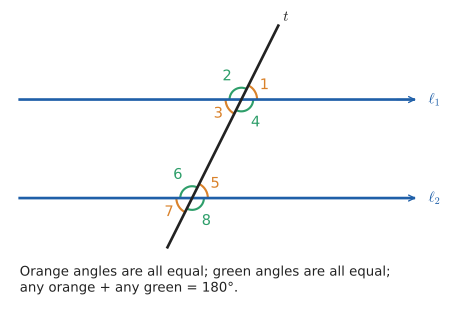
The pairs have names, which US tests use heavily:
| Name | Where they sit (using the figure) | Relationship |
|---|---|---|
Corresponding |
same position at each crossing: 1 & 5, 2 & 6, 3 & 7, 4 & 8 |
equal |
Alternate interior |
between the parallels, opposite sides of \(t\): 3 & 5, 4 & 6 |
equal |
Alternate exterior |
outside the parallels, opposite sides: 1 & 7, 2 & 8 |
equal |
Same-side (co-)interior |
between the parallels, same side: 3 & 6, 4 & 5 |
supplementary |
The table is really one fact: every acute angle in the figure is equal, every obtuse angle is equal, and an acute plus an obtuse makes 180°. (If the transversal is perpendicular, all eight are right angles.) The UK mnemonic is F-angles (corresponding), Z-angles (alternate) and C- or U-angles (co-interior), after the letter shapes they trace.
The facts also run backwards, and that is what makes them useful: if a transversal makes equal corresponding angles with two lines, those lines are parallel. This converse is how you prove lines parallel.
9.2.4. Worked example
Two parallel lines are cut by a transversal; angle 1 in the figure measures \(63^\circ\). Find all the others.
Check: \(\angle 4 + \angle 5 = 117^\circ + 63^\circ = 180^\circ\), as same-side interior angles must.
A typical algebraic version: same-side interior angles measure \((3x + 15)^\circ\) and \((2x - 5)^\circ\). Since they are supplementary,
so the angles are \(3(34) + 15 = 117^\circ\) and \(2(34) - 5 = 63^\circ\).
|
Looking parallel is not being parallel
The equal-angle facts hold only if the lines are parallel. If a problem doesn’t state it (or mark the lines with matching arrowheads), you may not assume it, however parallel the drawing looks. Diagrams in geometry problems are routinely "not drawn to scale". |
9.2.5. Where you’d use this
Navigation (bearings). A bearing is an angle measured clockwise from north. North lines at two different places are parallel, so the path between them is a transversal. If a boat sails from \(A\) to \(B\) on a bearing of \(063^\circ\), the angle at \(B\) between north and the way back is the co-interior partner of \(63^\circ\), namely \(117^\circ\) measured anticlockwise, so the return bearing is \(360^\circ - 117^\circ = 243^\circ\). That’s the rule every navigator and orienteer uses: back bearing = bearing \(\pm 180^\circ\).
DIY. A picture frame’s corners are \(90^\circ\), so each of the two pieces meeting at a corner is cut at \(45^\circ\) (the cut bisects the corner). A hexagonal mirror frame has interior angles of \(120^\circ\), so each cut is at \(60^\circ\) to the edge of the strip, which a mitre saw (whose dial reads 0° for a square cut) calls \(30^\circ\).
Physics. Light reflects off a mirror at the same angle it arrives. Put two mirrors at a right angle and a ray that hits both comes back exactly parallel to the way it came, whatever angle it arrived at: the two reflections turn it through \(2 \times 90^\circ = 180^\circ\). Bicycle reflectors, road "cat’s eyes" and the reflector arrays the Apollo astronauts left on the Moon (used to measure the Earth–Moon distance by laser to within centimetres) are three-mirror versions of this corner.
Computing. In a 2D game, a ball bouncing off a vertical wall keeps its vertical velocity and flips the sign of its horizontal velocity, vx = -vx. Equal angles in and out is the geometric fact; one sign flip is its implementation. Ray tracers do the same thing for every reflective surface, using vectors (Chapter 26).
9.3. Triangles: angle sum and congruence
9.3.1. The problem
Why do the angles of every triangle add to 180°? You’ve known the fact since childhood, but it’s not obvious: a long thin triangle and a fat equilateral one look nothing alike. And a related engineering question: why are bridges and roof trusses built from triangles rather than rectangles? Both answers come from the same place.
9.3.2. Vocabulary
|
Classifying triangles
By sides:
By angles: acute (all angles acute), right (one right angle), obtuse (one obtuse angle). In a right triangle the side opposite the right angle is the hypotenuse (always the longest side) and the other two are the legs. Triangle \(ABC\) is written \(\triangle ABC\). |
|
Interior and exterior angles
The interior angles of a polygon are the angles inside it at each vertex. Extend one side past a vertex and the angle between the extension and the next side is an exterior angle. Each exterior angle forms a linear pair with its interior angle. |
9.3.3. Why it works: the angle-sum theorem
Theorem. The interior angles of any triangle add to \(180^\circ\).
Proof. Take \(\triangle ABC\) with angles \(\alpha\) at \(A\), \(\beta\) at \(B\), \(\gamma\) at \(C\). Through \(C\), draw the line parallel to \(\overline{AB}\) (the parallel postulate says there is exactly one).
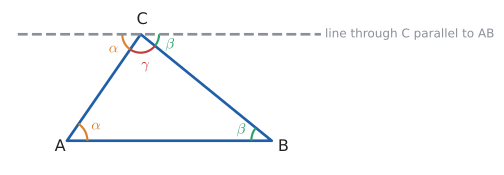
Side \(\overline{AC}\) is a transversal of the two parallel lines, so the angle between the new line and \(\overline{CA}\) equals \(\alpha\) (alternate interior angles). Likewise \(\overline{BC}\) is a transversal, so the angle on the right at \(C\) equals \(\beta\). Now the three angles at \(C\), namely \(\alpha\), \(\gamma\), \(\beta\), sit side by side along a straight line, so
Notice what the proof used: the parallel postulate and the alternate-angle fact. On a sphere, where the parallel postulate fails, so does the theorem.
Corollary (exterior angle theorem). An exterior angle of a triangle equals the sum of the two interior angles not adjacent to it. If the exterior angle at \(C\) is \(\delta\), then \(\delta = 180^\circ - \gamma = \alpha + \beta\).
Triangle inequality. Any side of a triangle is shorter than the sum of the other two: \(AB < AC + CB\). "The straight path is the shortest." Lengths 2, 3 and 6 can’t form a triangle because \(2 + 3 < 6\). This inequality reappears as a defining property of every distance function in mathematics and computing.
9.3.4. Congruence
Two figures are congruent (\(\cong\)) if one can be moved onto the other exactly by sliding, rotating and possibly flipping it. Same shape, same size. For triangles, all six parts (three sides, three angles) match.
The practical question: how little do you need to check to know two triangles are congruent? Think of it as "how much information pins down a triangle uniquely". If you’re told three side lengths, you can build only one triangle (up to moving it around): try it with three sticks. That is why a triangle frame is rigid while a rectangular frame can be pushed into a parallelogram. Four sides do not determine a quadrilateral; three sides do determine a triangle. Hence roof trusses.
|
Congruence criteria
Two triangles are congruent if they match in:
In a congruence statement \(\triangle ABC \cong \triangle DEF\) the order matters: \(A\) corresponds to \(D\), \(B\) to \(E\), \(C\) to \(F\). US textbooks then use CPCTC, "corresponding parts of congruent triangles are congruent", to conclude that any other matching pair of parts is equal. |
|
SSA and AAA don’t work
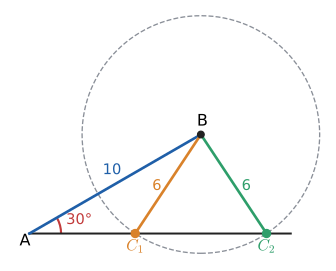
AAA fixes the shape but not the size: every equilateral triangle has angles 60°, 60°, 60°. That gives similarity, not congruence. SSA (two sides and a non-included angle) is ambiguous. Fix \(\angle A = 30^\circ\), \(AB = 10\) and \(BC = 6\). Swing the side of length 6 from \(B\) and it can hit the other ray from \(A\) at two different points, giving two non-congruent triangles. (This is the "ambiguous case" that resurfaces with the sine rule in Chapter 13.) The one exception is HL: when the given angle is a right angle, there’s only one way to do it. |
Try it: See both SSA triangles.
9.3.5. Worked example
In \(\triangle PQR\) and \(\triangle XYZ\): \(PQ = XY = 7\), \(\angle Q = \angle Y = 50^\circ\), \(QR = YZ = 9\). Are they congruent, and if so what is \(\angle R\) given \(\angle Z = 72^\circ\)?
-
The given angle at \(Q\) lies between sides \(PQ\) and \(QR\); at \(Y\) it lies between \(XY\) and \(YZ\). So this is SAS, and \(\triangle PQR \cong \triangle XYZ\) with \(P \leftrightarrow X\), \(Q \leftrightarrow Y\), \(R \leftrightarrow Z\).
-
By CPCTC, \(\angle R = \angle Z = 72^\circ\).
-
The angle sum then gives \(\angle P = 180^\circ - 50^\circ - 72^\circ = 58^\circ\).
9.3.6. Where you’d use this
Home. A flat-pack bookcase that sways sideways is a rectangle, which can shear into a parallelogram without changing any side length. The thin board nailed across the back turns it into two triangles, and SSS says a triangle with fixed sides can’t change shape. The same reason puts diagonal braces in garden gates (the brace runs from the bottom of the hinge side up to the top of the latch side, so it is pushed, not pulled) and triangles in every bicycle frame.
Engineering and surveying. Bridges and roof trusses (Warren and Pratt trusses are rows of triangles) and electricity pylons are triangulated for rigidity. Before satellites, national maps such as the UK Ordnance Survey were built from a network of triangles between hilltop "trig pillars": measure one baseline very accurately, measure angles, and the angle facts and similarity fix every other point.
Route planning and search. The triangle inequality gives you bounds for free. If a road trip is 30 km from \(A\) to \(B\) and 40 km from \(B\) to \(C\), then \(A\) and \(C\) are at least \(40 - 30 = 10\) km and at most \(70\) km apart in a straight line. Route planners such as A* use the straight-line distance as a lower bound on the road distance, which is what lets them skip hopeless routes safely. Nearest-neighbour indexes for search use the same trick: if your query is 10 units from a reference point \(p\), and an item is 3 units from \(p\), that item is at least \(10 - 3 = 7\) units from your query, so if you already have a match at distance 5 you never need to compute that item’s distance at all.
9.3.7. Exercises
-
Classify a triangle with angles \(35^\circ\), \(55^\circ\), \(90^\circ\) by angles, and say whether it can be isosceles.
-
An isosceles triangle has a vertex angle (between the legs) of \(40^\circ\). Find the base angles.
-
An exterior angle of a triangle is \(130^\circ\) and one of the non-adjacent interior angles is \(48^\circ\). Find the other two interior angles.
-
Which of these can be triangle side lengths: (a) 4, 5, 10 (b) 5, 5, 9 (c) 1, 2, 3?
-
Two triangles have \(AB = DE\), \(BC = EF\) and \(\angle A = \angle D\). Must they be congruent? Explain.
Answers
-
Right triangle (one angle is \(90^\circ\)). It is scalene: an isosceles right triangle needs both acute angles equal (\(45^\circ\)), and these are not.
-
The base angles are equal, so \(2x + 40 = 180\), \(2x = 140\), \(x = 70^\circ\).
-
Exterior angle theorem: \(130 = 48 + y\), so \(y = 82^\circ\). The interior angle adjacent to the exterior angle is \(180 - 130 = 50^\circ\). Check: \(48 + 82 + 50 = 180\).
-
(a) No: \(4 + 5 = 9 < 10\). (b) Yes: \(5 + 5 = 10 > 9\). (c) No: \(1 + 2 = 3\) is not greater than 3; the "triangle" is flat (degenerate).
-
No. The angle at \(A\) is not between \(AB\) and \(BC\), so this is SSA, which is ambiguous.
9.4. Similarity and scale factors
9.4.1. The problem
You want the height of a tree. You can’t climb it, but it’s a sunny day. You are 1.8 m tall and cast a 2.4 m shadow; the tree casts a 16 m shadow. How tall is the tree? Thales of Miletus supposedly measured the Great Pyramid this way around 600 BCE.
9.4.2. Intuition
Two figures are similar if one is a scaled copy of the other: same shape, possibly different size, possibly moved, rotated or flipped. Every length is multiplied by the same number \(k\), the scale factor, and every angle is unchanged. A photo and its thumbnail are similar; a photo stretched to fill a different aspect ratio is not.
In the tree problem, the sun’s rays are parallel, so the triangle formed by you, your shadow and the ray to the tip of your shadow has the same angles as the corresponding triangle for the tree. Same angles means same shape, so the ratios of sides are equal.
|
Similar figures and scale factor
\(\triangle ABC \sim \triangle DEF\) ("is similar to") means corresponding angles are equal and corresponding sides are in a common ratio:
\[\frac{DE}{AB} = \frac{EF}{BC} = \frac{FD}{CA} = k,\]
where \(k\) is the scale factor from the first triangle to the second. \(k > 1\) is an enlargement, \(0 < k < 1\) a reduction. Congruence is the special case \(k = 1\). A proportion is an equation stating two ratios are equal, such as \(\tfrac{a}{b} = \tfrac{c}{d}\). Its solution method, cross-multiplying, gives \(ad = bc\). |
|
Similarity criteria for triangles
|
AA is the workhorse: angles are usually easier to get than lengths, and parallel lines hand them to you for free. For instance, a line drawn across a triangle parallel to one side cuts off a smaller triangle similar to the original (the corresponding angles are equal). That fact is called the side-splitter or basic proportionality theorem.
9.4.3. The scaling laws
If lengths scale by \(k\), what happens to area and volume?
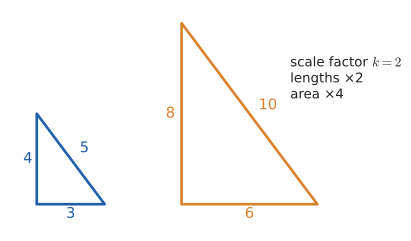
A square of side \(s\) has area \(s^2\). Scale it by \(k\) and its area is \((ks)^2 = k^2 s^2\). Any shape can be approximated by tiny squares, each of which scales by \(k^2\), so:
The 3-4-5 triangle has area \(\tfrac12 \cdot 3 \cdot 4 = 6\); the 6-8-10 triangle has area \(\tfrac12 \cdot 6 \cdot 8 = 24 = 2^2 \times 6\).
9.4.4. The method
Input: a figure with two triangles you suspect are similar, some known lengths, and one unknown.
Steps:
-
Prove similarity, usually by AA (look for shared angles, vertical angles, right angles, parallel lines).
-
Write the correspondence in order: \(\triangle ABC \sim \triangle DEF\). Matching letters tell you which sides correspond (\(AB \leftrightarrow DE\), etc.). Corresponding sides are opposite equal angles.
-
Write one proportion containing the unknown and three knowns, keeping each ratio in the same order (small/large on both sides, or large/small on both).
-
Cross-multiply and solve the linear equation.
-
Sanity check: does the bigger triangle have the bigger side?
Output: the unknown length (and, if needed, the scale factor \(k\)).
9.4.5. Worked example: the tree
Both triangles have a right angle (person and tree are vertical) and the same angle of elevation of the sun. By AA they are similar. Matching "height ↔ height" and "shadow ↔ shadow":
Sanity check: the scale factor is \(k = 16 / 2.4 = 6.\overline{6}\), and \(1.8 \times 6.\overline{6} = 12\). The tree’s shadow is much longer than yours, and so is the tree.
Alternative approach. Use the ratio within one triangle instead of between triangles: your height-to-shadow ratio is \(1.8 / 2.4 = 0.75\), and the same ratio holds for the tree, so \(h = 0.75 \times 16 = 12\). This "within" ratio is precisely what trigonometry will name the tangent of the sun’s elevation angle (Chapter 13). Choosing a method: use "between" ratios when a scale factor is given or obvious (maps, models); use "within" ratios when you have a single triangle’s shape and want to apply it to another, which is the trigonometric view.
|
Mixing up the correspondence
The most common error is matching the wrong sides. Always match by angles: the side opposite the right angle corresponds to the side opposite the right angle, and so on. Writing the similarity statement with vertices in matching order prevents the mistake. A second error is applying \(k\) to areas: a map at scale 1:50 000 shows a region whose real area is \(50\,000^2 = 2.5 \times 10^9\) times larger, not 50 000 times. |
9.4.6. Where you’d use this
-
Maps and plans: on a 1:25 000 walking map, 1 cm stands for 25 000 cm \(=\) 250 m, so a 6.4 cm stretch of path is \(6.4 \times 250 = 1600\) m. Areas scale by \(25\,000^2\): a field covering 2 cm² of map is \(2 \times 6.25 \times 10^8 \text{ cm}^2 = 125\,000 \text{ m}^2\), or 12.5 hectares. A 1:100 architect’s drawing works the same way: 4.2 cm on paper is a 4.2 m wall.
-
Optics: a pinhole camera projects a similar (inverted) image; the ratio of image height to object height equals the ratio of the image distance to the object distance. A 2 m tall person 20 m from a pinhole box 10 cm deep makes an image \(2 \times 0.1/20 = 0.01\) m, i.e. 1 cm tall. Your eye and every camera lens obey the same ratio.
-
Cooking: a round 20 cm cake recipe scaled to a 30 cm tin of the same depth needs \((30/20)^2 = 2.25\) times the ingredients, not 1.5 times, because the batter fills an area.
-
The square–cube law: scale an animal up by \(k\) and its weight (volume) grows like \(k^3\) while the strength of its bones (cross-sectional area) grows only like \(k^2\). That’s why giant ants in films are physically impossible and why elephants have thick legs.
|
Shadow measurer
Drag the sun’s elevation angle and the height of a pole. Watch the shadow length change, and see the "height / shadow" ratio stay constant for every object in the scene at a given sun angle. Then drag a second slider that scales a triangle by \(k\) and read off its perimeter (×\(k\)) and area (×\(k^2\)) live. |
9.4.7. Exercises
-
\(\triangle ABC \sim \triangle PQR\) with \(AB = 4\), \(BC = 6\), \(PQ = 10\). Find \(QR\) and the scale factor.
-
A 1:25 scale model car is 18 cm long. How long is the real car in metres? If the model’s paint covers 0.12 m², how much paint area does the real car have?
-
A 2 m post casts a 3.5 m shadow at the same time a building casts a 28 m shadow. How tall is the building?
-
Two similar cylinders have heights 5 cm and 15 cm. The small one holds 200 ml. How much does the large one hold?
Answers
-
\(k = PQ/AB = 10/4 = 2.5\), so \(QR = 2.5 \times 6 = 15\).
-
Length: \(18 \times 25 = 450\) cm \(= 4.5\) m. Area scales by \(25^2 = 625\): \(0.12 \times 625 = 75\) m².
-
\(h/2 = 28/3.5 = 8\), so \(h = 16\) m.
-
\(k = 15/5 = 3\), volume scales by \(3^3 = 27\): \(200 \times 27 = 5400\) ml \(= 5.4\) litres.
9.5. The Pythagorean theorem
9.5.1. The problem
A 5 m ladder leans against a wall with its foot 1.4 m from the wall. How high up the wall does it reach? A television is sold as "55-inch" (the diagonal) with a 16:9 aspect ratio; how wide is it? A game character is at \((3, 4)\) relative to an enemy; how far away is that? All three questions are the same question.
9.5.2. The theorem
|
Pythagorean theorem
In a right triangle with legs \(a\) and \(b\) and hypotenuse \(c\),
\[a^2 + b^2 = c^2.\]
Converse: if a triangle’s sides satisfy \(a^2 + b^2 = c^2\), the angle opposite \(c\) is a right angle. A Pythagorean triple is a set of positive whole numbers satisfying the equation: (3, 4, 5), (5, 12, 13), (8, 15, 17), (7, 24, 25), and any multiple such as (6, 8, 10). |
9.5.3. Why it works: a proof you can see
There are hundreds of proofs. This one is the most convincing at a glance.
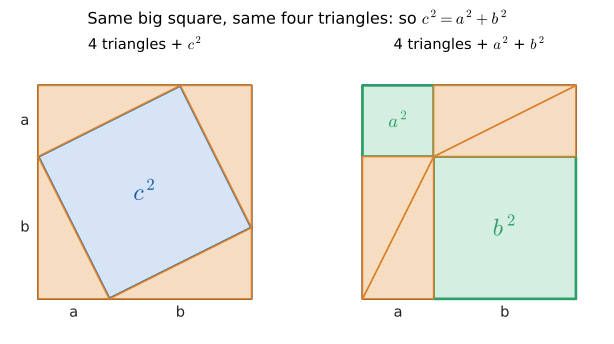
Take four copies of the right triangle with legs \(a, b\) and hypotenuse \(c\). Arrange them inside a square of side \(a + b\) in two ways.
-
Left: the triangles sit in the corners, hypotenuses facing inwards. The hole in the middle is a square of side \(c\). (It really is a square: at each corner of the hole, the two acute angles of the triangles plus the hole’s angle form a straight line, and the two acute angles add to \(90^\circ\), so the hole’s angle is \(90^\circ\).)
-
Right: slide the triangles into two rectangles of size \(a \times b\). The holes are now a square of side \(a\) and a square of side \(b\).
The big square and the four triangles are identical in both pictures, so the uncovered areas must match: \(c^2 = a^2 + b^2\). \(\blacksquare\)
The same picture gives an algebraic proof. Count the left-hand big square two ways:
Why the converse is true. Suppose \(\triangle ABC\) has \(a^2 + b^2 = c^2\). Build a genuine right triangle with legs \(a\) and \(b\); by the theorem its hypotenuse is \(\sqrt{a^2 + b^2} = c\). The two triangles now agree in all three sides, so they are congruent by SSS, and the original angle opposite \(c\) is a right angle too.
9.5.4. The method
Input: a right triangle with two known sides.
Steps:
-
Identify the hypotenuse \(c\): the side opposite the right angle, the longest side.
-
If you want the hypotenuse: \(c = \sqrt{a^2 + b^2}\).
-
If you want a leg: \(a = \sqrt{c^2 - b^2}\) (the hypotenuse squared minus the other leg squared).
-
Take the positive square root (lengths are positive). Leave an exact surd if asked, otherwise round at the end only.
-
Sanity check: the hypotenuse must be longer than each leg but shorter than their sum.
Output: the missing side.
9.5.5. Worked examples
The ladder. The ladder is the hypotenuse (\(c = 5\)); one leg is \(b = 1.4\); we want the height \(a\). Try it: Solve the ladder triangle.
(This is the 7-24-25 triple scaled by \(0.2\): \(1.4, 4.8, 5\).)
The television. With aspect ratio 16:9, write width \(= 16t\) and height \(= 9t\) for some \(t\). The diagonal is 55:
so the width is \(16t \approx 47.9\) inches and the height \(9t \approx 27.0\) inches.
The converse at work. Is a triangle with sides 9, 40, 41 a right triangle? \(9^2 + 40^2 = 81 + 1600 = 1681 = 41^2\). Yes. And 6, 7, 9? \(36 + 49 = 85 \neq 81 = 9^2\), so it isn’t a right triangle. In fact if \(a^2 + b^2 > c^2\) (with \(c\) the longest side) the triangle is acute, and if \(a^2 + b^2 < c^2\) it is obtuse. The law of cosines in Chapter 13 makes this precise.
9.5.6. Distance in two and three dimensions
Two points \((x_1, y_1)\) and \((x_2, y_2)\) are the ends of the hypotenuse of a right triangle whose legs are the horizontal and vertical separations \(\Delta x = x_2 - x_1\) and \(\Delta y = y_2 - y_1\). (\(\Delta\), Greek capital delta, means "change in".) So the distance is
From \((1, 2)\) to \((4, 6)\): \(\sqrt{3^2 + 4^2} = 5\). Chapter 10 develops this fully as the distance formula.
In 3D, apply the theorem twice. The diagonal of a box measuring \(3 \times 4 \times 12\): the floor diagonal is \(\sqrt{3^2 + 4^2} = 5\), and that floor diagonal together with the height forms another right triangle, so the space diagonal is \(\sqrt{5^2 + 12^2} = 13\). In general \(d = \sqrt{\Delta x^2 + \Delta y^2 + \Delta z^2}\), and the pattern continues to any number of dimensions, which is how machine learning measures the distance between 768-dimensional embedding vectors (Chapter 26).
|
Forgetting which side is the hypotenuse
\(a^2 + b^2 = c^2\) only applies to right triangles, and \(c\) must be the hypotenuse. Given legs 5 and 13, the hypotenuse is \(\sqrt{194} \approx 13.93\), not 12; given a leg 5 and hypotenuse 13, the other leg is 12. Also: \(\sqrt{a^2 + b^2} \neq a + b\). The square root does not distribute over addition: \(\sqrt{9 + 16} = 5\), but \(\sqrt9 + \sqrt{16} = 7\). |
9.5.7. Special right triangles
Two right triangles turn up so often that it pays to know their side ratios by heart. Both come from cutting a regular shape in half.
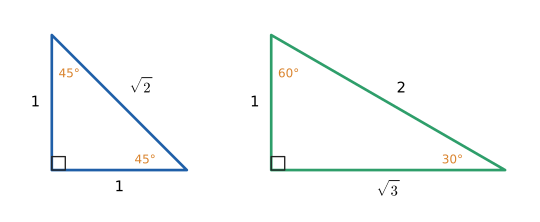
45-45-90. Cut a unit square along its diagonal. Each half is an isosceles right triangle with legs 1 and hypotenuse \(\sqrt{1^2 + 1^2} = \sqrt2\). Sides are in the ratio \(1 : 1 : \sqrt2\).
30-60-90. Cut an equilateral triangle of side 2 down its line of symmetry. Each half has hypotenuse 2, short leg 1 (half the base), and angles \(30^\circ, 60^\circ, 90^\circ\). The long leg is \(\sqrt{2^2 - 1^2} = \sqrt3\). Sides are in the ratio \(1 : \sqrt3 : 2\), with the short leg opposite the \(30^\circ\) angle.
Example. An equilateral triangle has side 10. Its height is the long leg of a 30-60-90 triangle with hypotenuse 10, short leg 5, so the height is \(5\sqrt3 \approx 8.66\) and the area is \(\tfrac12 \cdot 10 \cdot 5\sqrt3 = 25\sqrt3 \approx 43.30\). In general, an equilateral triangle of side \(s\) has area \(\tfrac{\sqrt3}{4}s^2\).
These ratios are exactly the values of sine, cosine and tangent at \(30^\circ, 45^\circ, 60^\circ\) that Chapter 13 will ask you to know: for example \(\sin 30^\circ = \tfrac12\) is "short leg over hypotenuse".
9.5.8. Where you’d use this
-
Building: to set out a square corner for a shed base, measure 0.9 m along one edge and 1.2 m along the other; the corner is square exactly when the diagonal is 1.5 m, because \(0.9^2 + 1.2^2 = 0.81 + 1.44 = 2.25 = 1.5^2\). (This is 3-4-5 scaled by 0.3; builders use 6-8-10 feet for bigger corners.)
-
Shopping: will a 65-inch 16:9 television fit a 1.5 m wide alcove? As in the worked example, \(t = 65/\sqrt{337} \approx 3.541\) inches, so the screen is \(16t \approx 56.7\) inches \(\approx 144\) cm wide (plus the bezel) and \(9t \approx 31.9\) inches \(\approx 81\) cm tall. It fits, with about 6 cm to spare.
-
Mechanics: two forces of 30 N and 40 N pulling at right angles have a resultant of \(\sqrt{30^2 + 40^2} = 50\) N. A plane flying at 200 km/h due north through a 50 km/h wind from the west actually moves over the ground at \(\sqrt{200^2 + 50^2} = \sqrt{42\,500} \approx 206.2\) km/h. Velocities, forces and displacements at right angles always combine this way, which is the doorway to vectors (Chapter 26).
|
Over 3,700 years old
The theorem is named after Pythagoras (c. 570–495 BCE), but the Babylonian clay tablet Plimpton 322 (c. 1800 BCE) lists fifteen Pythagorean triples, including (12 709, 13 500, 18 541), which nobody finds by accident. Euclid’s proof is Proposition 47 of Book I. US President James Garfield published an original proof in 1876 using a trapezoid made of three right triangles. Every primitive triple can be generated as \((m^2 - n^2,\ 2mn,\ m^2 + n^2)\); try \(m = 2, n = 1\). |
|
Pythagoras jigsaw
Drag the corner of a right triangle to change \(a\) and \(b\). The app animates the four triangles sliding between the two arrangements, and displays \(a^2\), \(b^2\) and \(c^2\) as numbers that always balance. Then unlock the right angle: as the angle opens past 90°, watch \(c^2\) exceed \(a^2 + b^2\). Try it: Solve any triangle |
9.5.9. Exercises
-
Find the hypotenuse of a right triangle with legs 8 and 15.
-
A rectangle is 20 cm by 21 cm. How long is its diagonal?
-
Is a triangle with sides 10, 24, 26 right, acute or obtuse? What about 5, 6, 8?
-
A 45-45-90 triangle has hypotenuse 12. Find its legs, exactly.
-
A 30-60-90 triangle has long leg 9. Find the short leg and the hypotenuse.
-
A drone flies 30 m east, 40 m north and climbs 120 m. How far is it from where it started?
Answers
-
\(\sqrt{64 + 225} = \sqrt{289} = 17\).
-
\(\sqrt{400 + 441} = \sqrt{841} = 29\) cm.
-
\(100 + 576 = 676 = 26^2\): right. \(25 + 36 = 61 < 64 = 8^2\): obtuse.
-
Legs \(\ell\) with \(\ell\sqrt2 = 12\), so \(\ell = 12/\sqrt2 = 6\sqrt2 \approx 8.49\).
-
Long leg \(= \sqrt3 \times\) short leg, so short leg \(= 9/\sqrt3 = 3\sqrt3 \approx 5.20\); hypotenuse \(= 2 \times 3\sqrt3 = 6\sqrt3 \approx 10.39\).
-
Ground distance \(\sqrt{30^2 + 40^2} = 50\); total \(\sqrt{50^2 + 120^2} = \sqrt{16\,900} = 130\) m.
9.6. Polygons, perimeter and area
9.6.1. The problem
A surveyor walks around a plot of land and records the corners as coordinates. What is its area? A tiler wants to know which regular shapes can tile a floor with no gaps. Both need the same two tools: angle sums of polygons and a reliable way to compute area.
|
Polygon vocabulary
A polygon is a closed plane figure made of straight segments (sides or edges) meeting at vertices. It is simple if its sides don’t cross each other, and convex if every interior angle is less than \(180^\circ\) (equivalently, the segment joining any two interior points stays inside). A polygon with a "dent" is concave. A diagonal joins two non-adjacent vertices. A regular polygon has all sides equal and all angles equal. Names by number of sides: triangle (3), quadrilateral (4), pentagon (5), hexagon (6), heptagon (7), octagon (8), decagon (10), \(n\)-gon in general. Perimeter is the total length of the boundary. Area is the amount of surface enclosed, measured in square units. |
|
Quadrilaterals
Watch the transatlantic trap: in the UK a trapezium has one pair of parallel sides; in the US a trapezium traditionally has none. |
9.6.2. Angle sums of polygons
Pick one vertex of a convex \(n\)-gon and draw every diagonal from it. You cut the polygon into \(n - 2\) triangles (each side except the two touching your vertex becomes the base of one triangle). Each triangle contributes \(180^\circ\), so
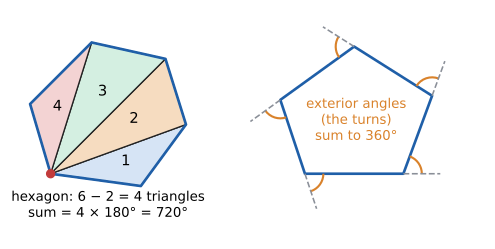
For a regular polygon each interior angle is \(\dfrac{(n-2) \times 180^\circ}{n}\): 60° (triangle), 90° (square), 108° (pentagon), 120° (hexagon), 135° (octagon).
The exterior angles are even simpler. Walk around any convex polygon: at each corner you turn through the exterior angle, and after one lap you have turned through exactly one full turn. So the exterior angles of every convex polygon add to \(360^\circ\), regardless of \(n\). For a regular \(n\)-gon each exterior angle is \(360^\circ/n\), which is the quickest way to find \(n\): a regular polygon with interior angles of \(156^\circ\) has exterior angles of \(24^\circ\), so \(n = 360/24 = 15\).
|
Only three regular tilings
For regular polygons to tile a floor, a whole number of interior angles must meet at each point to make \(360^\circ\). Six triangles (\(6 \times 60\)), four squares (\(4 \times 90\)) or three hexagons (\(3 \times 120\)) work. Pentagons (108°) don’t divide 360, and anything with more than six sides has angles over 120°, so fewer than three fit. That’s why bees, bathroom tiles and graphics engines use exactly these three. Hexagonal grids are popular in strategy games because every neighbour of a hexagon is the same distance away, which isn’t true of a square’s diagonal neighbours. |
9.6.3. Area formulas, derived
Every basic area formula comes from the rectangle by cutting and rearranging, which is worth seeing because it means you never need to memorise them blindly.
Rectangle: \(A = bh\) (base \(b\), height \(h\)). That’s the definition of area in square units: \(b\) columns of \(h\) unit squares.
Parallelogram: cut the triangle off one end and slide it to the other end. You get a rectangle with the same base and the same perpendicular height: \(A = bh\).
Triangle: two copies of any triangle fit together into a parallelogram with the same base and height. So
where \(h\) is the perpendicular height measured to the line containing the base (for an obtuse triangle that may fall outside the triangle).
Trapezoid with parallel sides \(a\) and \(b\), height \(h\): two copies, one rotated, form a parallelogram of base \(a + b\), so \(A = \tfrac12 (a + b) h\). ("Average of the parallel sides, times the height.")
|
Using the slant side as the height
The height in every area formula is perpendicular to the base. A parallelogram with sides 10 and 6 does not have area 60 unless it’s a rectangle; tilt it and the area shrinks towards zero even though the side lengths don’t change. Also keep units straight: lengths in cm give areas in cm² (and \(1 \text{ m}^2 = 10\,000 \text{ cm}^2\), not 100). |
9.6.4. Area from coordinates: the shoelace formula
The surveyor’s problem: you have the corners \((x_1, y_1), (x_2, y_2), \dots, (x_n, y_n)\) of a simple polygon, listed in order around the boundary. There’s no obvious base or height. The shoelace formula (or surveyor’s formula) handles any simple polygon, convex or not:
Read the notation piece by piece: \(\sum_{i=1}^{n}\) (capital sigma) means "add up the following expression for \(i = 1, 2, \dots, n\)" (it’s a for loop, and Chapter 14 covers it in detail); \(|\cdot|\) is absolute value; and the condition at the end says "wrap around" so the last vertex pairs with the first.
Why it works (sketch). Each term \(\tfrac12 (x_i y_{i+1} - x_{i+1} y_i)\) is the signed area of the triangle formed by the origin and the edge from vertex \(i\) to vertex \(i+1\): positive if the edge goes anticlockwise around the origin, negative if clockwise. Adding these triangles for every edge, the parts outside the polygon cancel (they are swept once each way) and only the polygon’s area remains. The sign of the total tells you the vertex order: positive for anticlockwise, negative for clockwise. (In Chapter 27 each term turns out to be a \(2 \times 2\) determinant.) The name comes from the criss-cross pattern of multiplications when you write the coordinates in two columns, like lacing a shoe.
Input: vertices \((x_1, y_1), \dots, (x_n, y_n)\) of a simple polygon in order (either direction), \(n \ge 3\).
Steps:
-
List the vertices in a column and repeat the first one at the bottom.
-
For each consecutive pair of rows, compute the cross product \(x_i y_{i+1} - x_{i+1} y_i\).
-
Add all the cross products.
-
Take the absolute value and halve it.
Output: the area of the polygon. (The sign before step 4 gives the orientation: positive = anticlockwise.)
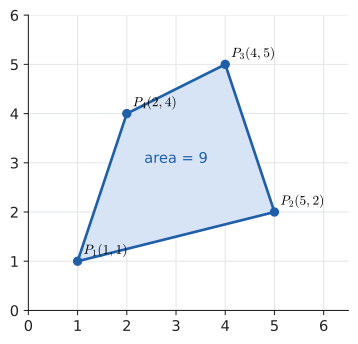
Worked example. Vertices \(P_1(1,1)\), \(P_2(5,2)\), \(P_3(4,5)\), \(P_4(2,4)\). Try it: Shoelace area calculator.
The sum is positive, so the vertices were listed anticlockwise.
Alternative approach: box and subtract. Draw the bounding rectangle from \(x = 1\) to \(5\) and \(y = 1\) to \(5\): area 16. Subtract the pieces of the box outside the polygon: below edge \(P_1P_2\), a right triangle \(\tfrac12 \cdot 4 \cdot 1 = 2\); right of edge \(P_2P_3\), \(\tfrac12 \cdot 1 \cdot 3 = 1.5\); above edge \(P_3P_4\), \(\tfrac12 \cdot 2 \cdot 1 = 1\); left of edge \(P_4P_1\), \(\tfrac12 \cdot 1 \cdot 3 = 1.5\); and one piece people forget, the \(1 \times 1\) square in the top-left corner between \(P_4(2,4)\) and the box corner \((1,5)\), which belongs to neither neighbouring triangle. Total removed: \(2 + 1.5 + 1 + 1.5 + 1 = 7\), so \(A = 16 - 7 = 9\). The box method works for simple shapes on grid paper, but that forgotten corner square shows how easy it is to get wrong; the shoelace formula is mechanical and never needs a picture.
Choosing a method. For triangles and standard quadrilaterals with known base and height, use the formulas. For any polygon given by coordinates, use the shoelace formula; it’s exact, handles concave shapes, and is a five-line program. For lattice polygons (all vertices on integer points) there’s also Pick’s theorem: \(A = I + B/2 - 1\), with \(I\) interior lattice points and \(B\) boundary lattice points. Here \(I = 8\) and \(B = 4\) (the edges pass through no other lattice points), so \(A = 8 + 2 - 1 = 9\). Consistent.
def shoelace_area(points):
    """Area of a simple polygon whose vertices are listed in order."""
    n = len(points)
    if n < 3:
        raise ValueError("a polygon needs at least 3 vertices")
    twice_area = 0
    for i in range(n):
        x_i, y_i = points[i]
        x_next, y_next = points[(i + 1) % n]   # wrap around to the start
        twice_area += x_i * y_next - x_next * y_i
    return abs(twice_area) / 2

print(shoelace_area([(1, 1), (5, 2), (4, 5), (2, 4)]))
print(shoelace_area([(0, 0), (4, 0), (4, 3)]))           # right triangle 4 x 3
print(shoelace_area([(0, 0), (0, 3), (4, 3), (4, 0)]))   # rectangle, clockwise
9.0 6.0 12.0
|
Self-intersecting polygons
The vertices must be in boundary order and the polygon must be simple. Feed it a "bow-tie" (vertices in the wrong order so edges cross) and the two lobes have opposite orientation and partly cancel, giving a meaningless number. Real GIS data occasionally contains such invalid polygons, which is why libraries like Shapely have an |
9.6.5. Where you’d use this
-
Decorating: a wall 4 m wide and 2.5 m high with a 0.8 m by 2.0 m door has \(10 - 1.6 = 8.4\) m² to paint. Two coats of a paint that covers 12 m² per litre need \(2 \times 8.4 / 12 = 1.4\) litres. For flooring, split an L-shaped room into rectangles (\(5 \times 4\) plus \(3 \times 2\) \(= 26\) m²) and add about 10% for cutting waste: buy 28.6 m².
-
Surveying and science: land registries, farm subsidy claims and ecologists measuring habitat all record a boundary as GPS points and apply the shoelace formula. Hexagonal grids appear in nature (honeycomb, graphene) because hexagons tile with the least boundary for a given area.
-
Computing: triangulating a polygon (the fan of triangles above, for a convex shape) is how a GPU draws it, and the shoelace formula is the area function in GIS libraries.
9.6.6. Exercises
-
Find the sum of the interior angles of a decagon, and each interior angle if it is regular.
-
Each exterior angle of a regular polygon is \(18^\circ\). How many sides does it have?
-
A trapezoid has parallel sides 7 and 13 and height 4. Find its area.
-
Use the shoelace formula to find the area of the triangle with vertices \((0,0)\), \((6,1)\), \((2,5)\).
-
Explain why a parallelogram with sides 8 and 5 can have any area between 0 and 40.
Answers
-
\((10 - 2) \times 180 = 1440^\circ\); each angle \(1440/10 = 144^\circ\).
-
\(n = 360/18 = 20\).
-
\(\tfrac12 (7 + 13) \times 4 = 40\).
-
Terms: \(0 \cdot 1 - 6 \cdot 0 = 0\); \(6 \cdot 5 - 2 \cdot 1 = 28\); \(2 \cdot 0 - 0 \cdot 5 = 0\). Sum 28, area 14.
-
Area is base times perpendicular height. With base 8, the height is \(5 \times\) (something between 0 and 1, depending on the tilt), so the area ranges from nearly 0 (flattened) up to 40 (a rectangle).
9.7. Circles
9.7.1. The problem
Is one 18-inch pizza more food than two 12-inch pizzas? (Most people guess no.) How long is the crust on a 45° slice? And a puzzle that has a lovely answer: if you stand anywhere on the edge of a circular stage and look at two fixed points on the edge, does the angle you see depend on where you stand?
9.7.2. Vocabulary
|
Parts of a circle
A circle is the set of all points in a plane at a fixed distance, the radius \(r\), from a fixed point, the centre.
|
|
Pi
\(\pi\) (Greek lowercase pi) is the ratio of any circle’s circumference to its diameter:
\[\pi = \frac{C}{d} = 3.14159\,26535\ldots\]
It is the same for every circle because all circles are similar: scaling a circle by \(k\) multiplies both \(C\) and \(d\) by \(k\), leaving the ratio unchanged. \(\pi\) is irrational (its decimal expansion never repeats; Chapter 1) and even transcendental (it is not a root of any polynomial with integer coefficients). |
9.7.3. Circumference, arc length, sector area
From the definition of \(\pi\):
For the area, cut the circle into many thin sectors and rearrange them alternately point-up and point-down.
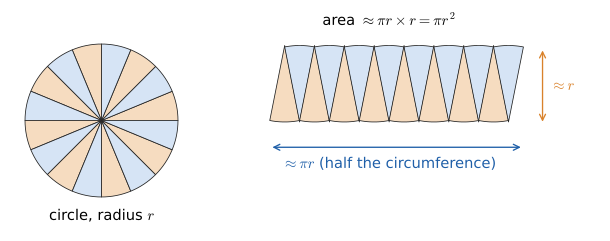
The result is almost a parallelogram. Its top and bottom edges are each half the circumference, \(\pi r\), and its height is almost exactly \(r\). As the slices get thinner, the scalloped edges flatten and the shape becomes a true rectangle \(\pi r\) by \(r\). So
"As the slices get thinner, the approximation becomes exact" is the idea of a limit (Chapter 16), and cutting a region into thin pieces and adding them up is exactly what an integral does (Chapter 19). You’ve just done calculus informally, as Archimedes did.
A sector or arc with central angle \(\theta\) (in degrees) is the fraction \(\theta / 360\) of the whole:
9.7.4. Worked examples
The pizza. Diameters 18 and 12 mean radii 9 and 6.
The single large pizza wins by about 12%. Area scales as the square of the diameter (scaling law again), and intuition consistently underestimates squares.
The slice. A 40 cm pizza (\(r = 20\)) cut into eight 45° slices.
|
Radius versus diameter
Problems often give the diameter (pizzas, pipes, wheels); formulas mostly use the radius. Halve first. Also, \(\pi r^2\) means \(\pi (r^2)\), not \((\pi r)^2\): square the radius, then multiply by \(\pi\). And keep \(\pi\) symbolic until the last step for an exact answer. |
9.7.5. Circle theorems
Two facts about angles in circles have short, satisfying proofs and many uses.
Tangent–radius theorem. A tangent is perpendicular to the radius at the point of tangency. (Intuition: the radius is the shortest path from the centre to the tangent line, since every other point of the line is outside the circle; and the shortest path from a point to a line is the perpendicular one.)
Inscribed angle theorem. An inscribed angle is half the central angle standing on the same arc.
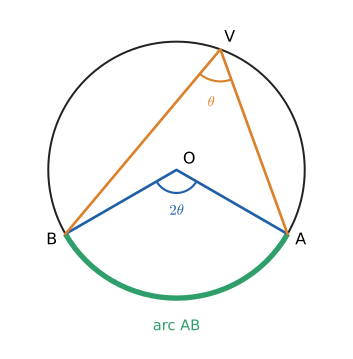
Proof (the case where the centre lies inside the inscribed angle). Draw the diameter from \(V\) through \(O\). This splits everything into two halves; look at one. In triangle \(VOA\), \(OV = OA\) (both radii), so it is isosceles and its base angles at \(V\) and \(A\) are equal; call each \(x\). The exterior angle at \(O\) of this triangle, the angle between \(\overline{OA}\) and the extension of the diameter, is the sum of the two remote interior angles: \(x + x = 2x\). The same argument on the other side gives an inscribed part \(y\) and a central part \(2y\). So the inscribed angle is \(x + y\) and the central angle is \(2x + 2y = 2(x+y)\). \(\blacksquare\) (The other cases, where the centre is outside the angle or on one side, use subtraction instead of addition.)
Consequences:
-
The stage puzzle. Every inscribed angle standing on the same arc is equal, since each is half the same central angle. It doesn’t matter where on the (major) arc you stand.
-
Thales' theorem. An angle inscribed in a semicircle is a right angle, because the central angle is a straight line, \(180^\circ\), and half of that is \(90^\circ\). Practical use: to find the centre of a circular table, put the corner of a sheet of paper on the edge; the two points where the paper’s edges cross the rim are the ends of a diameter. Do it twice; the diameters cross at the centre. Try it: See Thales' right angle.
-
Cyclic quadrilaterals (all four vertices on a circle): opposite angles add to \(180^\circ\), since the two arcs they stand on make up the whole circle. Try it: Try a cyclic quadrilateral.
9.7.6. Where you’d use this
-
Driving: a speedometer really counts wheel turns and multiplies by the circumference. Fit tyres 65 cm in diameter where the car expects 63 cm and each turn covers \(65/63 \approx 1.032\) times as far: when the dial says 100 km/h you are doing about 103 km/h.
-
Navigation: the Earth’s radius is about 6371 km, so one degree of latitude is an arc of \(\tfrac{1}{360} \cdot 2\pi \cdot 6371 \approx 111.2\) km, and one minute of arc is \(111.2/60 \approx 1.853\) km. That is where the nautical mile (1852 m) comes from.
-
Plumbing and medicine: the flow a pipe or blood vessel can carry depends on its cross-section \(\pi r^2\), so doubling a pipe’s diameter gives four times the area. (For slow, smooth flow it’s even more dramatic: flow goes like \(r^4\), which is why a slightly narrowed artery matters so much.)
-
Computing hardware: a 7200 rpm hard disk spins 120 times a second. A track 4.5 cm from the centre has circumference \(2\pi(0.045) \approx 0.283\) m, so it passes the head at about \(0.283 \times 120 \approx 33.9\) m/s, more than twice as fast as a track near the hub. That’s why the outer tracks read data fastest.
|
Computing pi
Archimedes (c. 250 BCE) trapped \(\pi\) between the perimeters of inscribed and circumscribed 96-sided polygons and proved \(3\tfrac{10}{71} < \pi < 3\tfrac17\), i.e. \(3.1408 < \pi < 3.1429\). In 2024 a record calculation reached over 200 trillion digits. You need only about 40 digits to compute the circumference of the observable universe to within the width of a hydrogen atom; NASA’s interplanetary navigation uses 15 or 16. Calculating \(\pi\) to huge precision is mostly a stress test for hardware and for fast multiplication algorithms. |
|
Inscribed angle explorer
Fix points \(A\) and \(B\) on a circle and drag a third point \(V\) around the rim. The display shows \(\angle AVB\) and the central angle \(\angle AOB\) live. Watch \(\angle AVB\) stay constant while \(V\) stays on one arc and jump to \(180^\circ - \angle AVB\) when it crosses to the other. Drag \(A\) and \(B\) to opposite ends of a diameter to see Thales' right angle. |
9.7.7. Exercises
-
A bicycle wheel has diameter 70 cm. How far does the bike travel in 100 revolutions? Give an exact answer and a decimal in metres.
-
A sector of a circle of radius 9 has central angle \(120^\circ\). Find its arc length and area, exactly.
-
An inscribed angle measures \(35^\circ\). What is the central angle on the same arc? What is the measure of the arc?
-
\(AB\) is a diameter of a circle and \(C\) is another point on the circle with \(AC = 6\), \(BC = 8\). Find the radius.
-
A circle’s area is \(49\pi\). Find its circumference.
Answers
-
One revolution is \(C = 70\pi\) cm; 100 revolutions is \(7000\pi \text{ cm} = 70\pi \text{ m} \approx 219.9\) m.
-
Arc \(= \tfrac{120}{360} \cdot 2\pi \cdot 9 = \tfrac13 \cdot 18\pi = 6\pi\). Area \(= \tfrac13 \cdot 81\pi = 27\pi\).
-
Central angle \(70^\circ\); an arc is measured by its central angle, so the arc is \(70^\circ\) too.
-
By Thales, \(\angle ACB = 90^\circ\), so \(AB = \sqrt{36 + 64} = 10\) and the radius is 5.
-
\(\pi r^2 = 49\pi \Rightarrow r = 7\), so \(C = 14\pi \approx 43.98\).
9.8. Surface area and volume
9.8.1. The problem
A soup can has radius 3.5 cm and height 10 cm. How much soup does it hold, and how much metal does it take to make? Why does a cone hold exactly a third of the cylinder that fits around it, not a half? And why is a sphere’s surface area exactly four times the area of its shadow?
|
Solids
|
9.8.2. The formulas and where they come from
| Solid | Volume | Surface area |
|---|---|---|
Prism (base area \(B\), perimeter \(P\)) |
\(V = Bh\) |
\(2B + Ph\) |
Cylinder |
\(V = \pi r^2 h\) |
\(2\pi r^2 + 2\pi r h\) |
Pyramid |
\(V = \tfrac13 Bh\) |
base plus triangular faces |
Cone |
\(V = \tfrac13 \pi r^2 h\) |
\(\pi r^2 + \pi r \ell\) |
Sphere |
\(V = \tfrac43 \pi r^3\) |
\(4\pi r^2\) |
Prisms and cylinders: stacking. A prism is a stack of identical thin slices, each with the base’s area. Stack them to height \(h\) and you get \(V = Bh\). A cylinder is a prism with a circular base, so \(V = \pi r^2 h\). This "stack of slices" idea is Cavalieri’s principle: two solids with equal cross-sectional areas at every height have equal volumes. (A stack of coins pushed sideways into a slanted pile keeps its volume.)
Cylinder surface area: unroll it. The curved side unrolls into a rectangle whose width is the circumference \(2\pi r\) and whose height is \(h\), area \(2\pi r h\). Add two circular ends: \(2\pi r^2 + 2\pi r h\).
Pyramids and cones: why one third? Here is a version you can hold in your hands. A cube of side \(s\) can be cut into three identical square pyramids, each with one face of the cube as its base and one shared corner of the cube as its apex: pick a corner, and the three faces of the cube that don’t touch it each serve as the base of one pyramid. The three pyramids are congruent and fill the cube, so each has volume \(\tfrac13 s^3 = \tfrac13 \times (\text{base}) \times (\text{height})\). Cavalieri’s principle and stretching extend this to every pyramid, and a cone is a pyramid with so many sides that its base is a circle, giving \(\tfrac13 \pi r^2 h\).
Another way to feel the third: a pyramid’s cross-section shrinks as you go up, and its area is proportional to the square of the remaining distance to the apex. Adding up slices whose areas grow like \(t^2\) gives the "one third" for the same reason that \(\int_0^1 t^2\,dt = \tfrac13\), as Chapter 19 will show.
Cone surface area. Cut the curved surface along a slant line and flatten it into a sector of a circle of radius \(\ell\) whose arc length is the base circumference \(2\pi r\). A sector’s area is proportional to its arc: it is the fraction \(\tfrac{2\pi r}{2\pi \ell}\) of the full disc \(\pi \ell^2\), giving \(\pi r \ell\).
The sphere. Archimedes considered this result his finest; he asked for it to be engraved on his tomb. Put a sphere of radius \(r\) snugly in a cylinder of radius \(r\) and height \(2r\). Then:
-
The sphere’s volume is \(\tfrac23\) of the cylinder’s: \(\tfrac23 \cdot \pi r^2 \cdot 2r = \tfrac43 \pi r^3\).
-
The sphere’s surface area equals the cylinder’s curved area: \(2\pi r \cdot 2r = 4\pi r^2\). (Remarkably, this holds slice by slice: the area of any horizontal band of the sphere equals the area of the corresponding band of the cylinder. That is why the Lambert cylindrical equal-area map projection works.)
-
The cone with the same base and height has volume \(\tfrac13 \pi r^2 \cdot 2r = \tfrac23 \pi r^3\), and cone + sphere = cylinder: \(\tfrac23 \pi r^3 + \tfrac43 \pi r^3 = 2 \pi r^3\).
And the "four times its shadow" question: the sphere’s shadow is a disc of area \(\pi r^2\), and its surface is \(4\pi r^2\).
9.8.3. Worked examples
The soup can (\(r = 3.5\), \(h = 10\), in cm). Try it: Cylinder volume and area.
Since \(1 \text{ cm}^3 = 1\) ml, the can holds about 385 ml.
An ice-cream cone with radius 3 cm and height 12 cm: Try it: Cone volume.
A ball of radius 6 cm: \(V = \tfrac43 \pi (216) = 288\pi \approx 904.8 \text{ cm}^3\) and \(SA = 4\pi (36) = 144\pi \approx 452.4 \text{ cm}^2\). Try it: Sphere volume and area.
|
Slant height versus height
Volume formulas use the perpendicular height \(h\); the cone’s curved-surface formula uses the slant height \(\ell\). If you’re given one and need the other, use \(\ell^2 = r^2 + h^2\). And remember units: volume in cubic units, area in square units. Doubling every dimension of a box multiplies its volume by 8, not 2. |
9.8.4. Where you’d use this
-
Home: a round paddling pool 3 m across, filled 40 cm deep, holds \(\pi (1.5)^2 (0.4) \approx 2.83\) m³ \(\approx 2830\) litres. A garden hose delivering 12 litres a minute takes about \(2830/12 \approx 236\) minutes, nearly four hours, to fill it.
-
Packaging: manufacturers minimise surface area (material cost) for a given volume. For a closed cylinder that happens when the height equals the diameter, a classic optimisation problem you’ll solve in Chapter 18.
-
Biology and medicine: small animals lose heat faster than large ones because surface area (heat loss) scales like \(k^2\) while volume (heat production) scales like \(k^3\); crushed ice melts faster than cubes for the same reason. Doctors track a roughly spherical tumour by its diameter, and a diameter that goes from 1 cm to 2 cm means \(2^3 = 8\) times the volume.
-
Computing: a 3D scan stored as a \(512 \times 512 \times 512\) grid of one-byte voxels (volume pixels) takes \(512^3\) bytes \(= 128\) MiB; doubling the resolution in each direction multiplies that by \(2^3 = 8\), to 1 GiB. A 3D printer’s slicer estimates the plastic needed from volumes: a solid 4 cm cube of PLA (density 1.24 g/cm³) is \(64 \times 1.24 \approx 79\) g. Data centres care about the surface-to-volume ratio for cooling.
|
Cube into three pyramids
A 3D model of a cube that splits along its interior diagonals into three congruent square pyramids, which can be dragged apart and rotated, then reassembled. A second panel fills a cone and a cylinder of the same base and height with "water" to show three cones fill one cylinder. Try it: Cylinder: three cones’ volume |
9.8.5. Exercises
-
Find the volume and total surface area of a box measuring 4 by 5 by 6.
-
A cylindrical tank has diameter 2 m and height 3 m. How many litres does it hold? (\(1 \text{ m}^3 = 1000\) litres.)
-
A cone has radius 5 and height 12. Find its slant height, volume and total surface area, exactly.
-
A sphere has volume \(36\pi\). Find its radius and surface area.
Answers
-
\(V = 120\); \(SA = 2(4 \cdot 5 + 4 \cdot 6 + 5 \cdot 6) = 2(20 + 24 + 30) = 148\).
-
\(r = 1\): \(V = \pi \cdot 1^2 \cdot 3 = 3\pi \approx 9.425 \text{ m}^3 \approx 9425\) litres.
-
\(\ell = \sqrt{25 + 144} = 13\). \(V = \tfrac13 \pi (25)(12) = 100\pi\). \(SA = \pi(25) + \pi(5)(13) = 25\pi + 65\pi = 90\pi\).
-
\(\tfrac43 \pi r^3 = 36\pi \Rightarrow r^3 = 27 \Rightarrow r = 3\); \(SA = 4\pi \cdot 9 = 36\pi\).
9.9. Geometric proof as a way of reasoning
9.9.1. The problem
You’ve now seen several proofs in passing. What exactly makes an argument a proof? And why does the US Geometry course spend weeks having students write proofs in a rigid two-column format? The answer matters beyond geometry: a proof is a chain where each step is justified by something already accepted, which is the same discipline as reasoning about a program’s correctness, writing a loop invariant, or arguing that a distributed protocol can’t deadlock.
9.9.2. Intuition
A proof is a conversation with a sceptic who accepts only the axioms, definitions and previously proved theorems. Each step must be one the sceptic can’t refuse. "It looks true in the diagram" is not a step. "These angles are vertical angles, so they’re equal" is.
|
Proof vocabulary
Chapter 21 and Chapter 22 treat all of this formally. |
9.9.3. The method: the two-column proof
Input: a "Given" and a "Prove", and usually a diagram.
Steps:
-
Mark the diagram with everything given (tick marks for equal sides, arcs for equal angles, arrows for parallel lines).
-
Work backwards from the "Prove": what would let you conclude it? (Often: two triangles that would be congruent, giving the result by CPCTC.) Then what would establish that?
-
Write two columns: Statements on the left, Reasons on the right. The first statements are the givens (reason: "Given").
-
Each later statement must follow from earlier ones, with its reason being a definition, postulate, or previously proved theorem.
-
The last statement is the "Prove".
Output: a proof in which every step is justified.
Example 1: vertical angles are congruent.
Given: lines \(\ell\) and \(m\) intersect, forming \(\angle 1\), \(\angle 2\), \(\angle 3\) with \(\angle 1\) and \(\angle 3\) vertical.
Prove: \(\angle 1 \cong \angle 3\).
| # | Statement | Reason |
|---|---|---|
1 |
\(\ell\) and \(m\) intersect; \(\angle 1, \angle 2\) and \(\angle 2, \angle 3\) are linear pairs |
Given (and definition of linear pair) |
2 |
\(m\angle 1 + m\angle 2 = 180^\circ\) |
Linear pair postulate (a linear pair is supplementary) |
3 |
\(m\angle 2 + m\angle 3 = 180^\circ\) |
Linear pair postulate |
4 |
\(m\angle 1 + m\angle 2 = m\angle 2 + m\angle 3\) |
Substitution (both equal \(180^\circ\)) |
5 |
\(m\angle 1 = m\angle 3\) |
Subtraction property of equality |
6 |
\(\angle 1 \cong \angle 3\) |
Definition of congruent angles |
Example 2: the base angles of an isosceles triangle are equal.
Given: \(\triangle ABC\) with \(\overline{AB} \cong \overline{AC}\).
Prove: \(\angle B \cong \angle C\).
Plan (working backwards): if we can split the triangle into two congruent halves, one containing \(\angle B\) and the other \(\angle C\), CPCTC finishes the job. Draw the bisector of \(\angle A\), meeting \(\overline{BC}\) at \(D\).
| # | Statement | Reason |
|---|---|---|
1 |
\(\overline{AB} \cong \overline{AC}\) |
Given |
2 |
Draw \(\overrightarrow{AD}\) bisecting \(\angle BAC\), with \(D\) on \(\overline{BC}\) |
Every angle has a unique bisector |
3 |
\(\angle BAD \cong \angle CAD\) |
Definition of angle bisector |
4 |
\(\overline{AD} \cong \overline{AD}\) |
Reflexive property (a segment is congruent to itself) |
5 |
\(\triangle ABD \cong \triangle ACD\) |
SAS (steps 1, 3, 4) |
6 |
\(\angle B \cong \angle C\) |
CPCTC |
As a bonus, CPCTC also gives \(BD = CD\) and \(\angle ADB = \angle ADC\); since those two angles form a linear pair, each is \(90^\circ\). So the bisector of the vertex angle is also the perpendicular bisector of the base.
9.9.4. Alternative styles
Mathematicians rarely write two-column proofs. The usual form is a paragraph proof, which is the same chain of justified steps in prose, as in the angle-sum and inscribed-angle proofs earlier in this chapter. There are also flow-chart proofs (boxes connected by arrows, popular in some US textbooks) and coordinate proofs, which place the figure on axes and compute (Chapter 10). Choosing: two-column format is a training tool that makes every justification explicit, and it’s what US tests expect; paragraph proofs are what you’ll read in every other mathematics book; coordinate proofs are best when the claim is about lengths, midpoints or slopes and a clever synthetic argument isn’t obvious.
|
Proving the converse by accident
The most common logical error is using the statement you’re trying to prove (circular reasoning), and the second most common is proving the converse instead. "If two lines are parallel then alternate angles are equal" and "if alternate angles are equal then the lines are parallel" are different theorems, each needing its own justification. Also, a diagram is never a reason: if a step says "because it looks perpendicular", the proof is broken. |
|
Euclid’s best seller
Euclid’s Elements, thirteen books and 465 propositions, was the standard geometry textbook for more than two thousand years and is said to have gone through more editions than any book except the Bible. Abraham Lincoln studied it as a young lawyer to learn what it meant to "demonstrate" something, working through the first six books. The two-column format is much newer: it was popularised in US high schools around 1900–1910. |
9.9.5. Exercises
-
State the converse of "If a triangle is equilateral, then it is isosceles." Is the converse true?
-
Give a counterexample to: "Every quadrilateral with four equal sides is a square."
-
Write a two-column proof: Given \(\angle 1\) and \(\angle 2\) are both complementary to \(\angle 3\). Prove \(\angle 1 \cong \angle 2\).
-
Write a paragraph proof that the diagonals of a parallelogram bisect each other. (Hint: alternate interior angles and ASA.)
Answers
-
"If a triangle is isosceles, then it is equilateral." False: a triangle with sides 5, 5, 8 is isosceles but not equilateral.
-
A rhombus with angles \(60^\circ\) and \(120^\circ\).
-
(1) \(\angle 1\) and \(\angle 3\) are complementary; \(\angle 2\) and \(\angle 3\) are complementary (Given). (2) \(m\angle 1 + m\angle 3 = 90^\circ\) and \(m\angle 2 + m\angle 3 = 90^\circ\) (definition of complementary). (3) \(m\angle 1 + m\angle 3 = m\angle 2 + m\angle 3\) (substitution). (4) \(m\angle 1 = m\angle 2\) (subtraction property). (5) \(\angle 1 \cong \angle 2\) (definition of congruent angles).
-
Let parallelogram \(ABCD\) have diagonals meeting at \(M\). Since \(\overline{AB} \parallel \overline{DC}\), the transversal \(\overline{AC}\) gives \(\angle MAB = \angle MCD\) and the transversal \(\overline{BD}\) gives \(\angle MBA = \angle MDC\) (alternate interior angles). Opposite sides of a parallelogram are equal, so \(AB = CD\). By ASA, \(\triangle MAB \cong \triangle MCD\). By CPCTC, \(MA = MC\) and \(MB = MD\), so \(M\) is the midpoint of both diagonals.
9.10. Choosing a tool: a summary
| You want … | Reach for … |
|---|---|
an unknown angle at a crossing or with parallel lines |
vertical / linear-pair / corresponding / alternate angle facts |
an unknown angle in a triangle or polygon |
angle sum \((n - 2) \cdot 180^\circ\), exterior angles sum to \(360^\circ\) |
an unknown length, two triangles with matching angles |
similarity (AA), then a proportion |
an unknown length in a right triangle |
Pythagoras (or special triangles; later, trigonometry) |
to show two triangles are identical |
SSS, SAS, ASA, AAS, HL (never SSA or AAA) |
the distance between two points |
\(\sqrt{\Delta x^2 + \Delta y^2}\); compare squared distances in code |
the area of a polygon given by coordinates |
shoelace formula |
lengths, areas or volumes after scaling by \(k\) |
\(k\), \(k^2\), \(k^3\) |
an angle subtended in a circle |
inscribed angle \(=\) half the central angle; semicircle gives \(90^\circ\) |
9.11. Interactive tools
Browser tools on the companion website that go with this chapter. Each example link in the chapter opens one of them with that example already set up.
9.12. Mastery check
-
Two parallel lines are cut by a transversal. One of the angles formed is \((4x - 10)^\circ\) and its same-side interior partner is \((2x + 40)^\circ\). Find both angles.
-
A regular polygon has interior angles of \(140^\circ\). How many sides does it have, and what is the sum of its interior angles?
-
A 1.5 m fence post casts a 2 m shadow; at the same moment a flagpole casts a 14 m shadow. How tall is the flagpole? Name the similarity criterion you used.
-
A rectangular screen is 24 inches wide and 10 inches tall. How long is its diagonal? Is a triangle with sides 12, 35, 37 a right triangle?
-
Find the area of the polygon with vertices \((0, 0)\), \((4, 0)\), \((4, 4)\), \((2, 1)\), \((0, 4)\) (in that order), using the shoelace formula. Is it convex?
-
A circle has radius 10. Find the length of an arc and the area of a sector with central angle \(72^\circ\), exactly. An inscribed angle stands on the same arc; what is it?
-
A cone and a cylinder have the same radius 3 and height 8. Find both volumes and their ratio. A sphere of radius 3 is scaled by 2; by what factor do its surface area and its volume change?
-
Explain in one or two sentences why SSA is not a valid congruence criterion, and write a two-column proof that if \(M\) is the midpoint of \(\overline{AB}\) and of \(\overline{CD}\) then \(\triangle AMC \cong \triangle BMD\).
Decision rule: All correct without hesitation → move on to Chapter 10, where every fact here becomes algebra. Stuck on 1–2 → reread Section 9.2. Stuck on 3–4 → reread Section 9.4 and Section 9.5. Stuck on 5 → Section 9.6.4. Stuck on 6–7 → Section 9.7 and Section 9.8. Stuck on 8 → Section 9.9. Stuck on more than three → work the section exercises first.
Mastery check answers
-
Same-side interior angles are supplementary: \((4x - 10) + (2x + 40) = 180 \Rightarrow 6x + 30 = 180 \Rightarrow x = 25\). The angles are \(4(25) - 10 = 90^\circ\) and \(2(25) + 40 = 90^\circ\): the transversal is perpendicular.
-
Exterior angle \(180 - 140 = 40^\circ\), so \(n = 360/40 = 9\) (a nonagon). Sum \((9 - 2) \times 180 = 1260^\circ\). Check: \(9 \times 140 = 1260\).
-
AA similarity (right angle and the sun’s elevation angle): \(h / 1.5 = 14 / 2 = 7\), so \(h = 10.5\) m.
-
\(\sqrt{24^2 + 10^2} = \sqrt{576 + 100} = \sqrt{676} = 26\) inches. \(12^2 + 35^2 = 144 + 1225 = 1369 = 37^2\), so yes, by the converse of the Pythagorean theorem.
-
Terms: \(0 \cdot 0 - 4 \cdot 0 = 0\); \(4 \cdot 4 - 4 \cdot 0 = 16\); \(4 \cdot 1 - 2 \cdot 4 = -4\); \(2 \cdot 4 - 0 \cdot 1 = 8\); \(0 \cdot 0 - 0 \cdot 4 = 0\). Sum \(20\), area \(10\). Check: the \(4 \times 4\) square (16) minus the notch triangle \((0,4), (2,1), (4,4)\) with base 4 and height 3 (area 6) gives 10. It is concave: the interior angle at \((2, 1)\) exceeds \(180^\circ\).
-
Arc \(= \tfrac{72}{360} \cdot 2\pi \cdot 10 = \tfrac15 \cdot 20\pi = 4\pi\). Sector \(= \tfrac15 \cdot 100\pi = 20\pi\). Inscribed angle \(= 72/2 = 36^\circ\).
-
Cylinder \(\pi \cdot 9 \cdot 8 = 72\pi\); cone \(\tfrac13 \cdot 72\pi = 24\pi\); ratio \(1 : 3\). Scaling by 2: surface area ×4, volume ×8.
-
SSA can produce two different triangles: the side opposite the given angle can swing to meet the third side at two points. Proof: (1) \(M\) is the midpoint of \(\overline{AB}\) and of \(\overline{CD}\) (Given). (2) \(AM = MB\) and \(CM = MD\) (definition of midpoint). (3) \(\angle AMC \cong \angle BMD\) (vertical angles). (4) \(\triangle AMC \cong \triangle BMD\) (SAS, using 2 and 3; the angle is between the two sides).