The Knowledge Map
Mathematics isn’t a ladder. It’s a web of ideas, each depending on a few others. This chapter is that web: the route-planner for the rest of the book, and the skeleton of the future skill tree.
Why a map rather than a list
School mathematics in the US is usually taught as a sequence of year-long courses:
That sequence is a scheduling decision, not a law of nature. The real constraint is dependency: you can’t understand the derivative without limits, and you can’t understand limits without functions. But you can learn graph theory long before calculus, and elementary linear algebra needs no calculus at all.
The map below shows each chapter and the chapters it builds on directly. An arrow from A to B means "B uses ideas from A". The dashed arrow marks a dependency that only matters for the optional parts of a chapter.
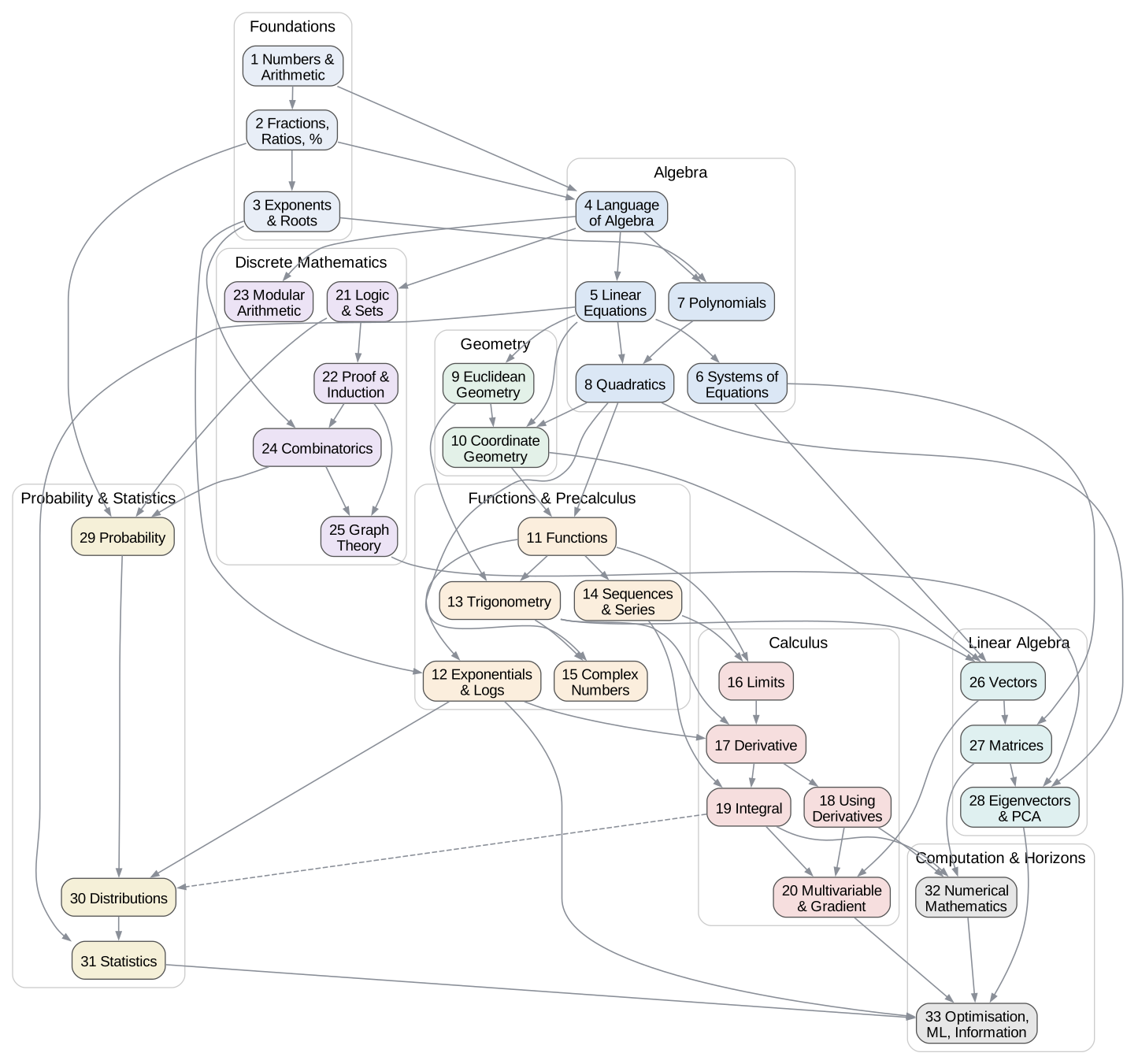
The three volumes cut the map along its natural seams. Volume 1 is the foundation every other chapter rests on (Parts I–IV). Volume 2 holds the continuous branches: calculus, linear algebra and numerical mathematics. Volume 3 holds the discrete and probabilistic branches and ends with the Horizons capstone, which draws on both.
The spine and the branches
The spine is the classical route to calculus:
For a computer scientist, several branches deserve equal standing:
| Branch | Why it matters in computing |
|---|---|
Calculus (Chapter 16–Chapter 20) |
Continuous change, optimisation, physics simulation, the training of machine-learning models. |
Linear algebra (Chapter 26–Chapter 28) |
Graphics, transformations, embeddings, search, machine learning. |
Probability (Chapter 29, Chapter 30) |
Uncertainty, randomised algorithms, hashing, machine learning. |
Statistics (Chapter 31) |
Inference, experimentation, A/B testing, metrics. |
Logic and sets (Chapter 21) |
Programming languages, databases, verification. |
Proof (Chapter 22) |
Algorithm correctness, loop invariants, reasoning about code. |
Number theory (Chapter 23) |
Hashing, checksums, cryptography. |
Combinatorics (Chapter 24) |
Algorithm analysis, probability, complexity. |
Graph theory (Chapter 25) |
Networks, search, compilers, dependency resolution, distributed systems. |
Numerical mathematics (Chapter 32) |
How computers actually approximate mathematical answers. |
Chapter 33 brings the branches together in optimisation, machine learning and information theory.
Suggested routes
These are starting points, not prescriptions. Use the mastery checks to skip what you already know.
- The calculus route
-
Chapter 1 → Chapter 2 → Chapter 3 → Chapter 4 → Chapter 5 → Chapter 7 → Chapter 8 → Chapter 10 → Chapter 11 → Chapter 12 → Chapter 13 → Chapter 14 → Chapter 16 → Chapter 17 → Chapter 18 → Chapter 19.
- The computer-science core
-
Foundations and Algebra, then Chapter 21 → Chapter 22 → Chapter 23 → Chapter 24 → Chapter 25 → Chapter 29. These can run alongside the calculus route.
- The machine-learning route
-
The calculus route through Chapter 18, plus Chapter 26 → Chapter 27 → Chapter 28, then Chapter 29 → Chapter 30 → Chapter 31, then Chapter 20 → Chapter 33.
- The "helping with homework" route
-
Follow the US-curriculum sidebars. Appendix D maps each school course to the chapters that cover it.
From map to skill tree
Each chapter breaks down into skills. In a future companion app, the map becomes a skill tree whose progress reflects demonstrated understanding, not the number of problems ground through:
Algebra                          Geometry
  ● Linear equations               ● Coordinates
  ● Quadratics                     ○ Vectors
  ● Functions                      ○ Transformations
  ○ Exponents
  ○ Logarithms
Because the tree records dependencies, it can tell you more than "wrong answer". For example: You understand equations but seem rusty on exponent laws. Refresh those two ideas before logarithms. That’s the purpose of the "Where this chapter sits" sidebar at the top of every chapter and the decision rule at the bottom.